

On-page SEO for electricians
On-page SEO is everything you do on a page to help it rank and turn visitors into calls. It’s not one job, it’s a stack of decisions that all lean on each other: get the intent right, and the title, the content, the links and the layout all have to line up behind it.
It all starts with search intent
Search intent is simply the reason someone types a keyword into Google, and before you touch a single tag you have to ask the question I ask of every keyword: what are they really trying to do? Google’s whole job is to serve up the exact kind of page that matches that goal. If your page doesn’t match the intent behind the search, Google won’t rank you for it, full stop. There are four flavours, and each one wants a different page. I go deeper in my guide to search intent for electrical websites.
Informational searches are someone trying to understand something, “why do my lights flicker randomly?”, “how to reset a tripped circuit breaker”, “what is an EICR certificate?”. They’re not ready to buy, so don’t try to sell, try to help, with a genuinely useful blog post or guide. Navigational searches are people looking for a business by name (“BrightSpark Electrician contact number”); you’ll never rank for a competitor’s brand, so focus this on your own homepage, contact page and Google profile. Commercial investigation is the researching-before-they-buy stage, “best electricians in Newcastle”, “fuse box upgrade vs full rewire”, where case studies, testimonials and a solid “why choose us” page nudge them toward you without the hard sell. And transactional searches are the gold: “emergency electrician near me”, “consumer unit installation in Hull”, “book EICR South London”. Those are people ready to hire now, so you optimise your service and location pages like your business depends on it, because it does.
Not sure which is which? Just Google the keyword and look at what’s already ranking. Blog posts and guides mean informational. Maps and service listings mean transactional. Reviews and comparisons mean commercial investigation. Google has already done the homework for you, copy the format that’s winning.
Title tags: small element, huge job
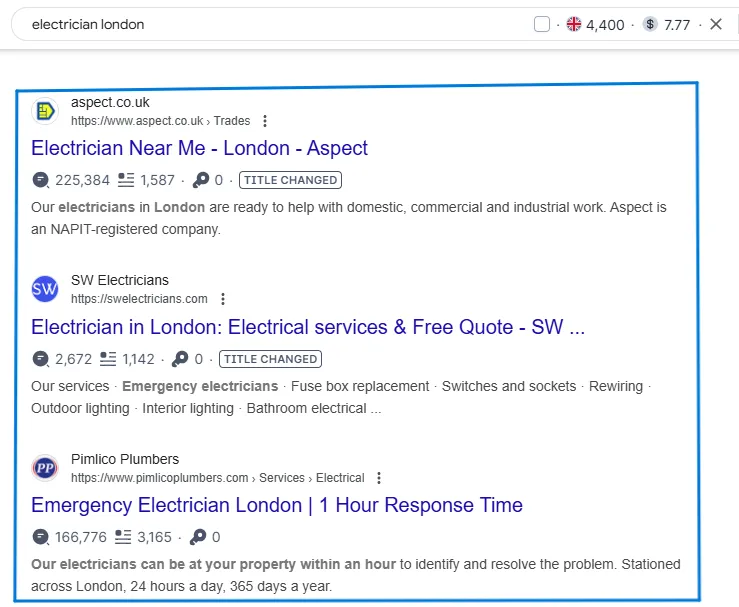
Your title tag is the clickable blue headline in the search results, and it’s pulling double duty. It tells Google what the page is about (yes, your keyword needs to be in there to rank well), and it’s the thing that earns the click. That second job is bigger than most people think: the title is often the only part of your page a searcher reads before deciding whether to click. Something as small as going from “Electrician in Manchester” to “Electrician Services in Manchester | Call Today” can win you more clicks without moving your ranking an inch.
The craft of it: front-load the main keyword you settled on in keyword research, include the town, keep it under about 60 characters (technically it’s nearer a 600-pixel limit, wide letters like M and W eat more room than an i or a j), and earn the click with a power word or two, “same-day”, “certified”, “no callout fee”. A reliable formula for a local service page is your local keyword, a hook, then your brand: Premium Electrician Services in Manchester, Call Now, No Callout Fee. Steer clear of emojis, ALL CAPS and duplicate titles across pages, they look spammy and get rewritten. And they do get rewritten: as Google’s own Gary Illyes put it, “we will never quit rewriting titles”. Match the page’s content and intent and Google leaves yours alone; waffle and it’ll swap in something of its own. I go deeper in my guide to title tags for electricians.
Meta descriptions
The meta description is the grey snippet underneath your title. It doesn’t directly move your ranking, but it’s the supporting actor to your title’s lead role, it backs up the promise and helps win the click. Aim for around 155 characters, work in the keyword, lead with a clear benefit and end on a nudge. Something like: “Fast, NICEIC-registered emergency electrician in Bristol. Fault finding, fuse boards and call-outs, day or night. Free quotes, call now.” Write a unique one for every page, the same as titles, Google will happily rewrite a lazy or duplicated description into something worse. There’s more on writing them in my guide to meta descriptions for electricians.
Headings, and where your keyword goes
Headings are the outline of your page, for visitors and for Google. I stick to one H1 per page, the main title, which says what the page is about. H2s are the big sections, and H3s sit under an H2 when that section has parts of its own. On a service page it looks like this: an H1 of “Emergency Electrician in Leeds”, H2s like “Residential repairs” and “Commercial services”, and an H3 under the first one such as “Socket replacements”. Keep them short, keep them in order (don’t jump from an H1 straight to an H4), and don’t use a heading just because you want big bold text, that’s a job for styling. Headings also help people using screen readers move around the page, so it’s not only an SEO thing.
As for the keyword, put it where it reads naturally and then leave it alone. Your main phrase belongs in the title tag, the H1, the first paragraph and the meta description, with the odd mention in a sub-heading or the body copy. Don’t cram the town into every heading, say it early and let the rest of the page carry it. If a heading sounds daft read out loud, rewrite it. And be realistic: placement is the easy bit, and it won’t rescue a thin page. A clear title, a tidy structure and copy that properly answers the question does far more than shuffling keywords around. Keep your headings honest too: an H2 that promises “Why upgrade your fuse board?” should answer exactly that, not start pitching something else.
Want the full walkthrough? Read my guides to header tags for electricians and keyword placement.
Content that satisfies intent, and builds authority
With the intent and tags sorted, the page itself has to deliver. For a transactional service page that means a clear H1 that says exactly what you do, your location worked in naturally (not stuffed), a prominent phone number, contact form and CTA buttons, and trust built with case studies and reviews. As I always say about these pages: strip the distractions, make it fast, and make it easy to trust you. For an informational blog post it’s the opposite energy, a catchy title, an intro that shows you actually get the pain point, real practical help, and only a soft CTA at the end (“need this done properly?”).
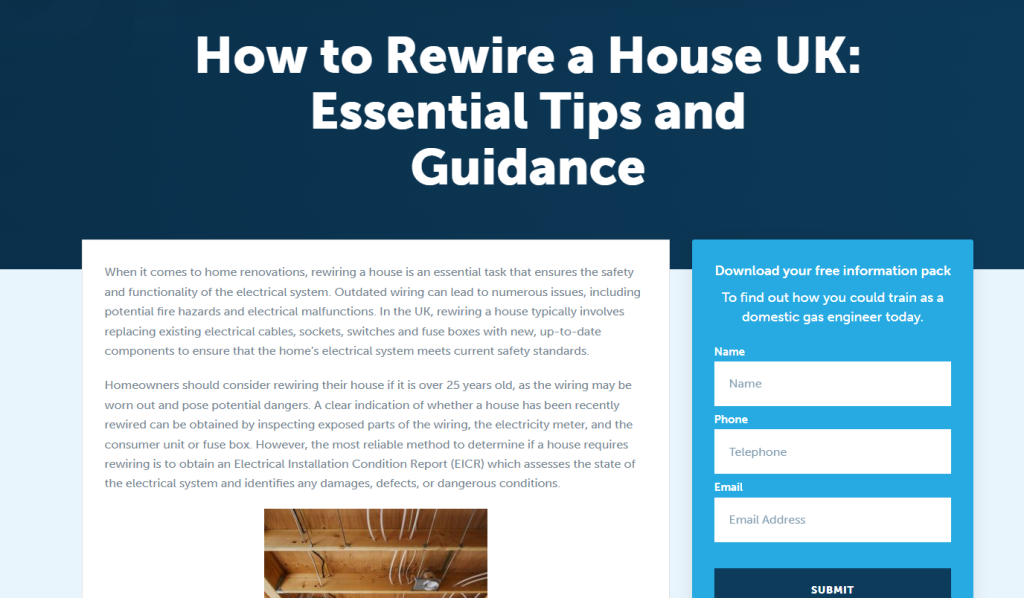
Underneath all of that, write for how modern search actually works. Google understands meaning now, not just exact-match words, so cover a topic the way a real expert would, the related terms, the natural language, the questions a homeowner would ask. Do that across enough pages and you build what’s called topical authority, and it snowballs: the more thoroughly you cover your trade, the more Google trusts you on all of it, and the easier every new page ranks. Weave your keyword in two to four times where it reads naturally and leave it there, stuffing it does more harm than good.
The simplest way to build that is a pillar page plus supporting posts. Pick the one service that really pays your bills, say consumer unit upgrades or EV charger installs, and make that page the most complete one on the subject. Then write supporting posts around it that answer the specific questions people ask (“How long does a consumer unit upgrade take?”, “Do I need an EICR to sell my house?”), and link each one back to the pillar. Give each topic one page to do the ranking: if two of your pages chase the same search, they end up competing with each other, which I explain in my guide to keyword cannibalisation.
Not sure what to write about? Your customers have already told you. Every question you’ve answered twice in a week, on a quote, on the phone or over WhatsApp, is a post waiting to be written, in your words and with your local examples. Real case studies, and a properly written page for each town you genuinely work in, count too, and localised content is worth reading up on if you cover more than one area. A handful of useful, well-linked pages beats dozens nobody reads.
I go deeper on this in my guides to topical authority, content pillars and content ideas for electricians.
Showing real experience and trust
Google’s quality guidelines talk about E-E-A-T: experience, expertise, authoritativeness and trust. It isn’t a setting you switch on or a score you can check, but it’s a handy test for the question every visitor is quietly asking: is this a real electrician who knows what they’re doing? Most electricians already have the proof. They just don’t put it on the page.
- Real photos from real jobs. Consumer unit swaps, EV charger installs, before and afters, with the town in the caption. Stock photos of a smiling bloke in a hard hat prove nothing.
- Your qualifications and registrations. Show whatever you genuinely hold, such as NICEIC or NAPIT membership, and don’t assume people know what the badges mean. One plain-English line does it.
- Genuine reviews. Put the reviews customers have left you on the relevant service page, next to the kind of job they’re talking about.
- A named author. Put your name, and a short line on your experience, on your About page and your blog posts, rather than leaving everything anonymous.
- Job stories. “A landlord in Bootle kept tripping the same circuit, here’s what we found” beats a generic paragraph every time, and it shows you’ve actually done the work.
None of it is a trick. It’s just proof, on the page, where a nervous homeowner can see it.
The full version is in my guide to E-E-A-T for electricians.
You don’t have to do all this yourself.
Reading it is one thing; doing it properly, month after month, is another. Hand it over and you can get back to what you’re brilliant at, the actual electrical work, and get your evenings back.
Internal linking: the bit nobody sees but everything depends on
Internal linking just means connecting the pages on your site with clickable links, your homepage points to your service pages, which point to their location variations, and so on. It sounds trivial. It isn’t. Internal linking is foundational, and it’s quietly doing three big jobs at once.
First, it helps Google find and understand your site, a new page with no internal links pointing at it (an “orphan page”) can sit unindexed for weeks, or get missed entirely. Second, it passes authority around, the ranking power your homepage builds up, often called “link juice”, should be funnelled into your money pages: your core services like rewiring, fuse board upgrades and emergency callouts, plus your local landing pages. And third, it tells Google what matters: if your “Emergency Electrician” page is linked once but a “How to Change a Plug” blog is linked twenty times, Google quite reasonably assumes the blog is the important one. That’s the opposite of what you want.
In practice you want a sensible structure, a tight top menu of four to six key services (not a sprawling list that confuses everyone), contextual links inside your content that read naturally (“we always recommend a full electrical inspection before upgrading an old fuse board”), related-post links to keep people moving, and clear CTA links toward booking. Build supporting blogs around each service in clusters, and add two or three internal links the moment you publish anything new, so it’s never orphaned. Every now and then, audit the lot with a tool like Screaming Frog to catch orphan pages and broken links before they cost you. For the step-by-step, see my guides to internal linking for electricians and anchor text for electricians, which covers what the clickable words should actually say.
Images and alt text
Photos of your own work earn trust and give you one more thing to optimise. Compress them so they load fast, give them descriptive file names like consumer-unit-upgrade-bristol.jpg rather than IMG_4471.jpg, and write alt text that genuinely describes the shot, “electrician replacing a consumer unit in Leeds”. It helps people using screen readers, it helps you turn up in Google Images, and it’s one more small, local relevance signal doing its bit. I cover it in full in my guide to alt text for electrical websites.
None of these pieces is hard on its own. The skill, and the graft, is in keeping them all aligned across dozens of pages: intent, titles, content, links and images, every one pulling in the same direction. It’s a core part of every campaign I run. Message me on WhatsApp.
That’s a lot of plates to keep spinning. Want them spun for you?
It’s all here, free, for you to run yourself. But it’s a lot to stay on top of, so if you’d rather just get the leads, I’ll take the whole lot off your plate.
You’ve got the full playbook. Want it done for you instead?
Everything you need to run this yourself is right here, free. But if you’d rather spend your days on the tools and your evenings off, send me a WhatsApp and I’ll run the lot, leads in 90 days or the next 90 are on me.