Search intent for an electrician's website is the reason behind a search: whether the person wants to learn something, find a specific business, compare options or hire someone now. It matters for rankings, because Google shows the kind of page that matches the goal, and a page that doesn't match is very unlikely to rank for that search. Electrician SEO Pro's rule is to match every page on an electrician's website to one type of intent.
What is search intent for an electrician's website?
Search intent for an electrician's website is the reason someone types a search into Google: what they're really trying to do. There are four types: informational (learning something), navigational (finding a specific business), commercial investigation (comparing options) and transactional (ready to hire now). Electrician SEO Pro's rule is to ask one question before going after any keyword: what is this person trying to do, and which page would answer it?
If you've been ignoring search intent because it sounds technical, I get it. Big mistake, though. It's the reason someone typed the words, that's it. Are they looking to learn something, buy something or find someone local to help? Craft content that answers that, and everything gets easier: more rankings, more clicks and more leads.
But does it really change where you rank?
Does search intent affect how electricians rank?
Yes, search intent affects how electricians rank, because Google's job is to return the kind of page that matches what the searcher wants, so a page that doesn't match the intent behind a search is very unlikely to rank for it, even when the rest of the SEO is solid. Electrician SEO Pro rates intent match as the first test a page has to pass: matching it gets a page into the running, but it still has to earn its place with quality content, relevance and trust.
Google doesn't just rank pages with the right keywords. It ranks pages that solve the right problem.
If someone wants to hire an emergency electrician and you hit them with a blog post on "how to fix a blown fuse", you've missed the mark. If they want to learn and you slam them with a hard sell, same story. But match what they're actually searching for, and you win trust, clicks, rankings and jobs.
Time to meet the four types, starting with the one most people begin with.
What is informational search intent for electricians?
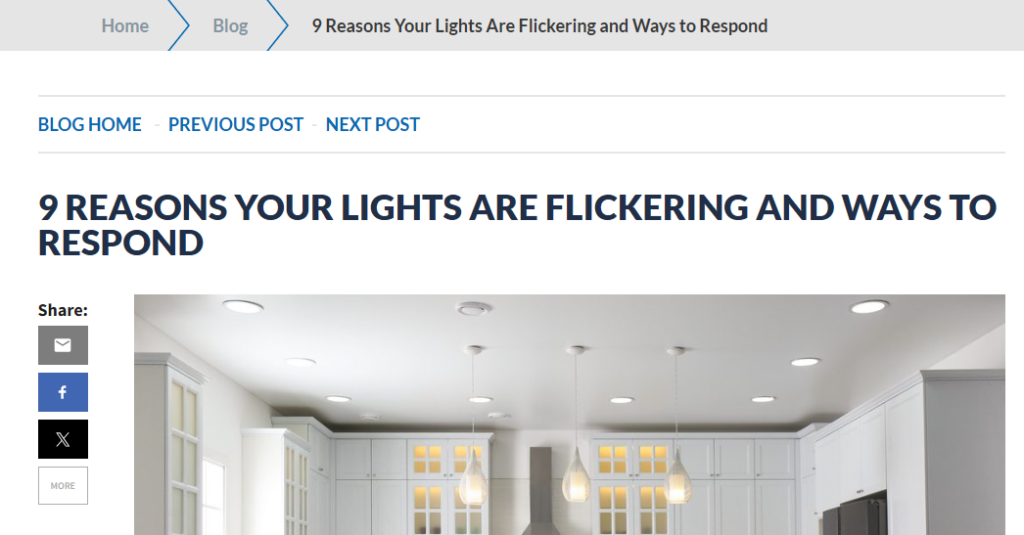
Informational search intent for electricians is when someone searches to understand something, such as "why do my lights flicker randomly?", "how to reset a tripped circuit breaker" or "what is an EICR certificate?", usually because something has gone wrong or confused them. These searchers aren't ready to buy yet. Electrician SEO Pro's rule for informational searches is to give real, practical help, not a sales pitch.
This is your chance to position yourself as the expert. Think blog posts, how-to guides and explainers. Don't try to sell, try to help. You're planting a seed, and they'll remember you when it's time to hire.
Then there are people who aren't looking for a guide at all. They're looking for you.
What is navigational search intent for electricians?
Navigational search intent for electricians is when someone already knows which electrical business they want and searches for it by name to reach its website or phone number. Your own business name is the navigational search you can win. Electrician SEO Pro's rule is to make sure the homepage, contact page and Google Business Profile are properly optimised, so the business shows up clean, clear and clickable for its own name.
Searches like these (made up):
- "Smith Electrical Leeds"
- "Smith Electrical contact number"
Brand visibility matters here, so own your name.
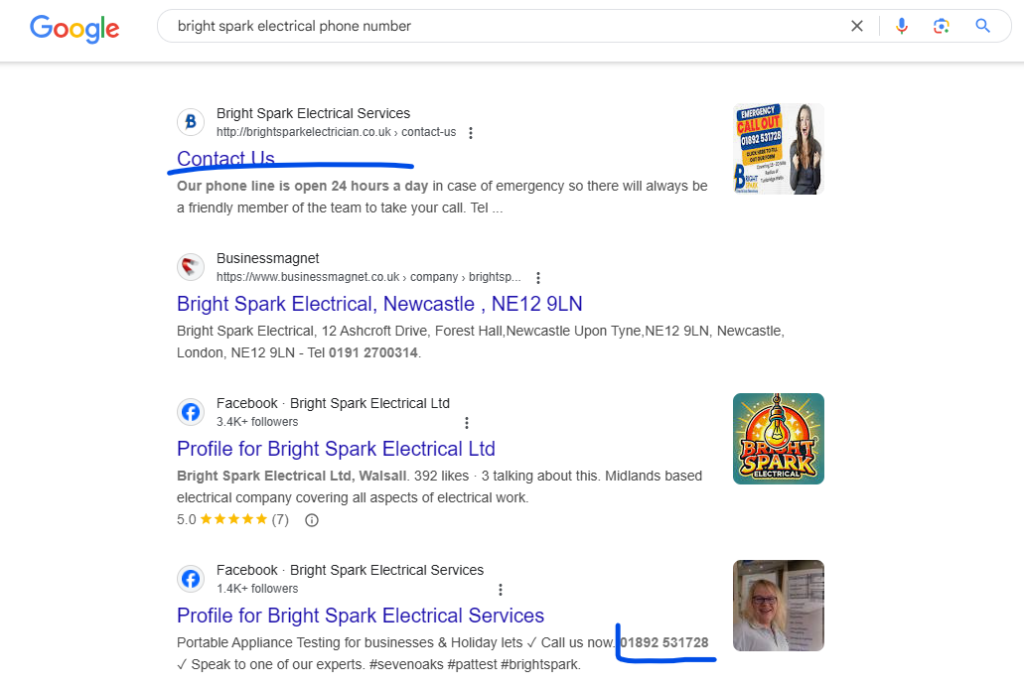
I know what you're thinking: could you rank for a competitor's name and put yourself in front instead? You're very unlikely to. Google Ads is the exception, because an ad can appear on those searches. I cover that in Google Ads vs SEO for electricians.
Next, the people who are shopping around.
What is commercial investigation intent for electricians?
Commercial investigation intent for electricians is when someone is researching before they hire, comparing options with searches like "best electricians in Newcastle", "EV charger installer reviews UK" or "fuse box upgrade vs full rewire". They're still deciding. Electrician SEO Pro's rule is to answer their comparison questions with case studies, testimonials, why-choose-us pages and pros and cons lists, which lets you nudge them toward you without the hard sell.
It's a bit like informational content, except it lets you sell your services (without seeming off), and you'll have much better success doing it than with a plain how-to.
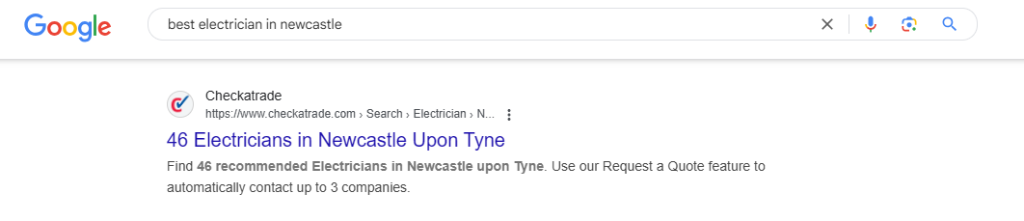
Look at what Google shows for that search: a directory page comparing 46 electricians. That tells you the searcher wants options, so give them proof you're a good one.
And then the holy grail.
What is transactional search intent for electricians?
Transactional search intent for electricians is when someone has a problem, is ready to pay and needs the right electrician now, with searches like "emergency electrician near me", "consumer unit installation in Hull" or "book EICR certificate South London". These are the searches closest to a booked job. Electrician SEO Pro's rule is to optimise service and location pages for them like the business depends on it: fast load, clear calls to action, phone number at the top and no distractions.
This is the holy grail. A company phone number right there on the results page? Chef's kiss. Brings a tear to my eye.
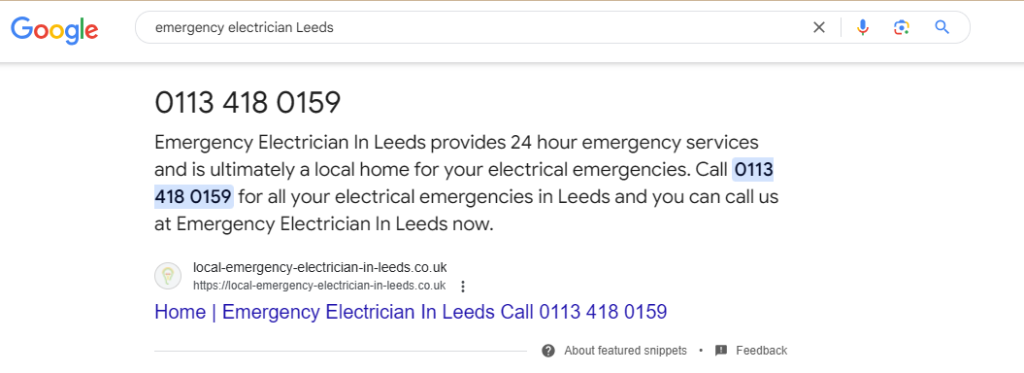
These pages give you the most bang for your buck. Make it easy for people to act now, and you can be in their property tomorrow, fixing the problem and getting paid.
Now you know the four types, how do you match your pages to them?
How should an electrician match their pages to search intent?
An electrician should match their pages to search intent by building service pages for transactional searches, blog posts for informational and commercial investigation searches, and location pages for local searches. If someone is ready to hire and you hand them a blog post, you've lost them, and if they're researching and get a hard sell, they'll bounce. Electrician SEO Pro's rule is one page, one intent.
Service pages (transactional). These aren't blogs and they aren't for storytelling. They're the get-the-job-done pages for people ready to book. Someone searching "consumer unit upgrade in Sheffield" doesn't want education, they want reassurance and action. Confirm you offer the service, confirm you do it in their area, and make contact dead easy: phone number up top, and forget the email address. Then add:
- A clear H1 that says exactly what you do, like "Fuse Box Installation in Leeds"
- Location mentions in the copy, without stuffing
- Icons or bullet points for services, pricing and availability
- Case studies and reviews for trust
- A prominent phone number, contact form and call buttons
- Internal links to related pages, like EICRs and rewiring
Here's one of my favourite examples:
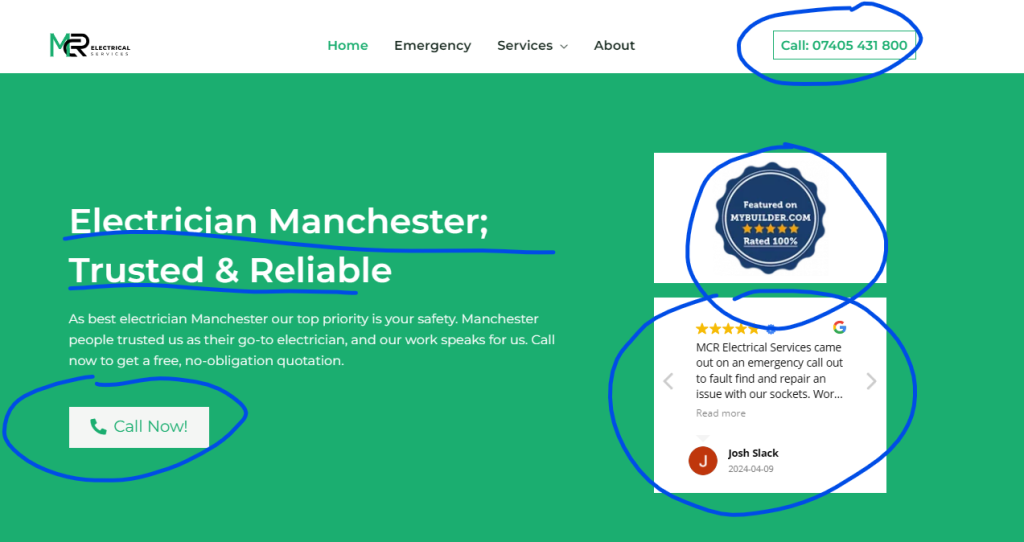
Strip distractions. Make it fast. Make it easy to trust you.
Blog posts (informational and commercial investigation). These aren't built to convert cold traffic straight away. They build authority, get you found in early-stage searches and guide people toward your services. Think "5 Signs You Need a Rewire in an Older Property" or "Which EV Charger Is Best for UK Homes?". Pick one of the two intents for each post, answer the question fast, then go deeper, link to the relevant service and finish with a soft call to action. One honest limit: these are the pages that can send your traffic numbers sky high while doing nothing for your bottom line, so don't put too much focus on them. They still show Google you know your niche, which helps everything else.
Location pages (transactional and local). To show up for "electrician in York", you need a page built for York, not a generic services page with a list of cities tagged on the bottom. Name specific areas, postcodes and neighbourhoods, talk like a local, add reviews from that town and add a map. Serve five or more towns? Build five unique pages. No shortcuts. My service page blueprint for electricians shows how.
Still not sure what intent a keyword has? There's a two-minute check for that.
How can an electrician check the search intent behind a keyword?
An electrician can check the search intent behind a keyword by typing it into Google and looking at what appears on page one, because that's Google showing what kind of content it thinks best answers the query. Blog posts and guides point to informational intent, maps and service listings to transactional, reviews and comparisons to commercial investigation, and your own homepage or contact page to navigational. Electrician SEO Pro's rule is to do this check before writing anything.
Seriously, the best keyword research tool is right in front of you: Google. Type the keyword in and look at page one.
Check the "People also ask" box too. It's full of clues.
If page one is all guides, a service page won't fit. If it's all maps and service listings, a blog post won't. Two minutes of research can save you weeks of wasted effort. For what else turns up on page one, see my guide to SERPs for electrical websites, and for finding the keywords in the first place, keyword research for electricians.
Match the intent and the rest gets easier.
Want a hand matching your electrician website to search intent?
You can get a hand matching your electrician website to search intent from Electrician SEO Pro, as part of a full SEO service for your electrical business, or do it yourself by checking page one before you write anything. Matching intent comes down to knowing what each page is for and what the searcher wants from it. Whichever route you take, the rule stays the same: one page, one intent.
If you've got the time, my free guide to keyword mapping for electricians shows how to give every page one job. If you'd rather spend your evenings pricing jobs than studying search results, I can take it off your hands, alongside the rest of your SEO.
See how I can help, or crack on yourself.
Over to you.