

Electricians do keyword research by finding the exact words customers type into Google, then picking the searches that match the services they offer, the towns they cover and a site small enough to compete. It starts with a list of services, towns and customer questions, then Google's free suggestions, then Keyword Planner for numbers. Electrician SEO Pro's rule is that a keyword only earns a page if it's a job you do, in a place you work, with a search you can realistically win.
What is keyword research for electricians?
Keyword research for electricians is the process of finding the exact words customers type into Google when they need an electrician, then deciding which of those searches your website should answer. It relies on real search data rather than guesses: the services people ask for, the towns they live in and the questions they ask before they ring. Electrician SEO Pro treats it as the first job in SEO, because every page, title and heading depends on it.
Keyword research isn't about being creative. It's not about dreaming up phrases that sound right, or cramming "electrician" into every page like seasoning. It's about data. Real searches, real people, real intent.
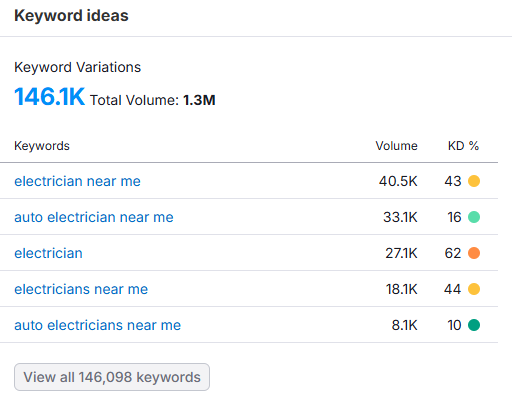
A keyword tool I used when I wrote this guide showed around 146,000 keyword variations related to electricians, with 1.3 million searches a month between them. Not all of that is for you (the list includes "auto electrician near me", for a start). But behind plenty of those searches is a local homeowner with a problem and a wallet, ready to ring someone. Keyword research is how you find those moments.
So does doing all that actually help you rank?
Does keyword research help electricians rank on Google?
Yes, keyword research helps electricians rank on Google, because it decides which search each page is built to match, and a page built for a real search has a better chance of showing up for it than a page built on a guess. The research itself isn't something Google measures: the ranking signals come from the pages you write with it, in their titles, headings and content. Electrician SEO Pro's rule is that no page gets written until its keyword has been checked.
Skip the research and you're probably doing one of three things:
- Guessing at what people search for.
- Targeting keywords too competitive for a small local site.
- Targeting 12 keywords on one page and confusing Google completely.
You've seen the classic: "electrician Leeds" crammed into the homepage 14 times, and the site still stuck on page 6 (made up, but you know the type).
Which raises the obvious question: where do you actually start?
Where should an electrician start with keyword research?
An electrician should start keyword research with a notepad, not a tool: three quick lists of the services you offer, the locations you cover and the questions customers ask you. That brain dump is your seed list, and every keyword tool you use later builds on it. Electrician SEO Pro starts keyword research for electricians the same way, because what you already know about your own customers is more useful than any tool's guess.
Grab a notepad, or open a Google Doc, and write three lists in plain English. No jargon, just what a customer would type:
- Services you offer. Fuse box upgrades, EV charger installs, full or partial rewires, emergency callouts, EICRs, outdoor lighting.
- Locations you cover. Don't just list the city. Add towns, postcodes and neighbourhoods, wherever people might search: Leeds, Roundhay, LS1, Bradford, Wakefield.
- Questions your customers ask. What do people say on the phone, in Facebook messages or on site? "How much does a rewire cost?", "Do I need an EICR?", "What's the difference between a fuse box and a consumer unit?"
It's not fancy. But it's real, and that's what makes it powerful. Don't start writing content from it yet, though. Most of it may not be worth your time until you've checked what people actually search.
Next, let Google add to the list, for free.
How can electricians find keyword ideas on Google for free?
Electricians can find keyword ideas on Google for free by using three features on the results page: Autocomplete, People Also Ask and Related Searches. Type a service from your seed list into Google and read the suggestions without pressing enter, then run the search and check the People Also Ask box and the related searches at the bottom of the page. Electrician SEO Pro starts with these because they cost nothing and come straight from Google's own results.
Autocomplete. Start typing a keyword from your list and don't hit enter. Those suggestions are Google's predictions, pulled from what people actually type. Start with "fuse box upgrade" and you get things like "fuse panel upgrade cost" and "fuse panel upgrade", plus a few that aren't for you at all (an "mgb fuse box upgrade" is a car). Keep the useful ones, bin the rest.
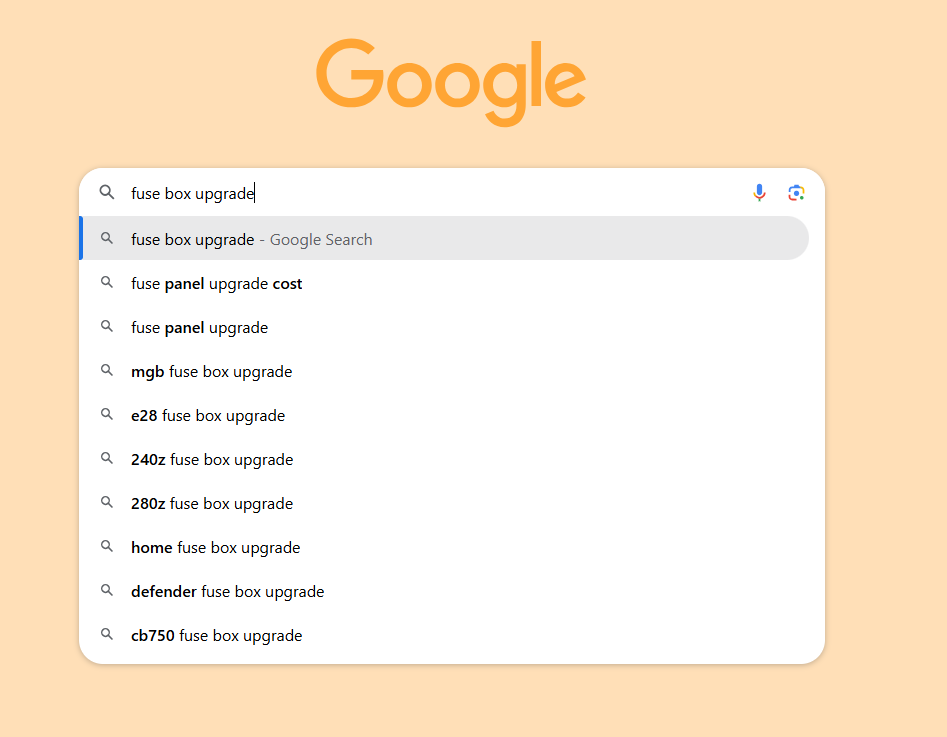
Try it with different combinations too: your service plus a town, plus "cost", plus "vs", and see what pops up.
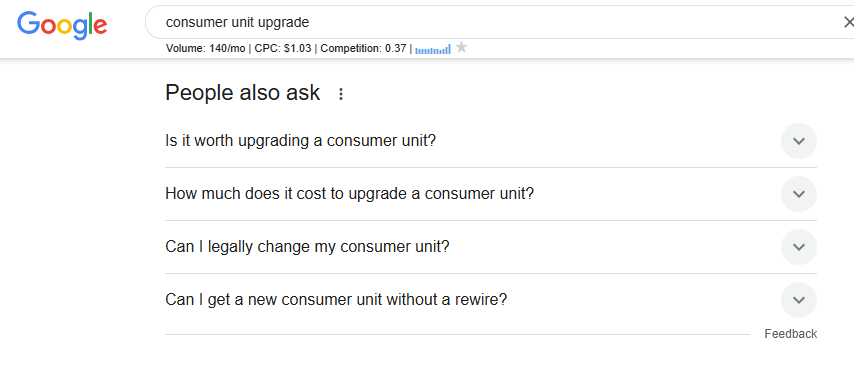
People Also Ask. Once you've collected the suggestions, run a proper search, say "consumer unit upgrade", and scroll down to the People Also Ask box. Those are questions Google thinks are related, which makes them a goldmine for blog topics, headings and supporting content.
Related searches. Right at the bottom of the results, you'll find Related Searches (sometimes labelled People Also Search For). They're alternative ways people phrase the same thing, or related jobs they're also after.
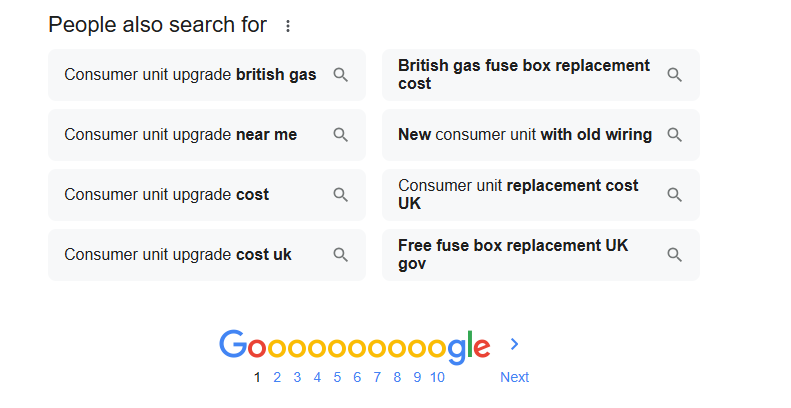
Do that across your whole seed list and you'll have dozens of real ideas without paying for a single tool.
Then it's time to put numbers on them.
How do electricians use Google Keyword Planner for keyword research?
Electricians use Google Keyword Planner for keyword research by pasting their seed keywords into its Discover new keywords tool, setting the location to the United Kingdom and reading the results for search volume, related ideas and competition. Keyword Planner sits inside Google Ads, but you don't need to run any ads to use it. Electrician SEO Pro uses it to put rough numbers on a keyword list, which is all a local electrician needs from it.
Here's the route in:
- Sign in to Google Ads with a Google account. Google will nudge you towards setting up a campaign. You don't need one.
- Find Keyword Planner in the Tools menu. Google moves things around, so have a poke about if it isn't where you expect.
- Choose Discover new keywords.
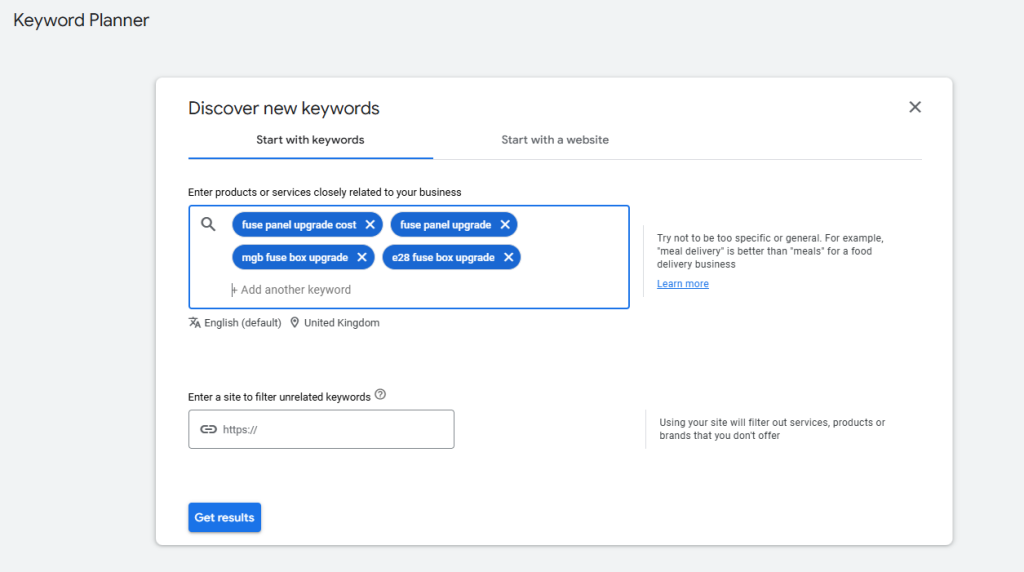
- Paste in the services, locations and questions from your brain dump and your Google research.
- Click Get results.
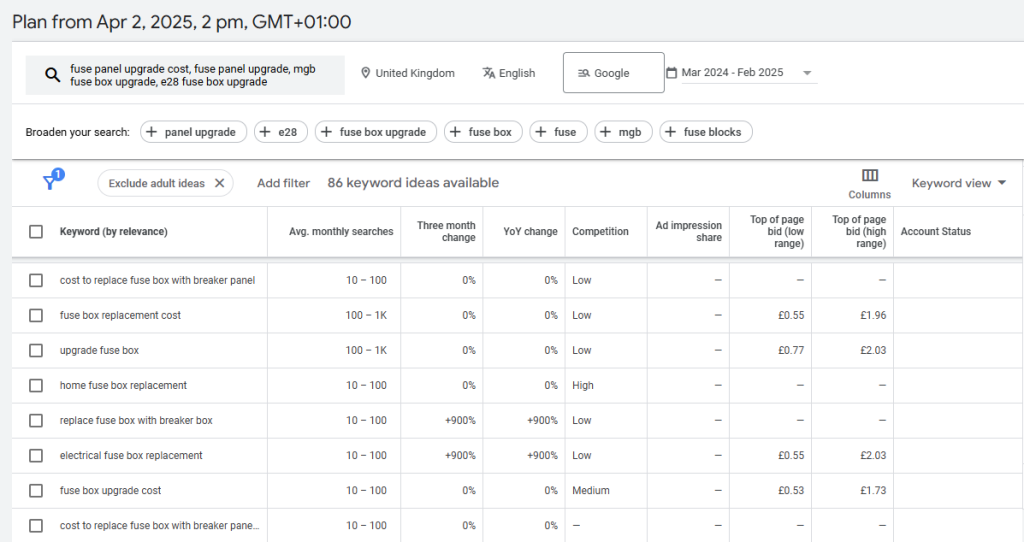
You get a table of average monthly searches, competition and bid ranges for what you entered, plus other ideas straight from Google. Take the good ones and add them to your list. In my screenshot, the search volumes come as ranges, like 10 to 100 and 100 to 1K, so treat them as rough guides rather than exact counts.
Use the filters to narrow the results by location or keyword theme and the junk drops away fast.
You don't need a paid tool for any of this. Free is plenty to start with.
Now for the bit most people skip: cutting the list down.
Which keywords should an electrician choose to target?
The keywords an electrician should choose to target are ones that get some search volume, match a service the business actually offers, have competition a local site can beat and have an intent the page can satisfy. Service plus location searches, such as "EV charger installation Newcastle" or "emergency electrician in York", come first, because they come from people ready to hire. Electrician SEO Pro's rule is that a keyword has to pass all four checks before it earns a page.
Here's how I separate the gold from the dirt:
1. It gets some search volume. Don't stress if it only shows 10 to 100 searches a month. For a local electrician, that's solid. You're not after viral traffic. You're after qualified, local people who need your services. Long-tail phrases like "how much does a consumer unit cost UK" or "can I install an EV charger myself" might only get 10 to 50 searches a month, but they're easier to rank for and perfect for blog posts.
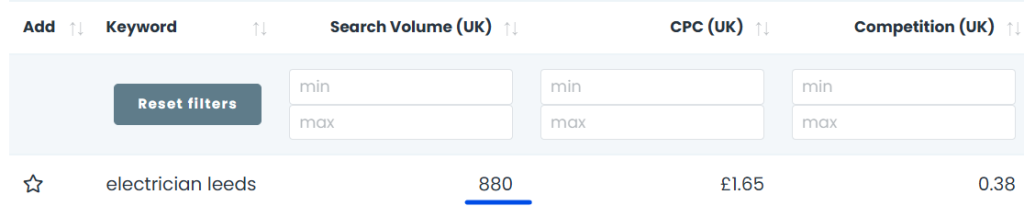
That's a good one: 880 UK searches a month for "electrician leeds" in the tool I checked (if we rank, of course).
2. It matches a service you actually offer. If you don't do landlord safety checks, don't target "landlord EICR certificate". Even if you rank first (by some miracle), you're not relevant, so visitors bounce off the page faster than you can say goodbye.
Here's a story. A client of mine, before I took them on, was ranking number five for a keyword that put them in front of 9,900 new pairs of eyes every month. It was completely irrelevant to their business, so it meant nothing. Relevance means more conversions and fewer tyre-kickers.

3. It isn't a bloodbath. Check the competition in Keyword Planner, then check the SERPs with your own eyes. If it says "High" and the top results are all massive companies, walk away and look for overlooked local gems like "EV charger installation Middlesbrough" or "rewire cost South Shields". That's where the wins are.
4. You understand the intent. Someone typing "fuse box humming at night" wants help, not to hire instantly, so save it for a blog post or FAQ. "Fuse box replacement in York" belongs on a service page, with a call to action and your phone number right at the top. I cover that properly in search intent for electrical websites.
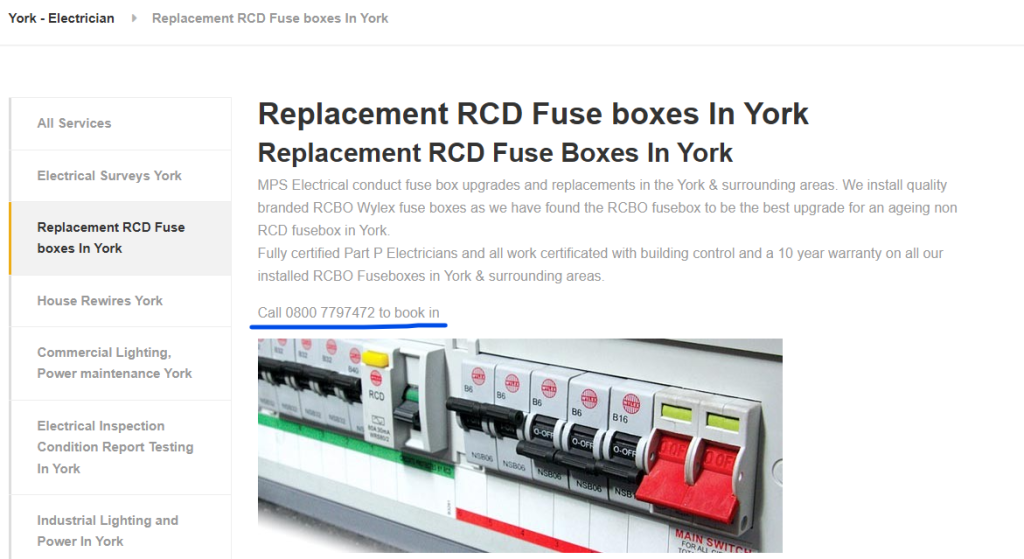
If you can't figure out what kind of page a keyword belongs on, don't use it.
Just as important is knowing what to walk away from.
Which keywords should electricians avoid?
Electricians should avoid keywords with thousands of searches a month that are dominated by national chains and directories, keywords for services they don't offer, and keywords they can't match to a page. Electrician SEO Pro's rule of thumb is to steer clear of keywords with 5,000 or more monthly searches until the site is strong enough to compete, because a small local site is up against national chains, lead-gen sites and directories there.
Three kinds of keyword to leave alone:
- Big, broad terms. Something like "electrician UK" is too broad, too competitive and often useless for a local business. Stick to medium or low competition where you can.
- Jobs you don't do. They bring visitors who were never going to hire you.
- Keywords with no home. If you can't say which page it belongs on, it doesn't make the list.
A lot of rubbish SEO agencies chase traffic for traffic's sake to make the monthly report look good. Traffic for traffic's sake doesn't ring your phone. Leads do.
So you've got a trimmed-down list. What now?
What should an electrician do once they have a keyword list?
Once they have a keyword list, an electrician should organise it into a content map, giving each main keyword its own page and grouping related keywords around it. Electrician SEO Pro's rule is one main keyword per page, so "EV charger installer York" gets a page of its own rather than sharing one with every town nearby. Most people skip this step, which is how a site ends up with four pages about the same thing.
Think of your site like a tree. The trunk is your service page, the branches are blog posts and supporting content, and the roots are the keyword research feeding all of it.
Take consumer unit upgrades. The service page targets "consumer unit upgrade Leeds". Blog posts around it answer "Do I need to upgrade my fuse box?", "How much does a consumer unit upgrade cost?" and "Consumer unit vs fuse box: what's the difference?", and they all link back to the service page.
Then put it in a spreadsheet, one row per page: page title, target keyword, page type, intent and notes.
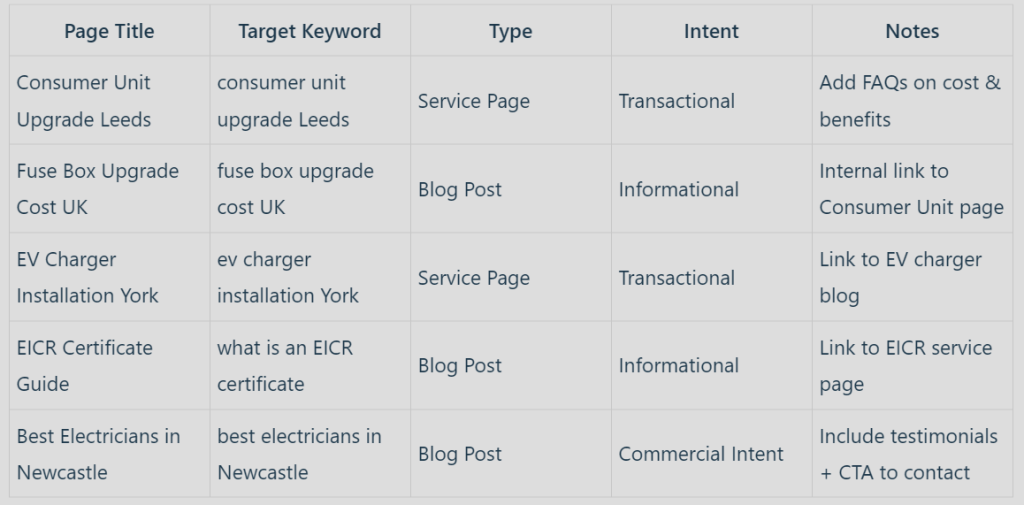
It takes a while and it's a bit boring, which is exactly why most people don't do it. The next steps have guides of their own: building the map is in keyword mapping for electricians, how pillar pages and supporting posts fit together is in content pillars, and where each keyword goes on the page is in keyword placement.
Seed list, real data, a ruthless cut and a map. That's the job.
Want a hand finding the right keywords for your electrical business?
You can get a hand finding the right keywords for your electrical business from Electrician SEO Pro, as part of a full SEO service for electricians, or do the keyword research yourself with a notepad, Google's free suggestions and Keyword Planner. Keyword research is only the start of SEO, but everything else is built on it. Whichever route you take, the rule stays the same: one main keyword per page, and only for jobs you actually do.
If you want a head start, my free list of SEO keywords for electricians has the common ones ready to go. If you'd rather spend your evenings pricing jobs than staring at spreadsheets, I can take it off your hands, alongside the rest of your SEO.
See how I can help, or crack on yourself.
Over to you.