

Local SEO for Electricians: The Ultimate Guide (2026)
Local SEO for electricians is how you get found at the exact moment someone nearby needs you, in the Map Pack, on Google Maps, and in the search results. Here’s the whole system: Google Business Profile, reviews, local keywords, pages that rank, and a site that turns visibility into booked jobs.
★★★★★ 5.0 · Google reviewsWhat local SEO means for electricians (and why it wins jobs)
Most electricians don’t have a lead problem. They have a visibility problem. The firm that gets the urgent call is usually just the one that showed up first when a homeowner searched nearby. That’s the whole game.
Local SEO is the work of getting your electrical business to appear in geographically relevant searches, across the local pack (the Map Pack, those three Google Maps listings at the top), and the standard organic results. It matters because nearly every electrical job is tied to place, urgency and trust, so Google leans heavily towards nearby firms that look credible enough to ring straight away.
For an electrician, that local intent shows up as near me searches, town-based service queries, and panic searches like “fuse box tripping” or “electrician open now”. If you run a 24/7 emergency service, local visibility pays you back twice over, because emergency demand collapses the decision window. The firm in view gets the call before the homeowner even starts comparing.
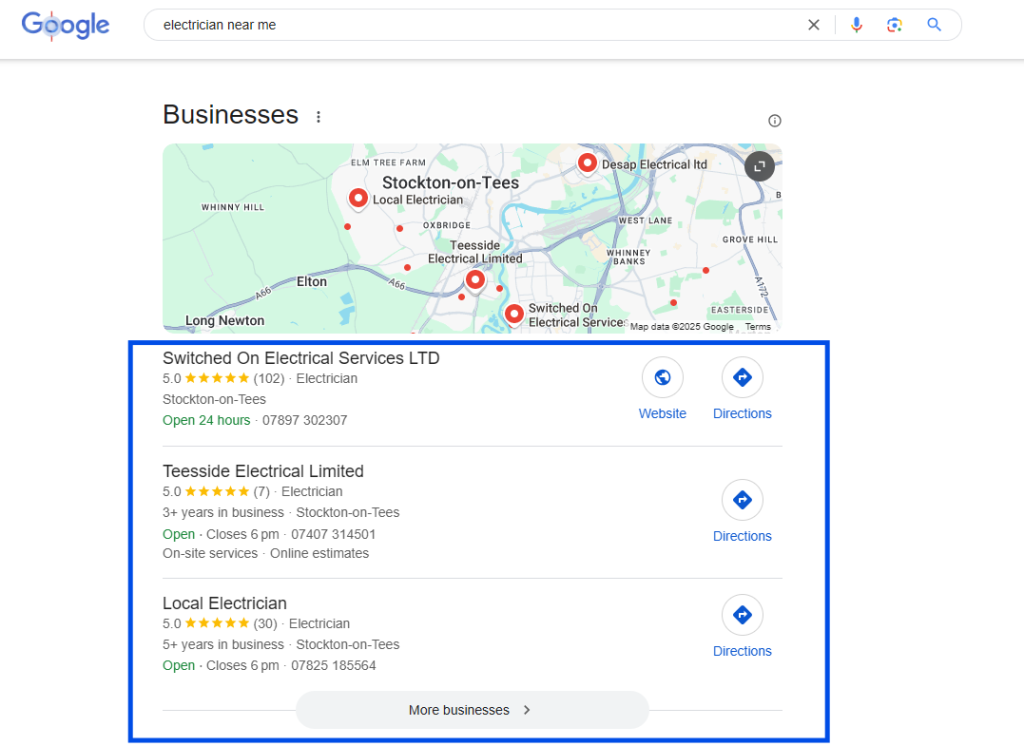
Those top three map results soak up an outsized share of the clicks because they package everything a homeowner wants in seconds: distance, star rating, opening hours, a phone number. Your Google reviews do double duty here, they signal prominence to Google and reassurance to the customer. A profile with recent, detailed reviews beats a sparse one even when both firms cover the same street.
One more thing worth saying early: a single-page website almost always underperforms in local search. It gives Google too little to work with. Split your work into proper service pages (emergency call-outs, EICRs, consumer unit upgrades, rewires, fault finding, EV chargers) and location pages for the areas you cover, and you create far clearer relevance signals and far more ways for people to find you.
How homeowners search for an electrician in 2026
The search journey is compressed now. A homeowner skims the Maps results, an AI Overview, reviews, photos and a couple of organic pages, all on one SERP, before they pick up the phone. The practical takeaway: you have to look trustworthy across several surfaces, not just rank for one blue link.
High-intent searches give away the job type instantly. Someone typing “emergency electrician” wants contact now. Someone typing “EV charger installation” is planning a purchase, comparing, and asking more questions, so they need more proof, qualifications and reassurance before they commit.
Problem-led searches are gold because they reveal urgency without naming the service. “Fuse box tripping” or “RCD tripping” often converts brilliantly, because the searcher doesn’t know whether they need diagnosis, a repair or a replacement. Explain the issue clearly and you become the obvious choice. Google autocomplete and the People Also Ask boxes are full of these phrasings, straight from real searchers.
And trust signals now drive clicks as much as ranking position does. Proximity, review quality, photos of real work and a visible response time all cut uncertainty, which is exactly why a smaller firm with better proof can pinch the job off a bigger one sitting higher up.
What “success” actually looks like: calls, quotes, booked jobs
Local SEO success isn’t impressions or a pretty traffic graph. It’s conversion actions: call clicks, direction requests, quote form submissions, online bookings, and the share of those enquiries that turn into booked work, your real conversion rate. That’s the only scoreboard that pays your wages.
Expect an uneven timeline, not a smooth line up and to the right. Google Business Profile work often moves the needle within weeks, because tweaks to categories, services, photos and reviews shift visibility and CTR fast. Website-led growth from service and location pages takes longer, but it builds broader, more defensible demand that keeps producing lead generation long after the initial push.
Treat local SEO as an asset you manage, not a one-off setup. A GBP suspension can wipe out your visibility overnight, and the firms that keep their profile clean and maintained are the ones that don’t get caught out when it happens.
Step 1: A Google Business Profile that ranks and converts
Your Google Business Profile is the single most important local asset you’ve got. Google still judges local visibility on three things, relevance, distance and prominence, so the goal is to push all three, not obsess over one.
Relevance comes from how clearly your profile matches the search. Your business categories, services and description all need to reflect the work you actually do, because a vague profile makes Google unsure when to show you. Distance is mostly out of your hands, Google uses the searcher’s location and your address or service area, so realistic coverage beats pretending you serve every postcode equally. Prominence is where most electricians win or lose: reviews, local links, photos on GBP and a strong website all tell Google you’re the real deal.
Then there’s conversion. Ranking without action is wasted visibility. A profile that spells out opening hours, emergency availability, service scope and contact options will out-convert a bare listing on the same ranking, because it kills objections before the click. Google Posts and fresh photos keep the profile looking active and maintained, and maintained profiles convert.
Categories, services and attributes
Your primary category should almost always be “Electrician”, because it lines up with the broadest, most valuable search demand. Only add specialist categories when they reflect a genuine chunk of your business and are backed by real service pages and reviews. List your supporting services around revenue priorities, consumer unit upgrades, rewires, fault finding, EICR inspections, lighting and socket work, emergency call-outs, rather than every job you’ve ever done. Specific services improve relevance and pre-qualify the enquiry.
Service-area business vs shopfront (and the rules that get people suspended)
If customers don’t visit you, you’re a service-area business and you must hide your address. Google ties visibility rules to customer experience, so an electrician working from home or a yard with no walk-in service keeps the address hidden. A genuinely staffed shopfront can show its address. Faking it is one of the most common triggers for enforcement, and once trust in the listing is damaged, recovery is slow.
The business name policy is strict and constantly ignored. Stuffing your business name with keywords or towns (“ACME Emergency Electrician London 24/7”) might give a short-term bump, but it raises your suspension risk and isn’t worth it. Same with duplicate listings, virtual offices and mismatched addresses, they cause both compliance headaches and ranking confusion. Give Google one clean, authoritative version of your business to trust.
GBP conversion checklist
- The basics, accurate. A concise description, correct hours, emergency info where relevant, and direct contact options. These tell a homeowner you’re available and suitable before they even hit your site, which lifts CTR.
- Photos that prove capability. Vans, uniformed staff, finished consumer unit work, EV charger installs, certifications and before-and-after shots. In a trade built on safety and trust, photos do a lot of the convincing.
- Description and services as pre-sales content. Answer the real questions up front: response times, EICR certificates, landlord work, emergency call-outs, service areas, so the listing handles objections for you.
The full Google Business Profile guide goes even deeper on profile optimisation.
Step 2: Reviews that drive rankings (without breaking policy)
Reviews pull double weight in local SEO: they feed prominence for Google and they’re the deciding factor for the human choosing between you and the next firm. Google reads quantity, recency, sentiment and detail as signs of an active, trusted business.
Review velocity matters more than people think. A steady trickle of a few relevant reviews a month looks natural and healthy; long gaps make a listing look neglected even with a high star rating. And detailed reviews beat generic praise, when a customer mentions “same-day consumer unit replacement in your town”, that context reinforces both your ranking relevance and the next buyer’s confidence.
Stay on the right side of policy. Incentivised reviews, review gating (only asking happy customers) and staff-written testimonials can backfire and put your profile at risk. The best review acquisition systems are simple, consistent and above board.
A dead-simple review system
Ask at the moment of satisfaction, not three weeks later. The sweet spots are the second the job’s signed off, when you send the invoice, or when you hand over the certificate, that’s when the value is freshest. Text or email a direct Google reviews link with one clear instruction; simplicity is what gets it done. Train every engineer and the office to ask the same way each time, so it becomes a habit, not an afterthought.
Review responses that convert
Reply to every review, good or bad, it shows you’re switched on after the invoice is paid. For positive ones, thank them, mention the job and keep it specific; that little layer of detail turns your review responses into proof of similar work for future searchers. For negative ones, stay calm, brief and professional: acknowledge it, offer a way to put it right, and never argue in public. Prospects judge how you handle a complaint as much as the complaint itself.
Step 3: Local keyword strategy, from “near me” to high-value services
Good keyword research for electricians starts with intent, not volume. The phrases worth chasing are transactional keywords that signal an immediate need or local buying intent, because those produce calls, not passive page views.
Emergency and same-day queries sit at the top of the intent ladder, “emergency electrician”, “electrician near me”, “same day electrician”. They convert fast because the searcher wants someone now. Price-led searches (“EICR cost”, “rewire cost”, “consumer unit replacement price”) signal comparison, so those pages need transparent ranges and a clear next step rather than vague promises.
Keep your targeting disciplined with a service-by-location matrix: map your core services against the towns, boroughs and postcodes that actually matter, and prioritise the pages that match real demand and sensible travel. Watch out for cannibalisation, where two pages fight over the same phrase. The rule: service pages own service intent, location pages own area intent, and blog posts own research and problem-led searches.
Core money keywords to target
Lead with your best-margin, best-closing services: emergency electrician, consumer unit replacement, rewire, fault finding, EICR, EV charger installation, landlord electrical inspection, and socket or lighting installation. Then add the local modifiers people actually use, city names, boroughs, suburbs, postcodes and “near me” variants. These are your local keywords, and they’re where the booked jobs live. My free electrical keywords list has 198 of them ready to copy, split into national, local and long-tail.
How to find them
Google autocomplete is one of the best sources of real phrasing, it reflects live search behaviour. People Also Ask reveals the questions sitting next to commercial demand, perfect for building pages that answer objections before the call. And Google Search Console shows the queries you already get impressions for, even when you’re ranking poorly, which tells you exactly where Google already sees you as relevant so you can strengthen those pages. Full keyword research walkthrough →
Step 4: A website structure that supports local rankings
Your site architecture decides how clearly Google and customers understand your business. A proper structure, a homepage, dedicated service pages, location pages and supporting content, creates far better local relevance than a brochure site trying to rank everything from one URL. A single-page website almost always stalls in local search because it squashes too many intents into one place.
Good on-page SEO makes every page’s job obvious. Sharp title tags and meta descriptions (your advert in the results), clear heading tags (one H1, descriptive H2s and H3s), concise service copy, and locally relevant internal linking all help Google interpret the page and help the customer decide to call. Put your calls-to-action early and often, especially on mobile: a visible phone number, a quote option, and clear service-area info on every important page.
Service pages that rank and convert
Each core service gets its own page with proof aligned to the job, qualifications, accreditations, guarantees, insurance and real photos, because electrical work is trust-sensitive and people are weighing up safety and risk. Be careful but not evasive on price: “from” pricing, the cost drivers and a clear explanation of what affects the quote build trust without boxing you into a number.
Here’s the order I build one in, so it works for the customer and gives Google clear clues:
- Choose the keyword first. For a town-focused page, “electrician” plus the town is the money phrase. Work in variations like “emergency electrician” plus the town, but keep the main phrase as the focus.
- Put it in a plain H1 and title. “Electrician in Liverpool: Domestic & Commercial Electrical Services” does the job. Keyword soup like “best cheap reliable electrical company” looks spammy, and I’d avoid “cheap” altogether because people read it as low quality.
- Write a human intro. In the first two or three sentences, name the town and your core services, and put a call to action in before they scroll.
- List your services with one-line descriptions. “All kinds of electrical work” is vague. Spell out consumer unit upgrades, rewires, fault finding and EICRs, and each one can grow into its own page later.
- Prove you’re local. Name the areas you work in and the property types you see, like Victorian terraces with tired wiring or new-builds with smart systems. There’s more on this in my guide to localised content for electricians.
- Make the call to action impossible to miss. A phone number and a quote button near the top and again near the bottom, easy to tap on mobile.
- Add short local testimonials. Two to four that mention the town and the job, with your accreditation and review badges as a logo row near the final call to action.
- Link onwards. Point to supporting blog posts and related services like EV chargers or EICRs, so visitors (and Google) have somewhere to go next.
Build one page properly, then reuse the formula for the towns that really matter, with genuine local detail each time rather than a swapped town name.
Every step, with examples, is in my service page blueprint for electricians.
Location pages done properly
Good location pages are not spun copies with the town swapped out, that’s how you end up with thin, spammy location pages Google now spots a mile off. A proper one has genuine local proof: jobs done nearby, travel times, common property types, area-specific service notes and FAQs. Expand coverage in a sensible order, start with the towns that already produce work or look commercially strong, then build outwards. Tie it together with internal linking: link each location page to the matching services and each service back to your key areas, and use an “areas we cover” hub so Google sees one coherent map of your footprint. Full on-page SEO guide →
Step 5: Local citations and NAP consistency, the trust layer
NAP consistency means your business name, address and phone number appear the same way everywhere online. It matters because conflicting data weakens trust signals, and local algorithms lean on consistency to confirm you’re a real, stable business at a real location.
Citations aren’t a substitute for a strong website or profile, but they corroborate. The value isn’t sheer volume, it’s giving Google repeated agreement about your identity, contact details and service area. The sources that count are core business directories, trade-relevant listings and reputable regional directories; relevance and editorial quality beat mass submission every time.
Citation hygiene gets important the moment you’ve moved, changed numbers, or used tracking lines inconsistently, old data lingers online for years. Audit by searching your business name, old phone numbers, former addresses and URL variations to surface duplicate listings and outdated records. Standardise one preferred format, then correct or remove duplicates, hitting the most visible platforms first. You’re not chasing perfection across every obscure directory, you’re after a stable, accurate footprint where Google and customers actually look.
Step 6: Content that wins local traffic and turns it into leads
The best local content sits between pure service pages and generic blogging. A service-plus-problem model catches people searching the symptom, tripping RCDs, a burning smell, flickering lights, dead sockets, then routes them to the right commercial service.
Problem-led content works because homeowners search the issue before the solution. Explain what a burning smell might mean, what to do right now, and when to call out, and you build trust early and catch traffic your competitors ignore. FAQ content does the heavy lifting too, answering the practical questions that block enquiries: availability, what affects the price, emergency response times, safety guidance, certification, and whether the power should be off.
Then there’s proof content, the stuff that converts. Before-and-after galleries, short job write-ups and local case studies turn claims into evidence, which is persuasive in a trade where workmanship is hard to judge before the visit. A solid case study follows a simple shape: problem, diagnosis, solution, time taken, cost drivers, outcome. Drop in the town, the property type and a couple of photos, and it earns both local relevance and trust.
Topics worth publishing: the urgent ones (“what to do when the fuse box keeps tripping”, “what a burning electrical smell means”), and the compliance ones (EICR guidance, landlord responsibilities, Part P basics, EV charger rules), which pull in people who are close to a regulated purchase and need a competent contractor, not just information.
Step 7: Technical SEO basics, fast, crawlable, mobile-first
Technical SEO for a trades site is about usability, indexation and speed, not complexity. A mobile-first site that loads fast, navigates cleanly and exposes your key pages gives Google and customers fewer reasons to bounce.
Core Web Vitals matter because slow pages kill trust and engagement. For local trades the effect is brutal and immediate: if a stressed homeowner can’t load your emergency page or tap your number quickly, the next electrician in the results gets the job. Keep navigation simple enough to reach any service or location page in a few taps, which helps crawlability and helps panicked users too. And give your conversion elements technical attention, click-to-call buttons, sticky CTAs and short quote forms all lift lead capture on mobile.
Watch for the usual growth blockers: bloated themes, broken internal links, accidental noindex tags, duplicate page templates and weak mobile rendering. None of them are abstract, each one quietly costs you discoverability or conversions.
Local schema markup to add
Add schema markup so search engines read your business cleanly. LocalBusiness schema should match your visible NAP exactly and include service-area info where it applies, structured data works best when it confirms what the page already says. Be careful with Review schema: only use it where it’s policy-compliant, and never mark up your Google Business Profile reviews on your own site, that mismatch can lose you rich results. Full technical SEO guide →
Tracking and measurement
If you’re not measuring it, you’re guessing. Set up GA4 to track calls, forms, bookings and key contact clicks as events, and use Google Search Console to see which queries and pages drive impressions and clicks. Local SEO decisions get a lot smarter when they’re based on page-level evidence rather than a hunch.
Call tracking is useful if you handle it carefully. Use dynamic number insertion on the website so you get attribution while keeping your real number on your citations, that preserves NAP consistency for search engines. Whatever you do, don’t swap your main business number across your public listings, that damages local trust signals fast. Full tracking & reporting guide →
SEO vs PPC: which, and when
The honest answer on SEO vs PPC is that they do different jobs. PPC buys you immediate placement, it’s great for fast lead generation in competitive areas, or for high-margin services where a paid click pays for itself many times over. The catch: the moment you stop spending, the leads stop.
Local SEO is the opposite. It takes longer to earn, but it compounds into lower-cost visibility that keeps producing enquiries after the spend stops. For most electricians the smart play is both: PPC to turn the tap on today, local SEO to build the asset that keeps paying tomorrow. If budget’s tight, start with your Google Business Profile and reviews (fastest wins), then let the website work catch up. More on Google Ads for electricians →
Common local SEO mistakes electricians make
Most local SEO damage comes from impatience. Keyword-stuffing your business name, publishing spammy location pages, or chasing shortcuts might create a flicker of movement, but it usually costs you trust, conversions, or your listing.
- Thin location pages. Targeting a town with no local value. Google’s got good at spotting templated pages, and users bounce when every town page reads off the same script.
- Low-quality citations and paid links. Electricians rarely need aggressive off-page link building to compete locally. You need accurate data, strong service pages, reviews and enough local authority, not a pile of junk links inviting a penalty.
- Neglecting reviews, photos and response times. That’s the prominence layer, and in a crowded market the small trust signals decide the click.
- A single-page website. Too little structure to rank for the range of services and areas you actually cover.
What to do if your Google Business Profile gets suspended
A GBP suspension is stressful but recoverable. Start by auditing the likely violations against Google’s guidelines: check the business name, address eligibility, categories, duplicate listings, and any mismatch between what the profile claims and how you actually operate (the business name policy is the usual culprit).
Then gather your evidence before you file the reinstatement request. Utility bills, business registration, signage, photos of premises where relevant and supporting documents make a far stronger case than a rushed appeal based on guesswork. Fix the underlying issue first, then appeal once, calmly, with proof.
Don’t let leads leak. Every page needs an obvious next step, phone, quote request, emergency contact, service-area confirmation. And every blog post should link to the matching commercial page (a “flickering lights” article should link to fault finding or emergency electrician), so traffic has a path to becoming a booked job rather than a dead end.
Local SEO checklist for electricians
Looking for a local SEO template for electricians? This is the checklist I’d work down for an electrical business. It pulls the steps above into one place, so tick off a group at a time. If you’re short on time, start with the Google Business Profile and reviews, because they tend to move fastest.
Google Business Profile
- Primary category is Electrician, with extra categories only for work you really do, and your main services listed.
- Business name is your real trading name, with no towns or keywords added.
- Address hidden and service areas set if customers don’t visit you.
- Opening hours, emergency availability and phone number are correct and match your website.
- New photos of real jobs, your van and your certificates added regularly.
Reviews
- A direct Google review link saved on every engineer’s phone and added to your invoice or certificate email.
- Every customer asked the same way when the job is signed off, and nothing offered in return.
- Every review answered, good or bad, with the job named where you can (see my guide to Google Business Profile reviews).
Website
- One page per core service, plus location pages only for areas you really cover.
- Service and town in the title tag, H1 and first paragraph of each page.
- Phone number and quote button visible without scrolling on a phone.
- Pages load fast on mobile, and every key page is a few taps from the homepage.
- LocalBusiness schema matches the name, address and phone number on the page.
Citations
- Same name, address and phone number on your website, Google profile and every listing (see my NAP consistency guide).
- Listed on Yell, Bing Places, Apple Maps and Facebook, plus the trade platforms you really get work from.
- Old addresses, old numbers and duplicate listings searched for and fixed.
- Real number on every public listing, with call tracking numbers used only on your website.
Tracking
- Call clicks, form submissions and bookings tracked as events in GA4.
- Search Console checked for the queries and pages bringing impressions and clicks.
- Enquiries compared with booked jobs each month, so you know what actually pays.
Tick the lot, then come back every few months, because profiles and listings drift.
Local SEO for electricians: FAQs
How do electricians rank higher on Google Maps?
Optimise your Google Business Profile with accurate categories, services, photos and hours. Then build steady review momentum, keep your NAP consistent, and back the listing with strong local service and location pages.
How long does local SEO take for an electrician?
Map Pack improvements can show within weeks of profile and review work. Broader organic growth from service and location pages usually takes three to six months, depending on competition and the state of your site.
Do electricians need a physical address for Google Business Profile?
Not always. A service-area business can hide its address if customers don’t visit, but Google still needs a real, eligible address to verify you.
Are location pages bad for SEO?
No, thin duplicate pages are the problem. Unique location pages with real local proof, relevant services and useful FAQs improve both relevance and conversions.
What’s the best keyword for an electrician?
There’s no single best keyword. High-intent terms like “emergency electrician” and “electrician near me” drive strong calls, especially paired with specific services and locations.
Let’s fill your diary.
The electricians who win local search aren’t the biggest firms, they’re the ones treating it as one system. Send me a WhatsApp and I’ll show you the fastest wins for your patch.