

Keyword cannibalisation, also spelled cannibalization, is when two or more pages on an electrician's website target the same search, so they compete with each other instead of working together. It splits links, relevance and clicks between the pages, and Google may rank the wrong one. Electrician SEO Pro's rule is one page, one purpose, one main keyword, and the fix is to merge, redirect or rewrite the weaker page.
How does keyword cannibalisation happen on an electrician's website?
Keyword cannibalisation happens on an electrician's website when two pages are built for the same search, usually because nobody planned which page owns which keyword. A typical case is two pages both aimed at emergency electrician in Leeds, or five blog posts about EV charger installs written in slightly different ways. It's rarely a technical fault. It's a planning problem.
Picture it. You've got two pages, both trying to rank for "Emergency Electrician in Leeds". You think: double the pages, double the chances, right?
Nah. You've just kicked your own SEO in the teeth. Google's sat there wondering which one is the real deal.
Plenty of electricians don't map out their SEO before they start churning out service pages and blog posts. I get it, it really is boring. But that's how you end up writing about EV charger installs five times.
I'm not judging. I did this myself when I first got into SEO, over seven years ago, and I'm telling you so you can skip the headache I got.
Is it actually costing you rankings, though?
Does keyword cannibalisation hurt an electrician's rankings?
Yes, keyword cannibalisation can hurt an electrician's rankings, because two pages chasing the same search split the links, relevance, internal link power and clicks that one strong page would have had. Google then has to pick between them, and it can pick the page you didn't want. Electrician SEO Pro's rule is to give every search one clear page to land on, so every signal points the same way.
Here's what gets split:
- Relevance. Two pages saying the same thing, so neither looks like the answer.
- Backlinks. Links earned by one page and links earned by the other, instead of all of them on one.
- Internal link power. Your own links spread across both.
- Clicks. Customers see two of your pages, or the wrong one.
Instead of one strong, clear signal, you're sending mixed messages.
I've seen it go two ways. Sometimes neither page does as well as one clear page would. Typically, in my experience, Google ranks the page you don't want for the keyword, like some kind of joke at your expense.
One honest limit: two pages on a similar topic isn't automatically a problem. If each page has a different purpose, that's not cannibalisation. It's only a problem when they're fighting over the same search.
So how do you tell the difference?
How do electricians spot keyword cannibalisation?
Electricians can spot keyword cannibalisation by searching Google with the site: operator and the target keyword, then checking whether more than one page from their own site shows up and whether those pages have the same purpose. If they do, that's cannibalisation. Electrician SEO Pro uses this old-school method because it's quick, free and still works.
Go to Google and type this, swapping in your own website and keyword:
site:yourwebsite.co.uk "electrician manchester"If several pages show up for the same search, you've probably got cannibalisation. But use your own SEO brain here. Go and look at those pages first and ask yourself: does each page have a different purpose or intent? If the answer is no, you've definitely got an issue to solve.
Here's what the search looks like. It's another electrician's site, so two pages showing up proves nothing on its own. It just tells you where to look.
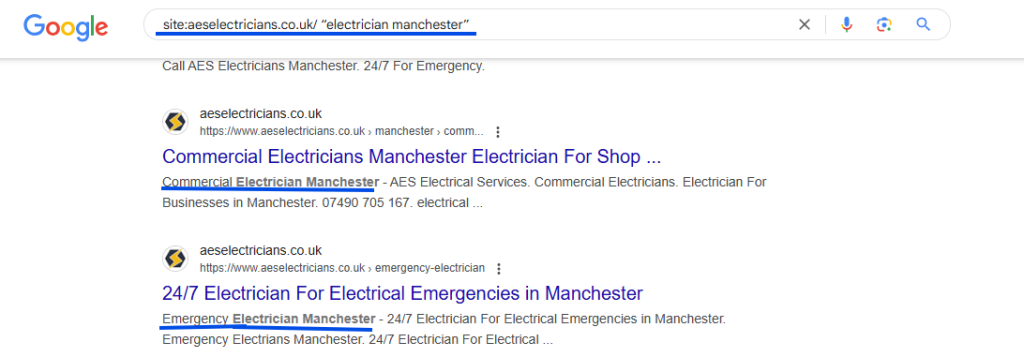
If you've got Search Console set up, there's a second check. Open Performance, click a search query, then open the Pages tab. Two of your pages in there for one query is the same warning sign.
Spotted one? Here's how to sort it.
How do electricians fix keyword cannibalisation?
Electricians fix keyword cannibalisation by deciding which page should own the keyword, then either merging the weaker page into it with a 301 redirect, or rewriting the weaker page to cover a different angle and a different search. If both pages must stay, a canonical tag tells Google which one is the main version. Electrician SEO Pro's order of play is redirect or rewrite first, canonical only when both pages have to stay.
First, choose the winner. I'd keep whichever page is already pulling its weight, with more links and more clicks.
Then pick your fix:
- Merge and redirect. Fold anything useful from the weaker page into the winner, then set up a 301 redirect from the old URL to the new one. My guide to 301 redirects for electrical websites shows how.
- Rewrite for a new angle. If the weaker page deserves to exist, give it a different job. Made up: you've got two pages chasing "emergency electrician in Leeds". Keep the service page, and turn the other into a post answering "what counts as an electrical emergency?", linking through to the service page.
- Use a canonical tag. Only if you have to keep both, say for legal reasons or syndication. The canonical tag says "this is the main page for this content". You won't usually need it on an electrician's site, but it's worth knowing. There's more in my guide to canonical tags.
After a merge, update your own internal links to point straight at the winning page, so visitors aren't sent through a redirect every time.
Fixing is one thing. Stopping it coming back is better.
How can electricians avoid keyword cannibalisation in future?
Electricians can avoid keyword cannibalisation by giving every page one main keyword and one purpose, and by writing down which page owns which keyword before publishing anything new. Electrician SEO Pro's rule is one page, one purpose, one keyword, full stop. A written keyword map is all it takes: what each page targets, what it's for and where it sits on the site.
Here's how I keep it simple:
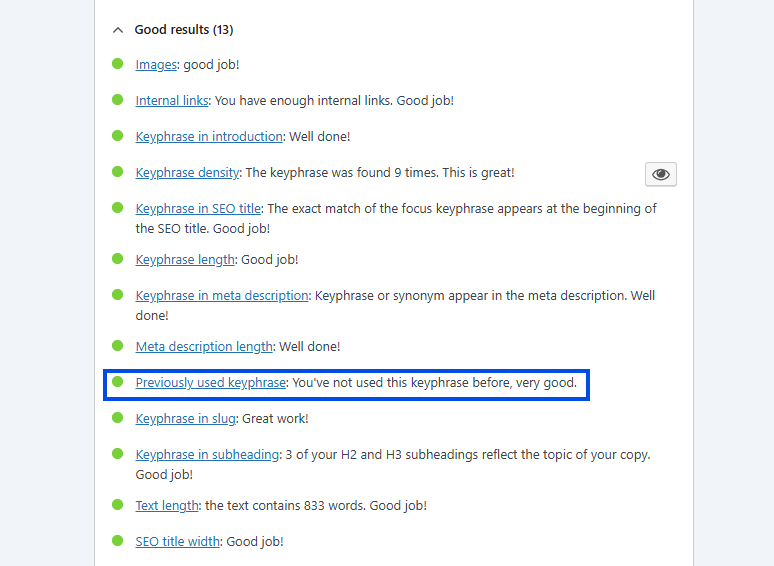
- One main keyword per page. If two pages are trying to rank for the same thing, you're already behind. An SEO plugin like Yoast SEO helps: it lets you set a keyphrase for each page and warns you if you've used it before.
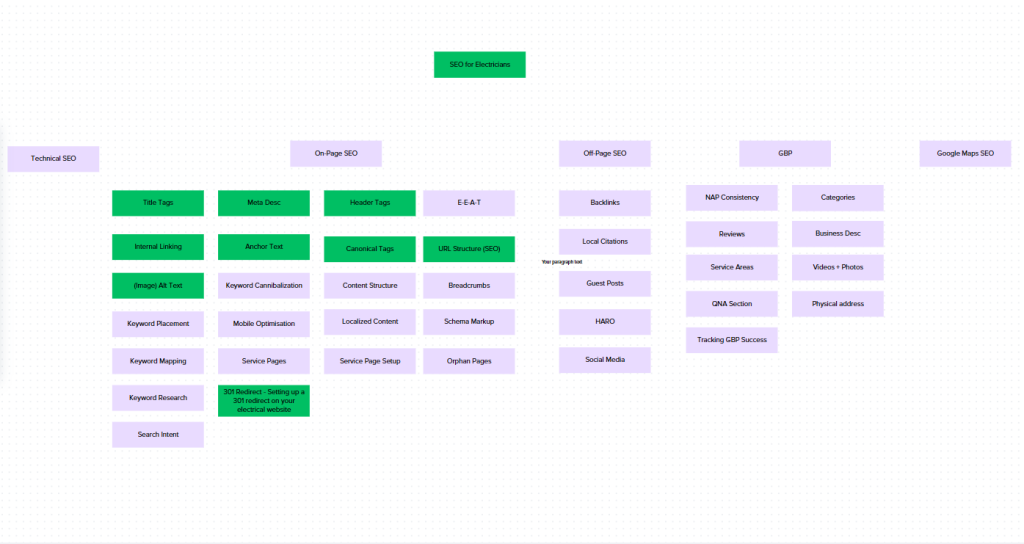
- A keyword map before you hit publish. Literally write it out. What keyword each page is targeting, what its purpose is, and where it fits. It turns chaos into strategy. I usually use Canva for a simple visual, and here's a very rough version of the content map for this very website. My guide to keyword mapping goes through it step by step.
Before you write anything new, run the same site: search for the topic. If a page already covers it, improve that one instead of starting another.
Don't get obsessed, though. You don't want to spend months planning. You need to start publishing.
One thing catches people out, so it gets its own question.
Do a service page and blog posts on the same topic cause keyword cannibalisation for electricians?
No, a service page and blog posts on the same topic don't cause keyword cannibalisation for electricians when each one targets a different search with a different intent. A service page for EV charger installation and posts like how long an EV charger takes to install all mention EV chargers, but one serves people ready to hire and the others serve people still learning. Electrician SEO Pro calls that a cluster, not a clash.
This might seem to go against everything I've said so far, but it doesn't. Yes, all these pages mention EV chargers. But they're long-tail variations with completely different search intent. That's not cannibalisation. That's smart targeting.
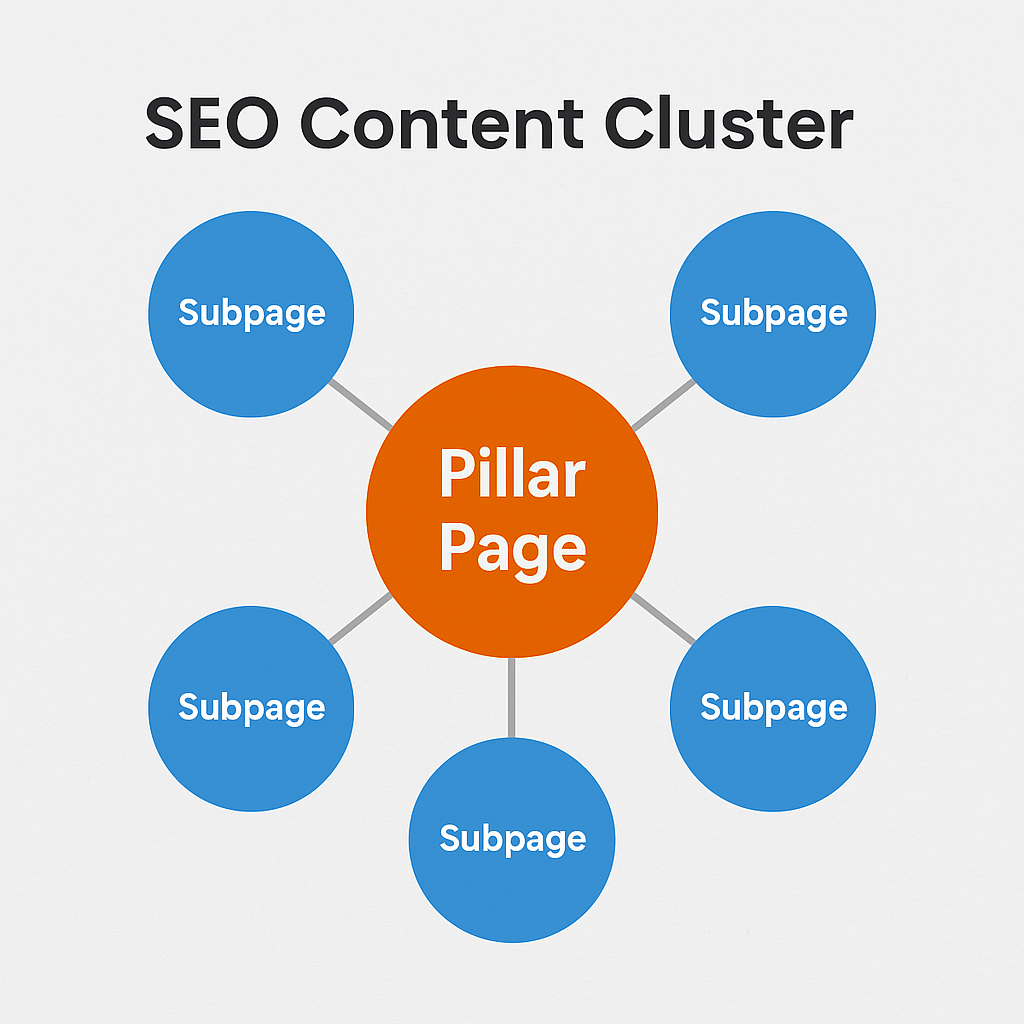
Think in clusters, not duplicates. You don't need three pages saying the same thing. Instead (made up):
- One solid service page: "EV Charger Installation"
- Supporting blog posts: "Best EV Chargers for Home Use", "How Long Does an EV Charger Take to Install?"
Not sure whether two pages are a cluster or a clash? Search both phrases and compare what Google shows. If it's the same kind of page for both, they're fighting. If it's different kinds, you're fine. My guide to SERPs for electricians explains how to read the results, and content pillars shows how to build clusters on purpose.
One page, one purpose, one keyword.
Want a hand fixing keyword cannibalisation on your electrician website?
You can get a hand fixing keyword cannibalisation on your electrician website from Electrician SEO Pro, as part of a full SEO service for your electrical business, or fix it yourself with a site: search and a written keyword map. Cannibalisation is a planning problem more than a technical one, so the fix is usually decisions rather than code. Whichever route you take, the rule stays the same: one page, one purpose, one main keyword.
If you've got the time, everything you need is in my free SEO for electricians guide. If you'd rather spend your evenings quoting jobs than auditing pages, I can take it off your hands, alongside the rest of your SEO.
See how I can help, or crack on yourself.
Over to you.