

A content pillar page for an electrician's website is one big, in-depth page on a core service, such as rewiring, EICRs or EV charger installs, that supporting pages link back to. Pillar pages help electricians rank, because they show Google which page is the main resource on a topic and give the site a clear structure. Electrician SEO Pro's advice is to build a few strong pillars around the services that bring in the most leads, not one for everything.
What is a content pillar page on an electrician's website?
A content pillar page on an electrician's website is a big, in-depth page about one core service or topic, such as rewiring, EICRs or EV charger installs, that covers every angle a customer might ask about: what it is, who it's for and why it matters. Related blog posts, location pages, case studies and FAQs all link back to it. In Electrician SEO Pro's view, the pillar is the hub of a topic and the supporting pages are the spokes that feed it.
Think of it as the fuse board of your content strategy. Every supporting page is a wire running back to it, feeding power (relevance and authority) straight to the source.
The big power hub on this website is my SEO for electricians page. It's the one page where everything on that subject lives.
Here's a visual of how it fits together, using four pillars for an electrician in Liverpool (all made up):
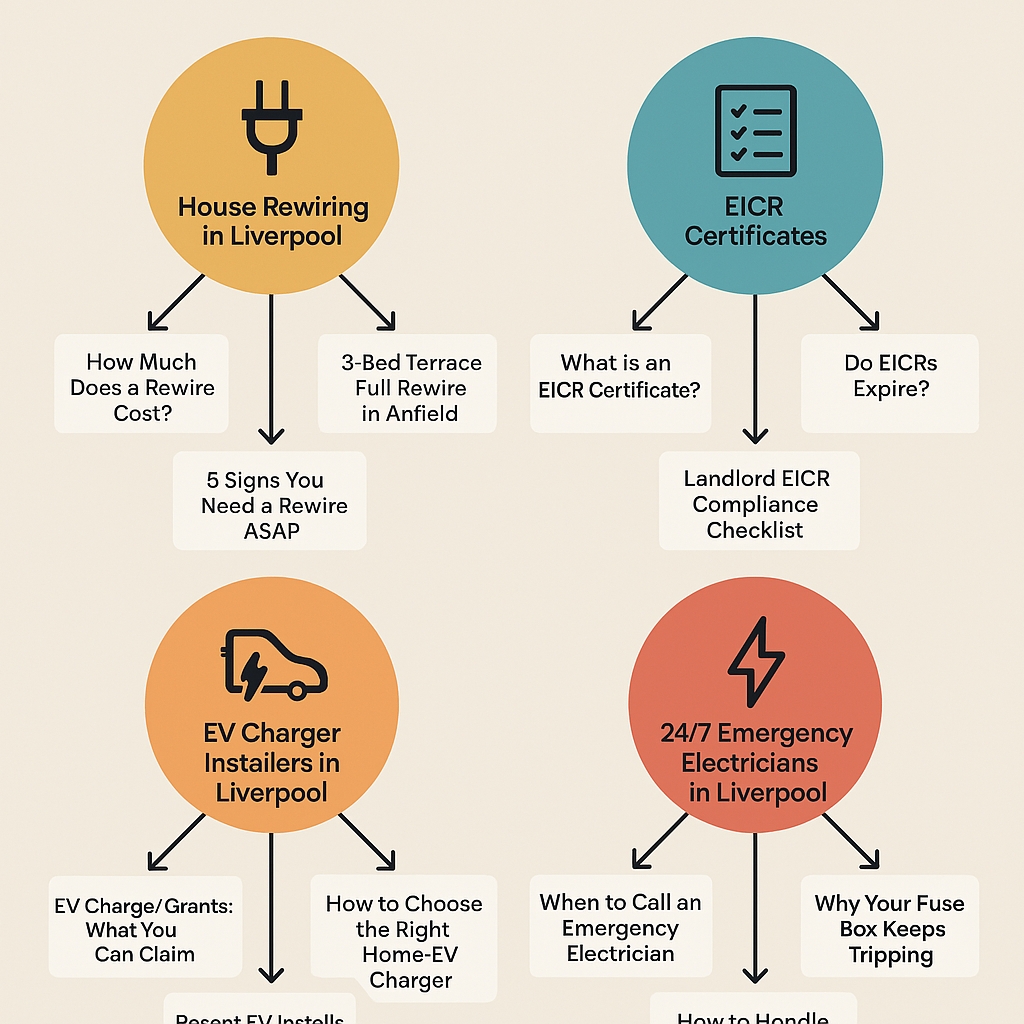
That's the structure. But does it actually help you rank?
Do content pillars help electricians rank in Google?
Yes, content pillars help electricians rank in Google, because a deep pillar page with supporting pages linking to it shows Google which page is the main resource on a topic, and that builds topical authority for the whole site. The pillar earns its ranking by being the most complete answer to a customer's search, and the supporting pages feed it through internal links. Electrician SEO Pro rates pillars as a genuine ranking strategy, with limits: a pillar can't rescue thin content, a service nobody searches for, or a page that doesn't match what the searcher wants.
Pillar pages do two jobs at once. They help Google understand your site, and they help real people find what they need.
Build a strong pillar, say "House Rewiring in Liverpool", then link your related blog posts, galleries and case studies back to it, and you're doing more than passing ranking power around. You're creating structure. That builds topical authority, which is Google learning to trust you as the expert on that subject in your area.
The perk I like best: when you publish something new, it hits the ground running faster, because the site is already known for that subject. A rising tide lifting all boats.
The "matches what the searcher wants" part matters, so my guide to search intent is worth a read alongside this one.
I keep saying ranking power gets passed around. The slang for that is link juice, so what does it mean?
What does link juice mean for an electrician's website?
Link juice, also called SEO juice, is slang for the ranking power that flows from one page to another through links, which for an electrician's website usually means internal links between your own pages or backlinks from other sites. When a strong, relevant page links to another, it passes some of its ranking power across, and that helps the linked page rank higher in Google. Electrician SEO Pro's rule is to point your supporting pages at your pillar, because that's where you want the power to end up.

Daft name, useful idea. Picture every link as a straw: the stronger the page it comes from, the more it passes along. That's why a pillar with lots of relevant pages linking to it ends up with more to give.
How to do the linking is in my guide to internal linking for electricians, and the outside-in version is in backlinks for electricians.
Now for the bit that matters most: what makes a pillar page worth linking to?
What makes a good content pillar page for an electrician?
A good content pillar page for an electrician focuses on one core service, goes deep enough to cover every angle, is easy to scroll, links out to supporting pages, answers real customer questions, mentions the areas served and gives the reader a next step. Electrician SEO Pro's rule of thumb is one topic per pillar, such as "EV Charger Installation in Liverpool", with 1,000 words or more of genuinely useful information. Not every long page is a pillar page: a real one is built to rank, convert and support the rest of your content.
The first four points are about structure.
1. One page, one focus. Target a single high-intent keyword, like "EV Charger Installation in Liverpool", and go deep on it. You're not trying to rank for ten topics at once. You're trying to build the best piece of content on the web for that one topic, covering every angle you can think of, so your competitors struggle to keep up. I always picture it as a blog page moat:

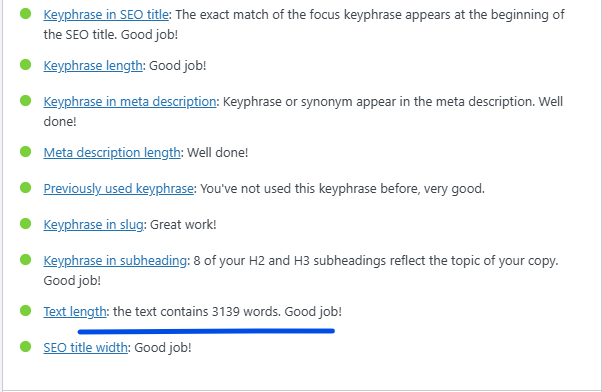
2. Not thin. Aim for 1,000 words or more of real answers, clear breakdowns, photos, examples and FAQs. No fluff, no keyword stuffing. That's my rule of thumb, not a Google rule. For scale, one of my own articles was 3,139 words when I checked (good luck to my competitors reading it):
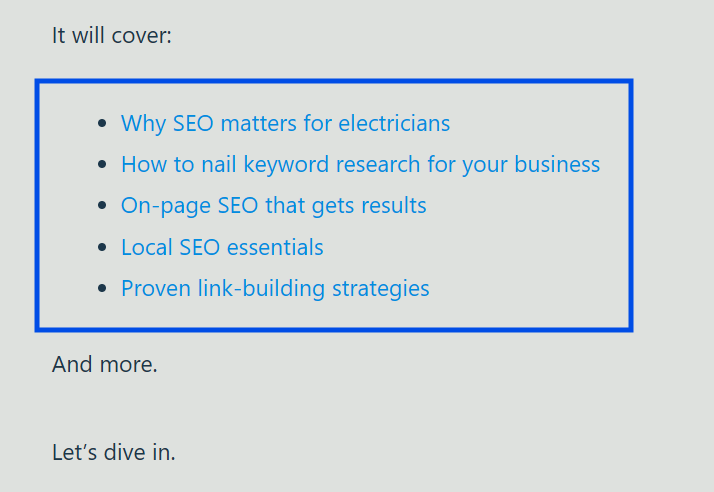
3. Structured like a guide. Clear headings, short paragraphs, maybe a contents box at the top. A short intro that lists what the page covers helps, like this one:
Think of it as a mini homepage for that one service, not just a sales pitch.
4. Links out to supporting content. Got a blog about EV charger grant schemes, or a case study from a local install? Link to them. My minimum is three separate, relevant internal links per page. That connects the dots and shows Google you've built a topic ecosystem, not a lonely page on its own.

The last three points are about the customer.
What should an electrician's pillar page say to customers?
An electrician's pillar page should say what customers actually want to know: how much it costs, how long it takes and what the process is, with the areas served named and a clear next step such as a call button or quote form. Electrician SEO Pro's rule is to answer every question customers keep asking, because people who find their answers stay on the page, trust you and, eventually, call.
5. Answers real customer questions. "How much does this cost?" "How long will it take?" "What's the process?" Cover the questions you get asked every month, plus the ones people search for on Google. My guide to keyword research for electricians shows how to find them. This is mostly cold traffic, so instant contact is rare. They read, they trust you, then they call.
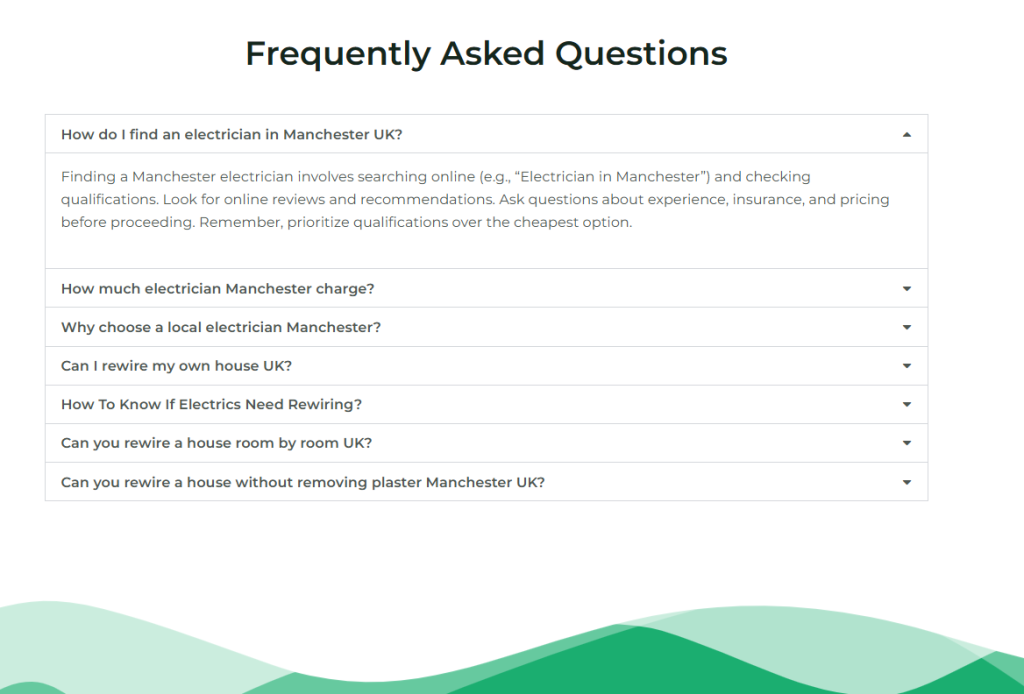
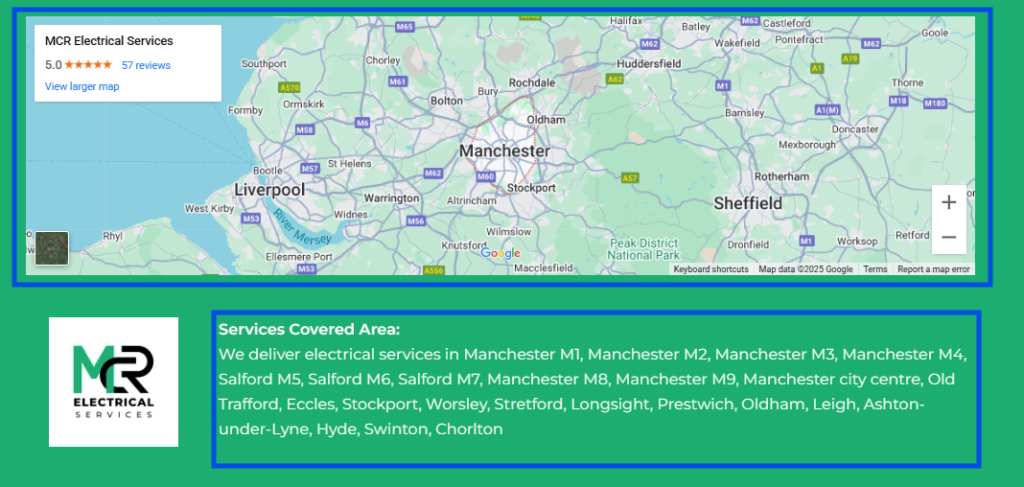
6. Localised. Mention the areas you serve and drop in local references. A map showing your coverage is a quick way to do it. It shows the page wasn't copied from a generic template: it's specific to the area your customers live in. My service page blueprint for electricians goes into the detail.
7. Tells them what to do next. A "Call Now" button or a quote form. They've read the page, so make acting easy. One catch: only push a hard call to action if the keyword you're targeting converts. Otherwise it's a waste of time and can turn people away.
So does every page on the site need this treatment?
Should every page on an electrician's website be a pillar page?
No, not every page on an electrician's website should be a pillar page, and most shouldn't. Electrician SEO Pro's rule is that pillar pages are for core services only: the ones that drive the most leads, have real search demand and have plenty of different angles to cover. Blog posts, case studies and location pages are supporting content, and their job is to feed the pillar.
Here's the test I use. Ask yourself:
- Is this something I want to rank for long-term?
- Would I ever send a customer here to explain the service?
- Can I write at least 1,000 words of helpful content about it?
- Are there supporting questions or blog posts that naturally relate to it?
Yes to all four? Boom, you've got a pillar opportunity.
Pillar pages aren't blog posts. They're not quick wins or filler. They're deep, strategic pieces that take time to build and keep paying back.
So how many is enough?
How many pillar pages does an electrician need?
An electrician needs three to six solid pillar pages, in Electrician SEO Pro's view, one for each of the core services that bring in the most leads. More than that dilutes the site's focus, because Google can't tell which pages matter most and your own pages start competing for the same search. The approach is to go deep, not wide.
Write a pillar for every service variation and you'll:
- Dilute your site's authority. Google won't know what's most important.
- Cause keyword cannibalisation. Multiple pages compete for the same term.
- Overcomplicate your site structure. It gets harder to manage and harder for customers to navigate.
Focus on the services people actually search for and book. Then use supporting blog posts and case studies to feed those pillars traffic, trust and topical authority.
Less is more here. Pick your pillars, build them properly, then let everything else point their way.
Want a hand building content pillars for your electrical website?
You can get a hand building content pillars for your electrical website from Electrician SEO Pro, as part of a full SEO service for your electrical business, or build them yourself by picking your core services and writing one deep page for each. A pillar page is a long-term piece of work, so it pays to choose the services carefully and build the supporting pages around them. Whichever route you take, the rule stays the same: one topic per pillar, and every supporting page links back to it.
If you've got the time, everything you need is in my free on-page SEO guide for electricians. If you'd rather spend your evenings pricing jobs than writing 1,000-word pages, I can take it off your hands, alongside the rest of your SEO.
See how I can help, or crack on yourself.
Over to you.