

Electricians do keyword mapping by giving every page on their website one main keyword, then recording each page, its keyword and its status in a spreadsheet. With one page per keyword, pages stop competing with each other and Google can see which page answers which search. Electrician SEO Pro's rule is one main keyword per page, with variations as secondary keywords, and a free Google Sheets template makes the map quick to build.
What is keyword mapping for an electrician's website?
Keyword mapping for an electrician's website is assigning one main keyword to one specific page, so every page has a clear job and no two pages compete for the same search. The finished map is a spreadsheet listing each page, its main keyword, its secondary keywords and its status. Electrician SEO Pro describes it as giving every page a job title, a main keyword and a reason to exist.
That page becomes the go-to page for that keyword. Google sees it and understands it. It's like giving each page its own job title: no overlapping roles, no duplicates, just a clean, clear setup.
Here's what a fleshed-out map looks like, using Liverpool as the example:
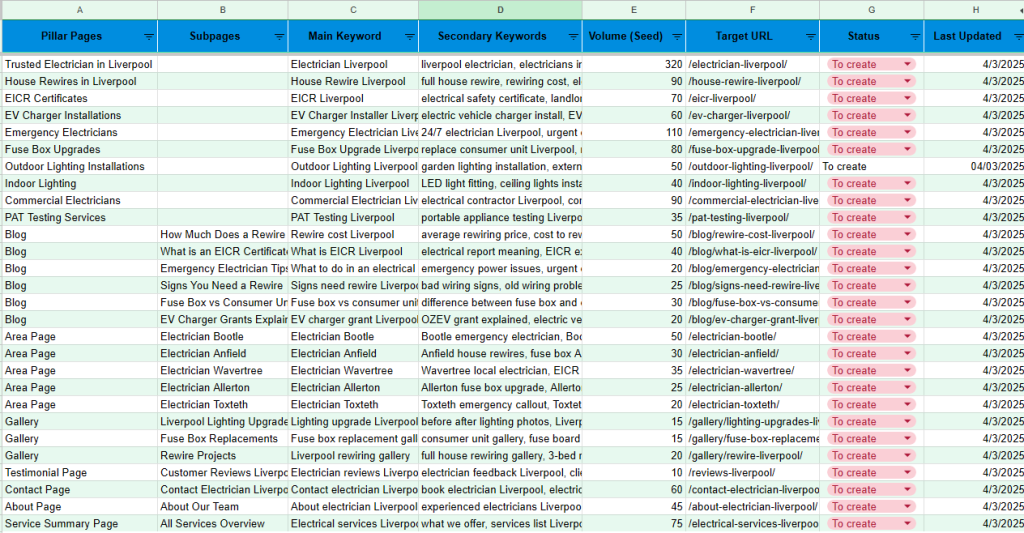
Fine, but does it actually help you rank?
Does keyword mapping help electricians rank on Google?
Yes, keyword mapping helps electricians rank on Google, because it gives every page one main keyword, so your pages stop competing with each other and Google can see which page answers which search. Google doesn't read your spreadsheet: it reads your pages, and the map is how you make sure each page is built for a different search. Electrician SEO Pro's rule is to map the keyword before writing the page.
Think of it like wiring a property. Run a load of cables without knowing what each one's connected to and you end up with a dangerous mess. Same with your site: a service page here, a blog post there, another "local electrician" page somewhere else, all aimed at the same keyword, and Google doesn't know which one to trust.
A proper keyword map makes things clearer:
- You know which keyword each page targets.
- You can see if you're overusing certain terms.
- You avoid pages competing with each other, which is keyword cannibalisation.
- You can plan content that builds on what's already working instead of duplicating it.
- You know exactly what to build next.
So when you've got a spare 30 minutes in your day, you know instantly where it should go.
First, what do you need in front of you?
What do electricians need before they start keyword mapping?
Before they start keyword mapping, electricians need three lists, the services they offer, the places they cover and the questions customers ask, plus keyword research to turn those lists into real search terms. A keyword map is only as good as the keywords in it. Electrician SEO Pro's advice is to finish the research first, then map, using a template so every map has the same columns.
Before you touch a single keyword tool, get the basics down:
- What you offer. Rewires, fuse box upgrades, EICRs, emergency callouts, EV charger installs.
- Where you want to rank. Wherever you work: Liverpool, Bootle, Wavertree, Anfield.
- What people ask you all the time. "How much does a rewire cost?", "Do landlords legally need an EICR?", "How long does a fuse box change take?"
Those questions matter as much as the services. They're the start of your blog content ideas and supporting pages, and they help you look like the go-to expert for everything electrical. And if you want a head start on the search terms themselves, my free electrical keywords list has 198 of them.
Then plug the lists into a keyword tool like Keyword Planner or Ubersuggest, or just start typing into Google and see what autocompletes. I walk through the whole method in keyword research for electricians. You're after real, local terms: "electrician Liverpool", "fuse box upgrade Liverpool", "EICR certificate cost Liverpool", "emergency electrician in Bootle". Don't worry if the volume looks small. It's the search intent that matters.
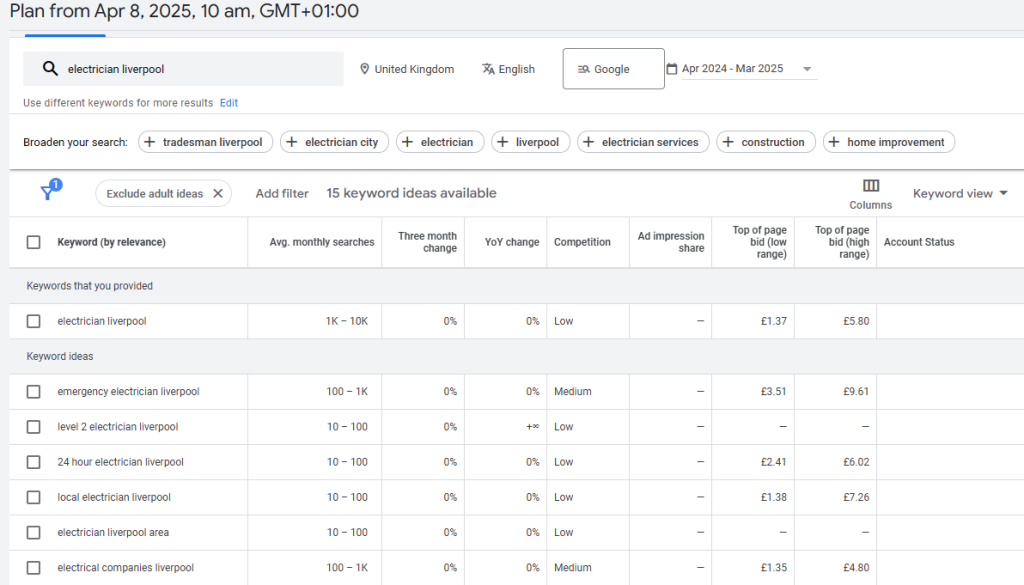
Now grab the template. Open my free keyword mapping template, click "Use Template" at the top right (you need to be signed in to Google) and a copy lands in your Google Drive. Rename it to whatever makes sense to you.
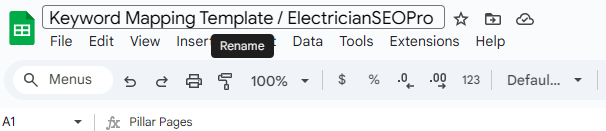
Template ready. Time to sort your keywords into groups.
How do electricians group keywords into clusters?
Electricians group keywords into clusters by choosing one pillar page for a service and place, then collecting the related keywords that belong around it as supporting pages or blog posts. A cluster for rewiring in Liverpool might have one main service page and several supporting pages, all linking back to it. Electrician SEO Pro's approach is to start with the pillar page that brings in leads, then build the supporting content around it.
You don't want ten pages fighting over the same keyword. You can cluster in the spreadsheet, or scribble it in a notepad first and move it across afterwards.
Start with a strong pillar page, like "Rewiring in Liverpool". Then build supporting content around it from your other related keywords:
- Blog post: "How Much Does Rewiring Cost in Liverpool?"
- Blog post: "5 Signs Your House Needs a Rewire"
- Related service page: "Trusted Electrician in Liverpool"
All of them link back to the pillar page. That structure shows Google which page is the main one on rewiring in the area, and how the rest support it.
Congrats, you've just clustered your first set of keywords. Now do the same for the rest. How pillar pages work in full is in my guide to content pillars for electrical websites.
Then every cluster goes into the map.
What should an electrician's keyword map include?
An electrician's keyword map should include one row for each page on the site, with columns for the pillar page, subpage, main keyword, secondary keywords, search volume, target URL, status and last updated date. Together they show what exists, what's missing and what to build next. Electrician SEO Pro's template uses exactly those columns, with the status set to To Create, To Optimise or Done.
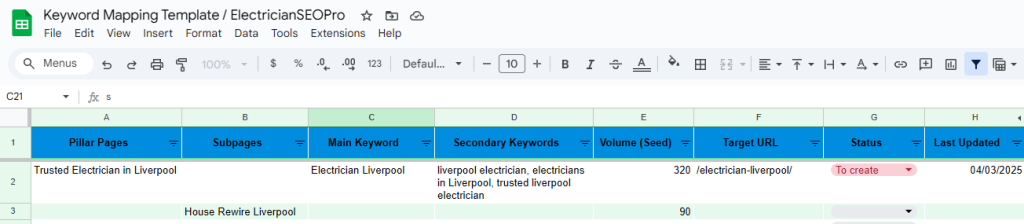
Each row is one page. The main keyword is the page's target, and the secondary column holds variations of it, not new topics. Status is the column I'd never skip: To Create, To Optimise or Done tells you at a glance what's next.
You might have spotted a column that looks like it breaks my own rule.
Can an electrician's page target more than one keyword?
An electrician's page can target more than one keyword, as long as it has one main keyword and the others are secondary keywords: variations, synonyms and related questions about the same topic, never new topics. In the template, "electrician Liverpool" is the main keyword for a page, while "Liverpool electrician" and "electricians in Liverpool" are secondary. Electrician SEO Pro's rule is one main keyword per page, with secondary keywords that are the same search in different words.
That sounds like it goes against my one-keyword-per-page rule. Hear me out.
Variations, synonyms and related questions help a page rank for more than one search, because they're all still about the same topic. "Electrician Liverpool", "Liverpool electrician" and "electricians in Liverpool" are one search worded three ways, so one page covers them. "How much does a rewire cost?" is a different topic, so it gets its own row.
Just don't overdo it.
Next, the reality check: what's already on your site?
How can an electrician check a keyword map for duplicate pages?
An electrician can check a keyword map for duplicate pages by going through every keyword and asking whether a page on the site already targets it. If one does and it fits the search intent, optimise it and assign the keyword in the map; if none exists, keep the keyword in the map as a page to create. Two pages aiming at the same keyword is keyword cannibalisation, and Electrician SEO Pro fixes it by merging them, redirecting the weaker page or giving one a different keyword.
This isn't about repeating what you've already mapped. It's a reality check on what's live. You might have a blog post, a half-finished service page or something buried in your navigation that already fits. That's fine: we're here to tidy up, not start again.
This is where most electrician websites fall apart. Picture five pages all accidentally aimed at "electrician in Liverpool" (made up), with Google unsure which one to trust. If you find two pages on the same keyword, pick a fix:
- Merge them into one solid page.
- Pick the stronger one and 301 redirect the weaker page to it.
- Reposition one of them to target a different keyword altogether.
The rule stays the same: one main keyword, one page. The full fix is in keyword cannibalisation for electricians.
Once the map is clean, it's time to put it to work.
How do electricians use a keyword map to plan new pages and content?
Electricians use a keyword map to plan new pages and content by prioritising the high-intent keywords with no page yet, scheduling a steady pace of new pages or posts, and handing the map to whoever builds or writes them. Service plus location keywords, such as "EV charger installation Liverpool", come first. Electrician SEO Pro treats the map as the content roadmap: every new service page, blog post or location page should start as a row in it.
A keyword map isn't just a spreadsheet. Used properly, it keeps guiding you for months, even years. Here's what to do with it:
- Prioritise by opportunity. Which high-intent keywords don't have a page yet? Start with the ones most likely to bring in leads.
- Schedule it. One or two pieces a week or a month, depending on your time. Consistency beats chaos.
- Delegate if you need to. Hand the map to a copywriter, an SEO or your web team and they know exactly what you want.
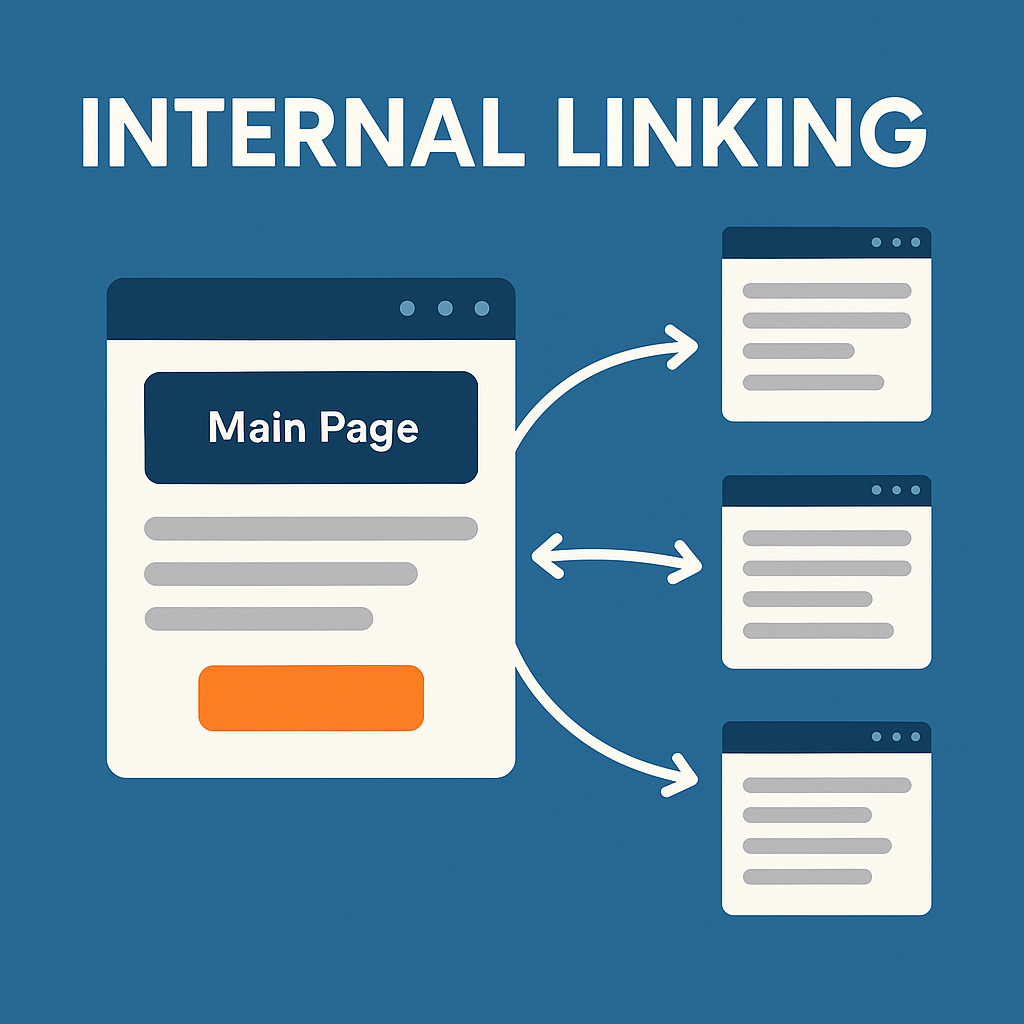
Mapping is also the best moment to plan your internal links. Every time you publish a new blog post, link out to three other pages on your site. Could your "House Rewire Cost" post link to your "Rewiring in Liverpool" page? Could your "Electrician in Bootle" page link to a "Why Get an EICR?" post? That's how the pages in a cluster back each other up.
No more guesswork. Just a map, and a plan to build it.
Want a hand with keyword mapping for your electrical business?
You can get a hand with keyword mapping for your electrical business from Electrician SEO Pro, as part of a full SEO service for electricians, or build the map yourself with the free template and an evening of keyword research. A good map covers every page you have and every page you plan. Either way, the rule stays the same: one main keyword per page, and every page with a job.
If you're doing it yourself, my on-page SEO guide for electricians covers what to do with each page once it's mapped. If you'd rather get on with the work than wrangle spreadsheets, I can take it off your hands, alongside the rest of your SEO.
See how I can help, or crack on yourself.
Over to you.