

An electrician should write a title tag that puts the service and the town first, adds one honest reason to choose them, and stays around 60 characters so Google doesn't cut it off. The title tag is a ranking signal and the headline people click, so it earns every word. Electrician SEO Pro's rule for electricians is one main keyword and one unique title per page, with the brand on the end only if it fits.
What is a title tag on an electrician's website?
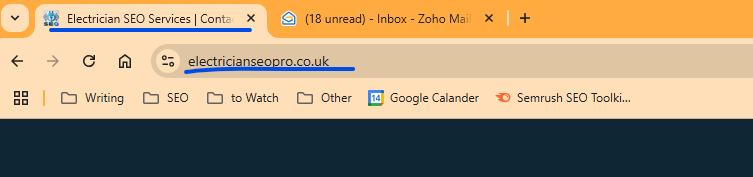
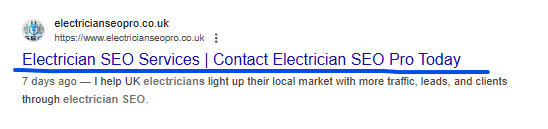
A title tag on an electrician's website is the HTML title of a page, set once per page in the page's head. It's the blue link in Google, the name on a browser tab, the label in a bookmark and, often, the headline when the page is shared on social media. Plugins like Yoast SEO let you set it without touching code. It's separate from the H1, which is the heading visitors see on the page itself.
Here's what it looks like in the code (made up). Don't worry about it, Yoast SEO handles it, and as long as there's one per page you'll be grand.
<head>
  <title>Emergency Electrician in Leeds | Smith Electrical</title>
</head>
It shows up in four places:
- Browser tabs. It helps a visitor work out which tab is yours when they've got twelve open.
- Bookmarks. Bookmark bars chop titles short, so short and snappy wins.
- Social shares. On Facebook and X, it's the headline in the preview.
- Google results. The one that matters. It's the big blue link above the meta description on the results page, and it's often your first and only chance to get the click. The difference between fully booked and tumbleweed.
It's only a few words, so does Google actually care what goes in it?
Is a title tag a ranking signal for electricians?
Yes, a title tag is a ranking signal for electricians, because it's one of the clearest clues Google has about what a page is about, which helps the page rank for the service and town in it. It's also the headline people choose from, so it works as your first sales pitch. Electrician SEO Pro rates the title tag as a genuine on-page signal for relevance: it can't make up for thin content, and stuffing it with keywords makes a page worse, not better.
You'll hear people say title tags don't matter any more. I don't buy it.
I've never written a title without the keyword in it, and I never plan to. Even if it only nudged things by 1%, typing your keyword into a title costs you nothing.
Now the honest bit. Content comes first. If the page is rubbish, a brilliant title just gets people to bounce faster. A title is the bare minimum, not the finish line: it works alongside great content and solid backlinks.
So what should it actually say?
What should an electrician's title tag say?
An electrician's title tag should say what the page is about in the words a customer would search, with the main keyword near the front, usually the service and the town, followed by a reason to click and the brand name if it fits. Electrician SEO Pro's rule is one main keyword per title, because trying to rank one page for several searches waters all of them down.
For a homepage or a local service page, the setup I use is:
Main keyword | reason to click | brand nameMade up, so you can see it working:
- Homepage: Electrician in Liverpool | Call Today | Smith Electrical
- Service page: Emergency Electrician in Leeds | 24/7 Callouts | Smith Electrical
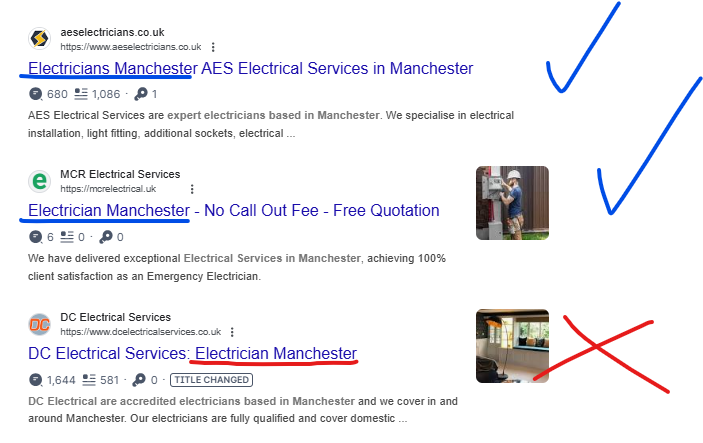
Homepage searchers are usually ready to ring, so tell them to. Put the keyword at the front so a searcher spots "yes, this is for me" at a glance. It doesn't have to be the very first word, just towards the front. In this search, two titles lead with the keyword and one buries it.
Blog posts are different. Be accurate, include your keyword and make it interesting, like a decent newspaper headline, but don't bait people just for the click. If the content disappoints they'll bounce. Starting with How, What, Why, When, Where or Who works well because it matches how people search (made up): "What Does an EICR Certificate Cover, and Do You Need One?"
Whatever the page, match what the searcher wants. My guide to search intent shows how to tell a ready-to-hire search from a still-learning one.
And how much of that fits before Google chops it?
How long should an electrician's title tag be?
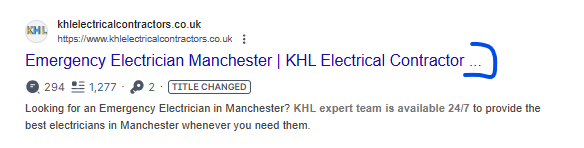
An electrician's title tag should be about 60 characters long, because Google cuts titles to fit the width of the screen and replaces the end with three dots. Google sets no character limit, so the cut-off depends on pixels, not characters: wide letters like M and W take up more room than I or J. Electrician SEO Pro's rule is to put the keyword and the town at the front, so the important part survives if the end gets chopped.
The 60-character rule is a bit of a fib, really. The usual rule of thumb is about 600 pixels. Here's a title getting the chop, brand name and all:
If yours runs long:
- Go easy on capitals. They take up more room than lowercase letters.
- Cut punctuation you don't need.
- Remove repeated words. Say it once.
Yoast SEO shows a title width bar as you type, and SERP preview tools (Mangools has one) show you exactly where the cut falls.
Even a title that fits isn't safe, though, because Google sometimes swaps it.
Does Google rewrite an electrician's title tag?
Yes, Google sometimes rewrites an electrician's title tag in the search results, using the page's headings and other text instead of the title you wrote. It tends to happen when a title is half-empty, boilerplate, out of date or doesn't describe the page. Electrician SEO Pro writes each title so it describes its own page honestly, which gives Google less reason to change it.
Google's own guidance on title links says the title you see is generated automatically and can draw on your headings and other on-page text, not just the title tag. It also asks for distinct text on every page, and for you not to repeat the same words.
I'll be honest: it winds me up when Google changes a title I've carefully written. But most of the reasons are fair. A title that describes the page leaves Google nothing to fix.
It's also why every page needs its own title tag. The same title on ten service pages means ten identical-looking results, and a customer can't tell which to click. If you've got similar pages for good reason, whip out a thesaurus and make each one say something different.
Rewrites aside, what actually makes someone pick your link?
How can electricians get more clicks from a title tag?
Electricians can get more clicks from a title tag by matching the search exactly, putting the keyword near the front and adding one believable reason to choose them, such as same-day callouts or a free quote. Electrician SEO Pro's rule is to treat the title tag like a headline, because it's often the only part of the page a customer reads before deciding.
Your ranking gets you seen. Your title gets you clicked. Here's a plain title, then a mock-up of a better one:


What I reach for:
- Power words that are true. Same-Day, Fast, Vetted, Certified and Expert all work. But "Guaranteed" needs a guarantee, and "No Call-Out Fee" needs no call-out fee.
- Speed. People searching for an electrician often needed one yesterday, so same-day, 24/7 and quick response times stand out.
- A touch of curiosity. Not clickbait. Overdo it and you look unreliable, and shouting "MUST READ" just looks spammy.
What I'd avoid:
- Keyword stuffing. "Electrician Manchester | Manchester Electricians | Emergency Electrician Manchester" reads like a robot wrote it. Google doesn't need telling what the page is about, and customers get bored by the third repeat.
- Emojis and special characters. You can use them. I wouldn't. They can look spammy or loud, and you end up sounding more like a clickbait TikToker than a serious electrician. I suspect Google strips them or rewrites the title, though I can't prove it.
Next question: should the title and the page heading say the same thing?
Should an electrician's title tag and H1 be the same?
An electrician's title tag and H1 can be the same, but they don't have to be, and they do different jobs. The title tag is the headline in Google, so it can carry a reason to click, while the H1 is the heading on the page, so it can simply say what the page is about. Electrician SEO Pro's rule is to keep both on the same topic and the same keyword, so nothing feels different when a customer clicks through.
I like both to include the keyword. My title tag has a bit of click-through design to it, and my H1 just tells the visitor exactly what they're getting. By the time they see the H1 they're already on the site, so they don't need the extra nudge.
Here's how the first version of this very article did it. First the title in Google:
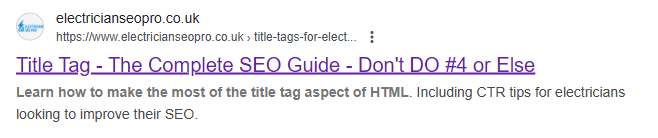
Then the heading on the page:

Same topic, same keyword, different jobs. There's more on the heading side in my guide to header tags for electricians.
Then there's the brand name, which doesn't always earn its place.
Should an electrician put their business name in the title tag?
An electrician should put their business name in the title tag on the homepage and service pages, and leave it out of blog post titles when space is tight. A familiar name gets clicked, because customers who've spotted your van or your team will recognise it in the results. Electrician SEO Pro's rule is that the keyword wins the space first, and the brand goes on the end only if it fits.
People have seen your van or your team around, so even a slight familiarity makes them more likely to pick you over a stranger.
Blog readers are different. They don't know you yet and, honestly, they don't care. They want an answer. For a long-tail blog post, getting the keyword in is worth far more than your name.
You'll notice this article's title tag has my brand on the end. It fits, so it's in. If it hadn't, the question would have won.
Last one: how often should you touch a title once it's live?
How often should an electrician update their title tags?
An electrician should update their title tags only when there's a clear reason, such as a page that ranks well but gets few clicks, or a year in the title that's gone out of date, not on a fixed timetable. Electrician SEO Pro's approach is to change one title at a time and leave it three to four weeks before judging the result.
In an ideal world I'd be testing titles constantly. In reality most electricians have far more valuable jobs, so tweak when there's a reason. If you've got the year in your title and H1, like I do on some posts, go back each year, update it and refresh the page too.
When there is a reason, here's the process:
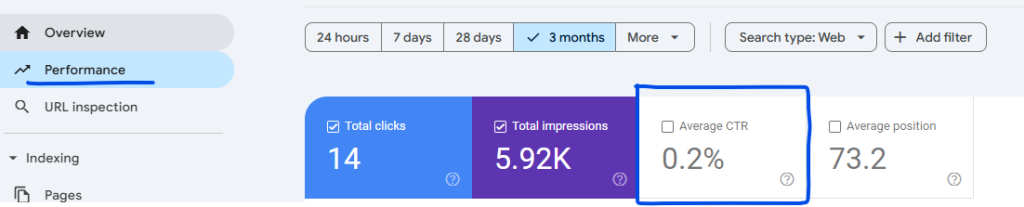
- In Search Console, open Performance and look for pages that rank well but get few clicks.
- Write a handful of variations, with different power words, calls to action and urgency.
- Swap the best one into the title tag.
- Note the date you changed it somewhere you'll find again.
- Leave it three to four weeks, then compare.
Check the position before you blame the title. In this screenshot the average position is 73.2, so a low click-through rate there is mostly a rankings problem, not a title problem.
Write a good one, check it now and then, and get on with the real work.
Want a hand with your electrician title tags?
You can get a hand with your electrician title tags from Electrician SEO Pro, as part of a full SEO service for your electrical business, or work through your own pages one at a time with Search Console and a spare evening. Title tags are only one part of on-page SEO; headings, descriptions, content and internal links matter just as much. Whichever route you take, the rule stays the same: one main keyword and one unique title per page.
If you've got the time, everything you need is in my free on-page SEO guide for electricians. If you'd rather spend your evenings quoting jobs than counting characters, I can take it off your hands, alongside the rest of your SEO.
See how I can help, or crack on yourself.
Over to you.