Google understands what an electrician's website means by using language AI such as BERT and neural matching, so it can match a page to what a customer is asking and not just the words they typed. That's NLP, and Google does use it in ranking. For electricians it comes down to one thing: write each page the way you'd explain the job to a customer, with the service and town said naturally. Electrician SEO Pro's rule is that clear and complete beats clever and repeated.
What does NLP mean for an electrician's website?
NLP, or natural language processing, is the kind of AI that helps Google understand what words mean, and for an electrician's website it means a page is read for meaning, not just matched on keywords. A customer searching "fuse box upgrade" can be shown a page that says "consumer unit replacement", because Google reads the idea behind both phrases. That's the point of NLP: it lets Google read like a person would.
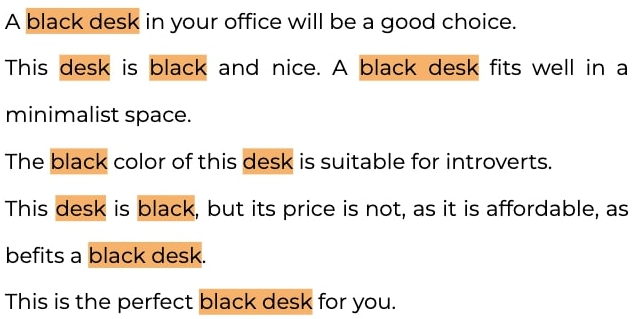
It wasn't always like this. Old search engines looked for exact matches. Type "electrician in Newcastle" and a page with that phrase twenty times might well have ranked. That's where keyword stuffing came from. Here's what it looks like (it's a desk, but swap in "electrician in Newcastle" and you've got the idea):
Today Google reads the whole page for meaning. That includes:
- Synonyms and variations. "Electrical contractor" instead of "electrician".
- Related phrases. "Fuse box upgrade" when someone searches "consumer unit replacement".
- The intent behind the sentence. "How much does rewiring cost?" is someone researching, not someone ready to book.
It also looks at the rest of your website and who links to it, but the writing is where you have the most control. NLP is why relevance beats repetition.
So Google reads meaning. Does that actually affect rankings?
Does Google use NLP to rank electricians' websites?
Yes, Google uses NLP in how it ranks electricians' websites: AI language systems such as BERT and neural matching help it work out what a search means and which pages answer it, so reading meaning is part of ranking, not a side feature. There's no NLP score to check and no tool that switches it on. Electrician SEO Pro's rule is to write clearly and completely about each job and let Google's systems do the reading.
Google lists these systems in its own guide to ranking systems. In plain English, RankBrain relates words to concepts, so Google can return relevant pages even without exact keyword matches. Neural matching connects the ideas in a search to the ideas on a page. BERT helps Google understand how combinations of words change the meaning.
NLP isn't a magic wand and it isn't a secret weapon. It's Google getting better at reading. That's good news if you write like a human, and bad news if you've been counting keywords.
So what is Google actually picking up when it reads your page?
How does Google work out what an electrician's page is about?
Google works out what an electrician's page is about by reading the whole page for meaning: how completely it covers the job, the words that normally go with that job, the things it mentions, and whether it matches what the searcher wants. Electrician SEO Pro breaks that into four things to get right: topic coverage, related terms, the things mentioned, and intent.
Here's what each looks like on an electrician's page:
- Topic coverage. If a page is about fuse box upgrades, Google expects to see related points like regulations, safety checks, consumer unit types and how long the job takes. The more useful and complete the page feels, the more confident Google can be about showing it.
- Related terms. A page about EICRs would naturally include words like "landlord", "tenant", "certificate", "electrical safety" and "every five years". If it sounds like someone in the know wrote it (you), that's a good sign.
- Things mentioned. Electrician, fuse box, inspection, house, UK electrical regulations. Clear "things" help Google see that a page is about electrical safety in a UK home. Links between related pages on your own site, placed in context, help join the dots. Internal linking for electricians covers how.
- Intent. Is this the right type of page for this search? If someone searches "how much does an EICR cost" and your page is a list of services with no prices, it won't help them. Search intent for electrical websites goes deeper.
Don't read that as a checklist of words to add. Write the page properly and most of them turn up on their own.
That's also why one page can show up for more than one search.
Can one page on an electrician's website rank for lots of related searches?
Yes, one page on an electrician's website can rank for lots of related searches, because Google matches pages to the meaning of a search, not only the exact words. A well-written page about one job can pick up searches that phrase it differently, ask a related question or use another name for the same thing. How many it picks up depends on how well the page covers the topic.
Say you've got a page about consumer unit upgrades. It might also show up for searches like these (all made up):
- "fuse box replacement"
- "is my fuse box legal?"
- "how to upgrade electrics in an old house"
- "does my home need rewiring?"
Here's a list of searches one of my own pages shows up for. None of them is the same phrase twice:
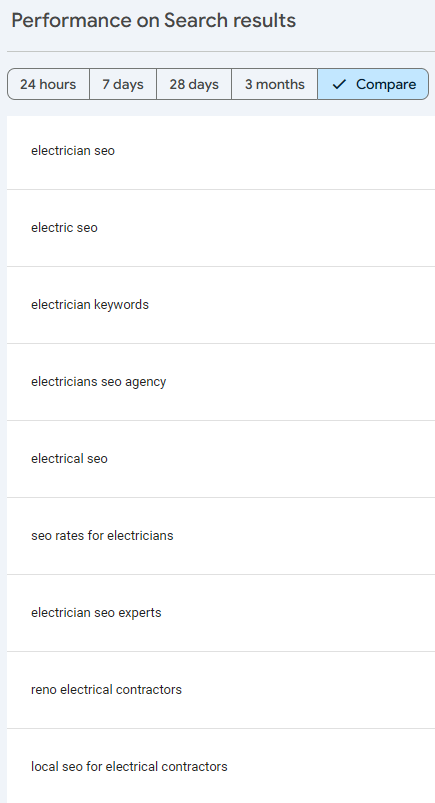
Cover the topic properly and you'll often be found for more than you aimed at. No promises on which searches, or how high.
So how should an electrician write to take advantage of that?
How should electricians write so Google understands their pages?
Electricians should write their pages the way they'd explain the job to a customer, because plain, complete wording is what Google understands best. That means everyday language, the words customers use, real answers to real questions, a clear structure, and the service and town said naturally. Electrician SEO Pro's rule is to write for the customer first and check the keywords afterwards.
You don't need to be a data scientist, and you don't need to write like a robot. Here's the version I'd follow:
- Write like you're talking to a customer. If you were explaining an EICR or a fuse box upgrade to someone in their kitchen, how would you say it? That's your voice. Drop the jargon, skip the waffle and keep it real.
- Use related terms naturally. On an EV charger page, words like "home charging", "Zappi", "off-street parking" and "installation cost" turn up if you cover the topic properly. Don't hammer "EV charger installation" fifty times. My test: if I was looking for an answer to this, what would I want to see?
- Answer questions people actually ask. "How long does an EICR take?" and "Is it illegal to do electrical work yourself?" are the sort of thing customers type. Build the questions your customers ask you into your service pages and blog posts, with a straight answer under each one.
- Structure it well. Clear H2s and H3s, tight paragraphs, bullets where they help. Not for an algorithm, but because real people hate walls of text. Header tags for electricians covers the structure.
- Blend service and location naturally. Nobody wants to read the same town three times in a sentence.
Here's the difference (both made up):
- Bad: "We are the best electrician in Durham offering Durham fuse box upgrades in Durham."
- Better: "We carry out fuse box upgrades across Durham, Chester-le-Street and the surrounding areas."
The second one is clean, clear and relevant. It tells Google where you work and what you do.
Which raises the obvious question: are keywords even needed now?
Does an electrician still need keywords if Google understands meaning?
Yes, an electrician still needs keywords, because the words on a page tell Google and customers what you do and where, even though Google understands meaning and doesn't need them repeated. Put the service and the town where they naturally belong, such as in the title, the H1 and the opening paragraph, and let the rest of the page do the explaining.
Keywords haven't gone away. "Electrician", "fuse box upgrade" and "Durham" are still the plain words that tell a customer and Google what you offer. What's gone is the idea that repeating them wins. If you're still stuffing the same keyword in twenty times, plus variations, you're making the page worse for the person you want to read it.
Where those words go is covered in keyword placement for electricians, and how to choose them is in keyword research for electricians.
So can an electrician forget the rest of SEO?
Can an electrician ignore the SEO basics because of NLP?
No, an electrician can't ignore the SEO basics because of NLP, because language understanding only helps Google read a page it can already find, load and trust. Title tags, page structure, site speed, a mobile-friendly layout and internal links all still matter. Electrician SEO Pro's view is that NLP rewards good basics rather than replacing them.
Not even close. NLP isn't a magic wand. You still need to nail the basics:
- Your title tag still matters. It's the headline that gets the click. See title tags for electricians.
- Your page structure still matters. Google reads top to bottom and humans scan fast.
- Your site speed still matters. No one waits for a slow electrician, or a slow website.
- Your mobile experience still matters. Plenty of customers search for an electrician on their phone. Mobile optimisation for electrical websites has the checks.
- Your internal links still matter. They tell Google which pages on your site are important.
Focus on quality first and let Google's language skills handle the rest. Be clear. Be helpful. That's basically it.
Want a hand with the words on your electrician website?
You can get a hand with the words on your electrician website from Electrician SEO Pro, as part of a full SEO service for your electrical business, or rewrite your pages yourself using the kitchen test. A page-by-page review checks that each one says what the job is, where you do it and what the customer needs to know. Either way, the aim is the same: pages written for people that Google can read without effort.
If you've got the time, everything you need is in my free on-page SEO guide for electricians. If you'd rather spend your evenings pricing jobs than polishing paragraphs, I can take it off your hands, alongside the rest of your SEO.
See how I can help, or crack on yourself.
Over to you.