SERPs, short for search engine results pages, are the pages Google shows when someone searches, and for electricians they usually hold ads, the map pack and organic listings, plus answer boxes such as AI Overviews. Knowing what's on the SERP for your keyword tells you what Google thinks customers want. Electrician SEO Pro's rule is to look at the SERP before writing the page, so the page matches what's already working.
What does a SERP look like when someone searches for an electrician?
When someone searches for an electrician, the SERP looks like a stack of ads at the top, the map pack with three local businesses, then organic listings, with answer boxes such as AI Overviews or People Also Ask added on some searches. A local search shows the map pack, while a how-to question brings more answer boxes. Electrician SEO Pro treats each part as a separate place to be found.
Type "emergency electrician in Manchester" into Google and that page of results is the SERP. It's where the fight for attention, clicks and leads happens.
It's not just ten blue links and done any more. Today's SERP is packed with features, and each one is a chance for your electrical business to get the click. If Google doesn't show you on it, customers won't see you either. That's where SEO earns its keep.
Let's go through the parts one at a time, starting with the bit you pay for.
Are the ads at the top of the SERP worth it for electricians?
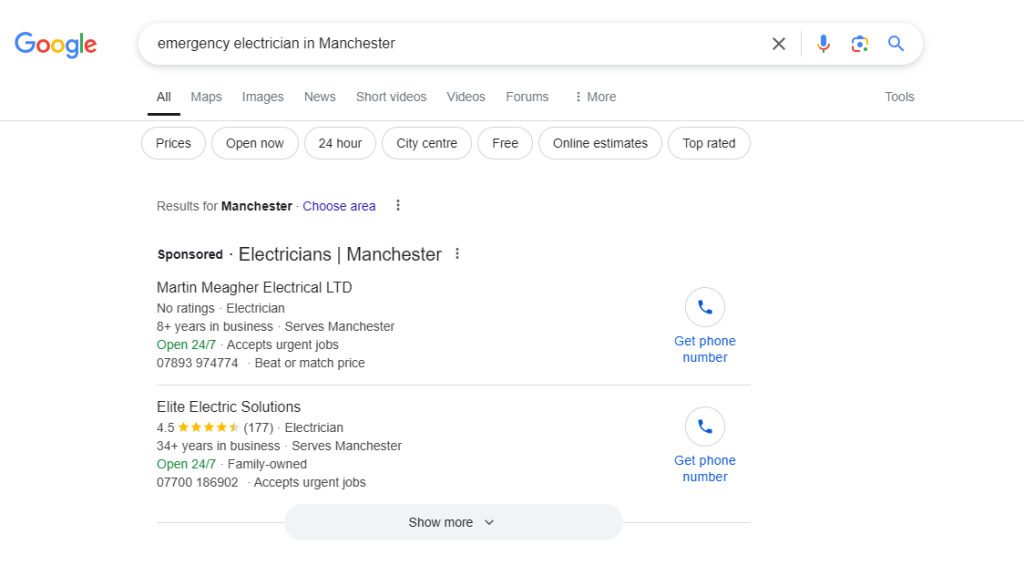
The ads at the top of the SERP are worth it for electricians who want calls this week and can pay for every click, but they stop the moment the budget does. They're marked Sponsored, and on local searches they can appear as listings with a call button. Electrician SEO Pro treats ads as a short-term lead tool and SEO as the long-term one.
Here's how it works. You tell Google you'll pay whenever someone clicks your ad for something like "rewiring service Sheffield". If the ad and the landing page both deliver, you can be taking calls the same day. As long as you keep handing over cash.
The catch is that you pay for every click, whether they book or bounce. Brilliant for quick wins, less brilliant as a long-term plan. I compare the two properly in Google Ads vs SEO for electricians.
Under the ads comes the box local electricians fight over.
How does an electrician get into the map pack?
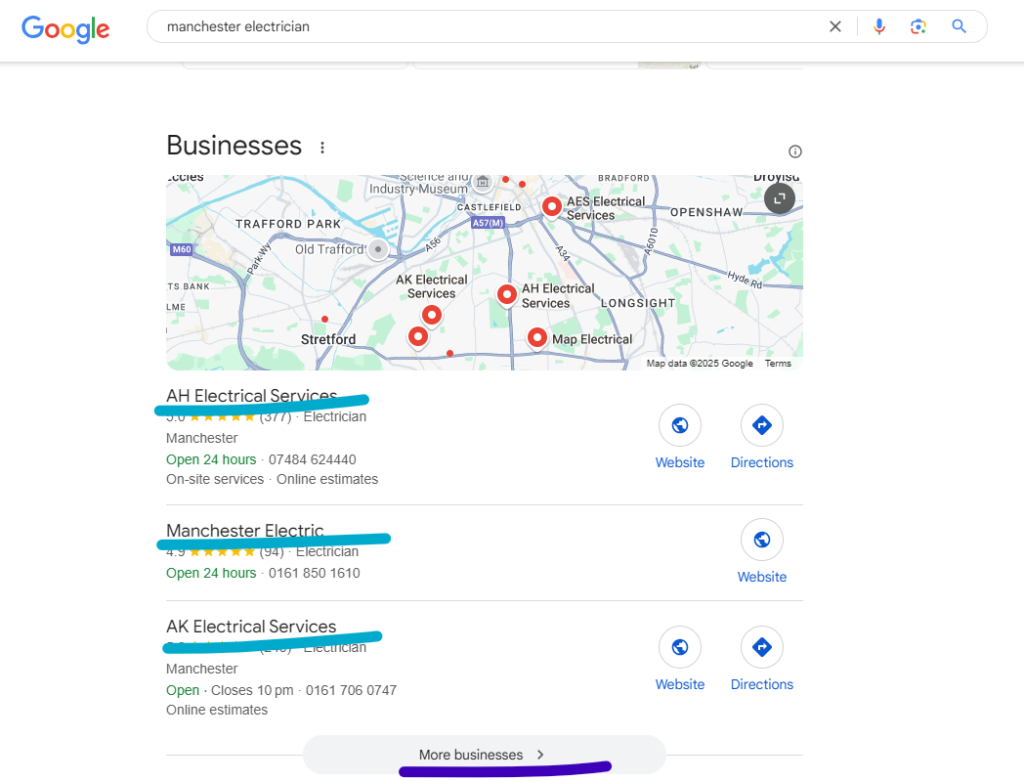
An electrician gets into the map pack with a fully filled-in Google Business Profile, backed by a website that supports it with local keywords, matching name, address and phone details and good internal links. The map pack is the box of three local businesses with names, ratings and a call button. Electrician SEO Pro's view is that it's the most valuable spot on the SERP for a local electrician.
A fully filled-in profile means accurate categories, services, opening hours, service areas, photos and reviews. Gather those reviews like your business depends on it, because it does.
I've worked on a lot of local campaigns, and I can tell you the number one player for getting a business more leads, by far, is the Google Business Profile that appears in this box. Even a website optimised just as well never pulls the same kind of leads, because it simply doesn't appear as high.
Your website still has a job: backing the profile up. That means local keywords, an embedded map, NAP consistency and good internal linking. If you haven't built your profile yet, start with my Google Business Profile guide for electricians.
Anyone outside the top three is hidden behind a More businesses button.
Then come the listings most people picture when they think of Google.
How does an electrician's website rank in the organic listings?
An electrician's website ranks in the organic listings when its page matches what the searcher wants, its on-page SEO is solid and it's a better option than the pages already there. Organic listings are the standard blue links, with no ads, no map pins and no payment per click. Electrician SEO Pro's rule is to match the search first and polish the page second.
This is where your homepage, service pages, location pages and blog posts should be showing up. And if you rank here, you're not paying a penny for those clicks, unlike Google Ads.
You'll only earn the spot if three things are firing:
- Your content matches the search. My guide to search intent shows how to read what people actually want.
- Your on-page SEO is solid. That means smart internal linking, strong titles and descriptions, and content built around the keyword. It's all in my on-page SEO guide.
- You're the better option. You're up against spammy competitors, so your edge is relevance, trust and getting the technical side right.
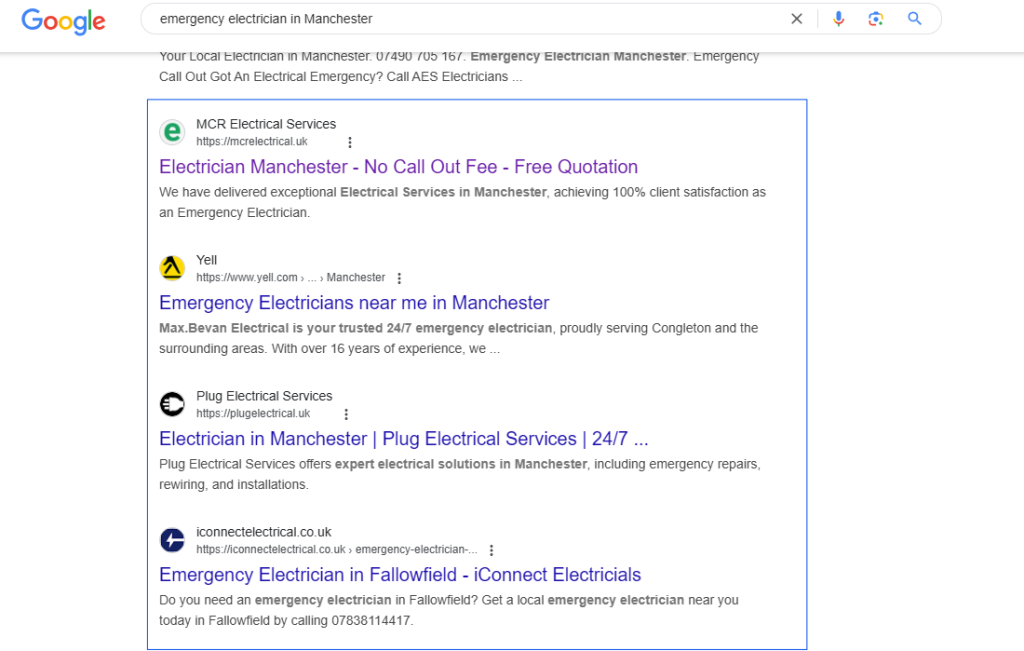
If you're ranking here, you're not just visible, you're credible.
Next up are the answer boxes that sit above all of it.
How can electricians get quoted in featured snippets and AI Overviews?
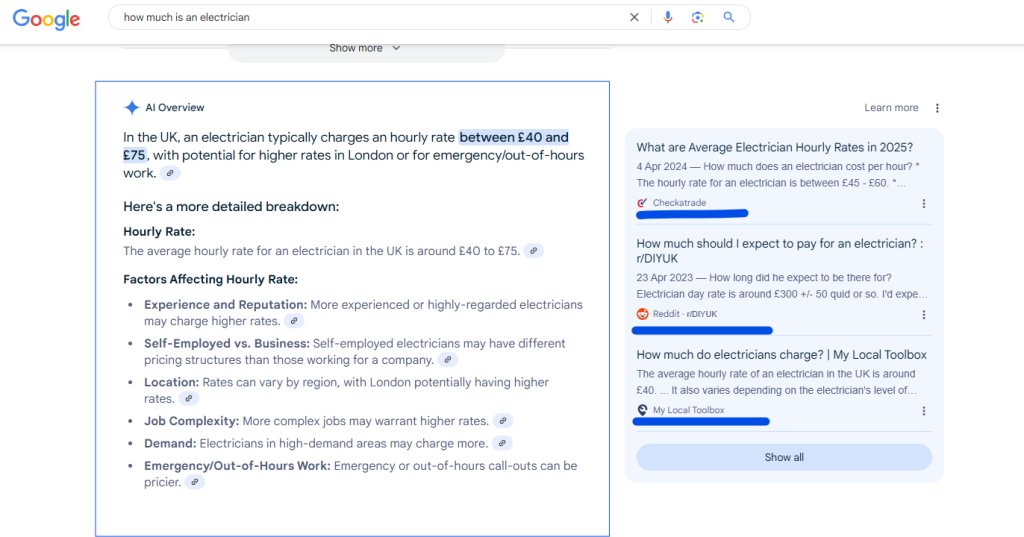
Electricians can get quoted in featured snippets and AI Overviews by answering a question directly, in plain words, near the top of a page built around that question. A featured snippet is a boxed answer at the top of the results, and an AI Overview is an AI-written summary that links to its sources. Electrician SEO Pro's approach is a heading that asks the question and a short, complete answer straight underneath.
Answer questions directly in your blog content, especially "what is", "how to" and "cost of" searches. For featured snippets, clear formatting helps: numbered steps, bullet points, a direct answer high up, and content that matches the question.
Google's own guidance on AI features says there's nothing extra to add: no special markup, no special files and no special optimisation, just a page that's indexed and eligible to show with a snippet. So I wouldn't lose sleep over schema for this. I'd keep the basics tidy: real reviews, up-to-date information and a named author.
Nobody can promise you a spot. An AI Overview pulls from several sources and gives people a ready-made answer, so there's even less need to click through. The aim is to be one of the sources. In my view, AI Overviews have been taking over from featured snippets, which is one more reason to write answers that stand on their own.
There are two more boxes worth a look.
Should electricians care about People Also Ask and video results?
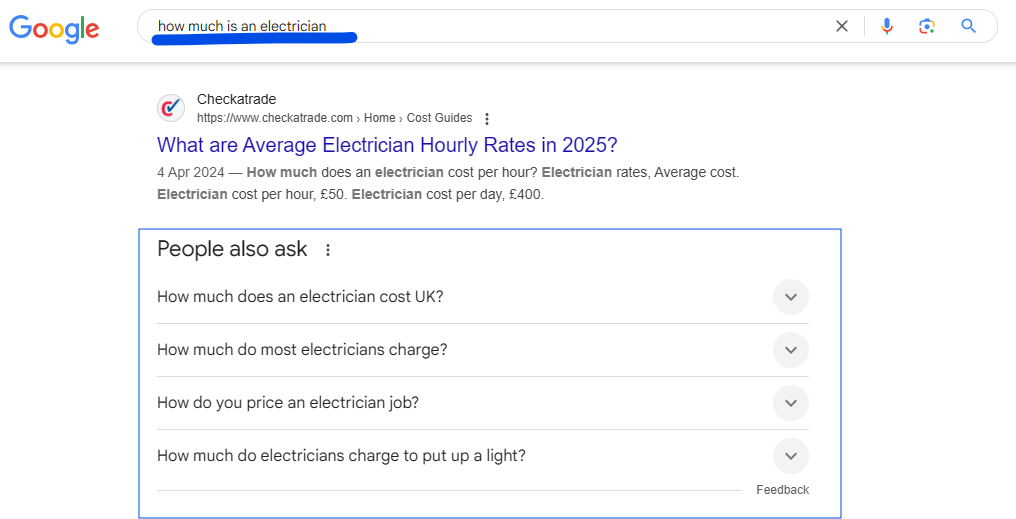
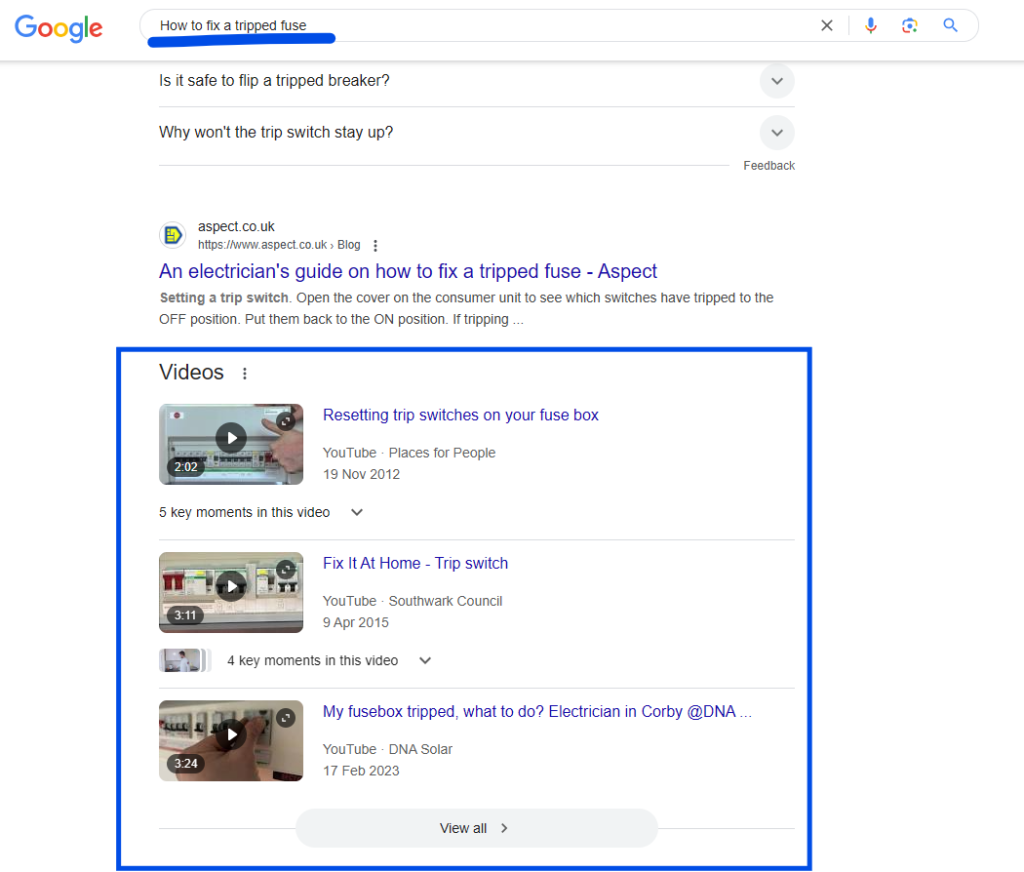
Electricians should care about People Also Ask, because it shows the exact questions customers type, and about video results only when Google shows a video for their keyword. People Also Ask boxes are dropdown questions under a result, and each click brings up more. Videos appear on how-to searches, such as how to fix a tripped fuse, not on searches like emergency electrician near me. Electrician SEO Pro reads People Also Ask as a free list of what customers are asking.
People Also Ask is free exposure and a free list of what your customers want to know. Google literally hands you the questions. Click one and more keep appearing, a bit like whack-a-mole.
Most of your competition won't bother, because a lot of the suggestions may not be backed by keyword data. But from my SEO experience, if Google is telling you people are searching for something, write the content and forget what the data says, in this case.
Videos are fussier. You won't see them for "consumer unit installer in York", but you will for "how to fix a tripped fuse" or "what's involved in an EV charger installation?". If you're writing helpful content and YouTube videos are on the SERP for your keyword, make one too, and give it a clear title and description. It's a second way to show up.
So how do you read the whole page before you write anything?
How should an electrician analyse the SERP before writing a page?
An electrician should analyse the SERP before writing a page by searching the target keyword in Google and noting what's already ranking on page one, which features appear and whether the tone is helpful or hard-sell. It takes about five minutes and needs no tools. Whatever Google is showing is what it thinks searchers want, and Electrician SEO Pro's rule is to give them that, only better.
Here's the five-minute version:
- Type your target keyword into Google. Search the way your customer would, because results change with where and how people search.
- Look at what's ranking on page one.
- Ask yourself: are these blog posts, location pages or directory listings? Is there a map pack? Any featured snippet or AI Overview? Is the tone helpful or hard-sell? Are your competitors there?
Here's a worked example with "ev charger install cost uk". You get ads, an AI Overview, People Also Ask and organic listings.
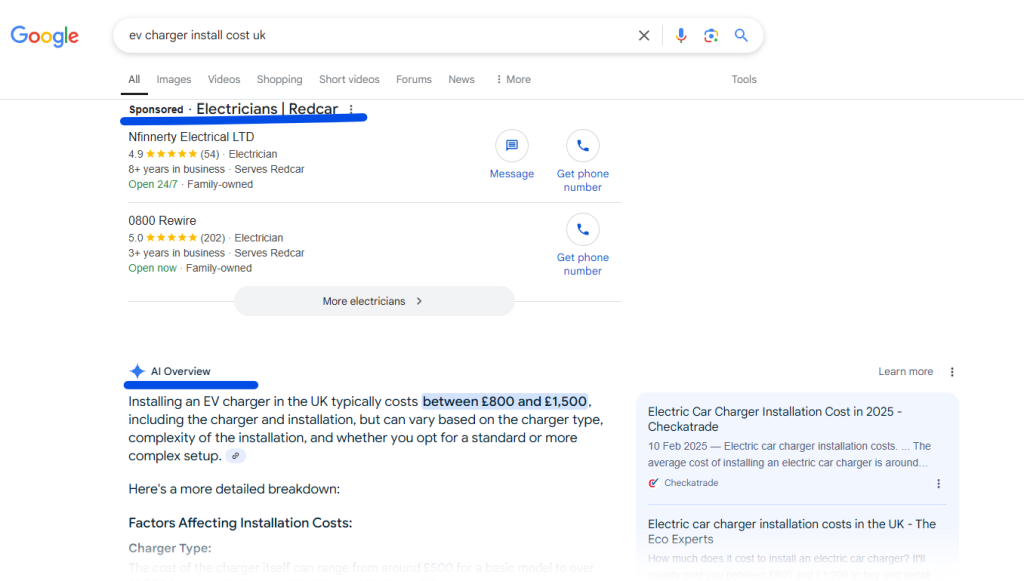
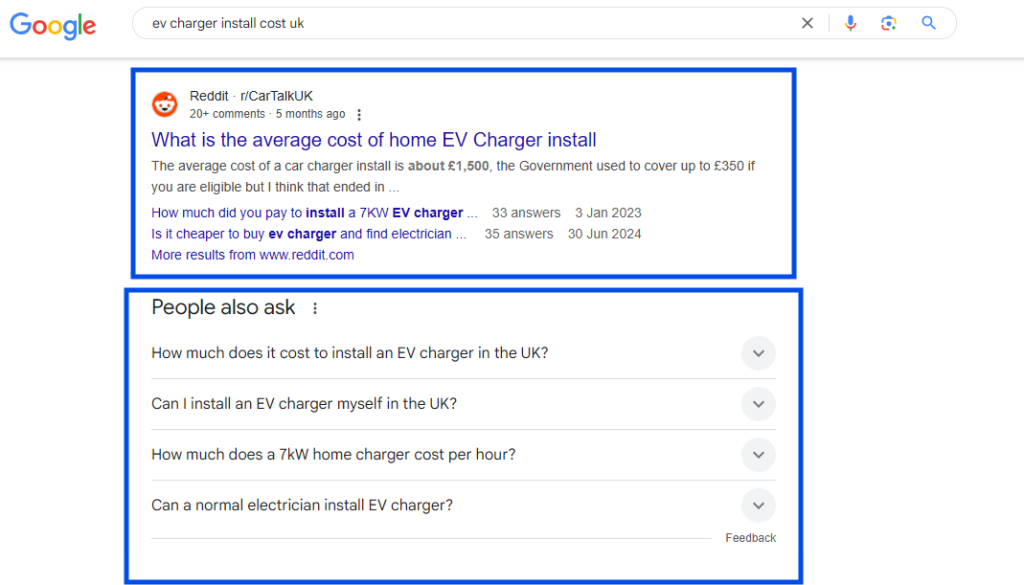
My reading: Google has decided this is an informational search. People want to learn, not buy. So write a post like "How Much Does It Cost to Install an EV Charger in the UK?" and answer some of the People Also Ask questions in an FAQ section on the page. Run ads too if you really want to dominate. My guide to search intent covers how to read this.
No guesswork, just giving Google what it already likes, done better.
One more thing: which of these features can you ignore?
Which SERP features can electricians ignore?
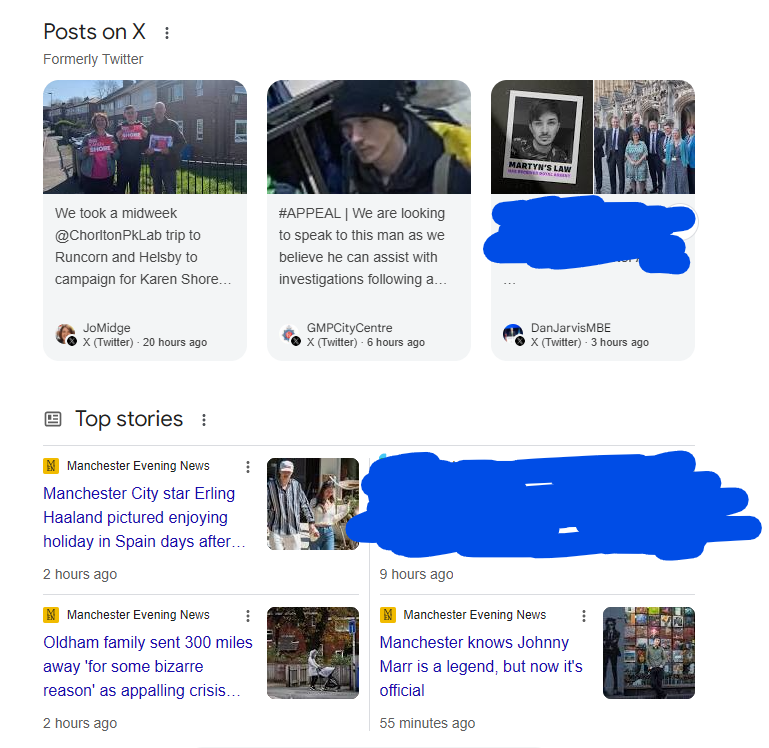
Electricians can usually ignore news boxes, social media posts, shopping listings and job panels on the SERP, because those features show up for national brands, trending topics and products, not for searches like fuse box upgrade in York. Discussion results such as Reddit threads are the one to keep an eye on, because they can appear on cost questions. Electrician SEO Pro's rule is to spend time only on the features that show up for the keywords you're targeting.
For a search like "fuse box upgrade in York", you're never going to be competing with BBC News. So while it's good to know they exist, these aren't worth your time:
- Top Stories and news boxes
- Social results, mostly X
- Shopping and product listings
- Jobs panels
The one I'd watch is discussions and forums. A Reddit thread sat in the organic results for "ev charger install cost uk". You can't optimise a Reddit thread, but it's a clue that the search is informational.
Here's what the features look like. I've scribbled over the grimmest headlines, you're welcome.
Want a hand getting your electrician website found on the SERPs?
You can get a hand getting your electrician website found on the SERPs from Electrician SEO Pro, as part of a full SEO service for your electrical business, or check the SERPs yourself with a five-minute search for each keyword you care about. Reading the SERP is the first step in deciding what to write; the page itself still has to be the better answer. Whichever route you take, the rule stays the same: look at the SERP first.
If you've got the time, everything you need is in my free SEO for electricians guide. If you'd rather spend your evenings quoting jobs than squinting at Google, I can take it off your hands, alongside the rest of your SEO.
See how I can help, or crack on yourself.
Over to you.