

Yes, internal linking matters for an electrician's website: links between your own pages are how Google finds them and judges which matter most, and how a customer gets from a blog post to the service page that wins the job. Internal linking is a ranking signal. Electrician SEO Pro's rule is to link every page towards the service pages that bring in work, with descriptive anchor text, and to add those links as you publish.
What is internal linking on an electrician's website?
Internal linking on an electrician's website means connecting the pages of the site to each other with clickable links, so customers and Google can move from one page to the next. A homepage that links to an emergency electrician page, which links on to the towns you cover, is internal linking. Each link tells Google that two pages are related, and gives customers a next step.
Here's the simple version. Your homepage links to your "emergency electrician services" page, guiding visitors (and Google) deeper into the site. That page links to the service areas where you provide it. And so on. It's about giving the reader more context.
From an SEO point of view, Google gets to grips with what your website is about much more easily when it's linked up properly. Internal links also pass on what SEO folk call link juice: a bit of strength handed from one page to another.
So is that a ranking signal, or just good manners?
Is internal linking a ranking signal for electricians?
Yes, internal linking is a ranking signal for electricians, because Google uses the links between your own pages to find them, understand what they cover and judge which ones matter most. Electrician SEO Pro rates it as one of the cheapest on-page wins: it's free and fully in your control. The limits are real, though. Internal links won't rescue a thin page, and Google can only follow a standard HTML link, not a button that runs a script.
Google's link best practices say every page you care about should have a link from at least one other page on your site, and that Google can only crawl a link that's a proper HTML link with an href.
Not all pages have equal power. Your homepage usually gets the most backlinks and attention, so use it to give other key pages a boost. Linking from stronger pages to newer ones, like a new service page or a blog post, spreads that strength around without relying on more backlinks.
Here's the bit that catches people out (made up). Your "Emergency Electrician" page is linked once from the whole site. Your blog post on changing a plug is linked twenty times. Google might reasonably decide the blog post matters more. Make sure the page you link to most is a page that earns you money.
Which pages should that be?
What pages should an electrician link to most often?
An electrician should link to their service pages and local landing pages most often, because those are the pages that bring in jobs. Electrician SEO Pro calls them money pages: core services such as rewiring, fuse board upgrades and emergency electrician work, plus the pages for the towns you cover. Every internal link you build should push some attention towards them.
Not every page on your site needs to rank. Focus on the ones that bring in the jobs, or you're just wasting your time.
Here's what a simple structure looks like (made up):
- Homepage to Electrical Services.
- Electrical Services to Rewiring, then on to Rewiring in Leeds.
- Blog post to Rewiring Services.
That's how you give your key pages a boost without relying on external backlinks. If you're building the town pages themselves, my service page blueprint for electricians walks through it.
Now, what kinds of links are there?
What types of internal links should an electrician use?
An electrician should use four types of internal links: contextual links inside the text, navigation links in the menu and footer, related-post links on blogs, and call-to-action links that lead to a contact or booking page. Electrician SEO Pro rates contextual links as the most valuable of the four, because they sit in the text where a customer is already reading about the topic. The other three support them.
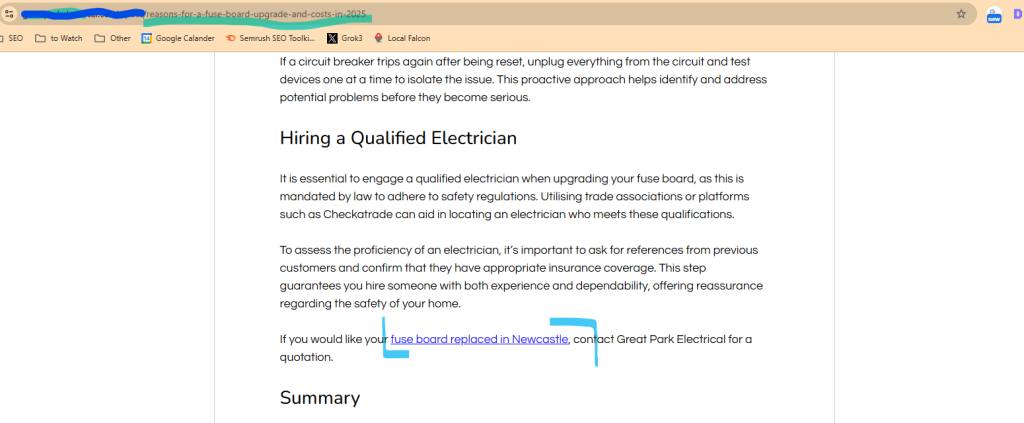
Contextual links. These sit naturally inside a paragraph, a sentence or a service description. On your Fuse Box Upgrade page, you might write "We always recommend a full electrical inspection before upgrading an old fuse board", with "electrical inspection" as the link to your inspection service. It builds relevance and helps the customer in one move. Someone reading "Why Are My Lights Flickering?" who hits a link to your house rewiring page is now on a page built to convert (made up). It's not just SEO. It's smart sales flow.
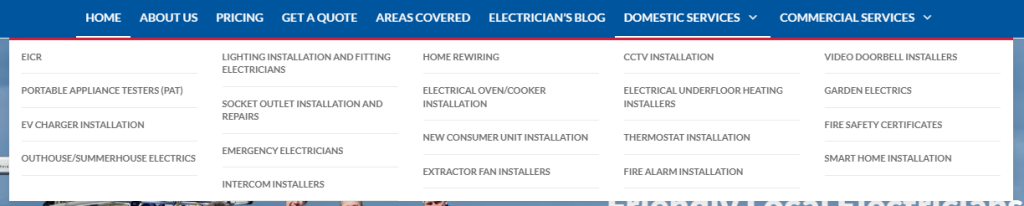
Navigation links. These are your menus, sidebar and footer. Don't overdo them. Cluttering the menu with every service and town dilutes the impact, and flood it with hundreds of links and people just bounce. Limit your top menu to 4 to 6 key services, and use the footer for location pages, contact details and trust pages such as accreditations or reviews. Think of them as the site's backbone, not a dumping ground. Breadcrumbs are navigation links too, and I cover them in my breadcrumb guide for electricians. Here's one that's not the worst I've seen, but still cluttered:
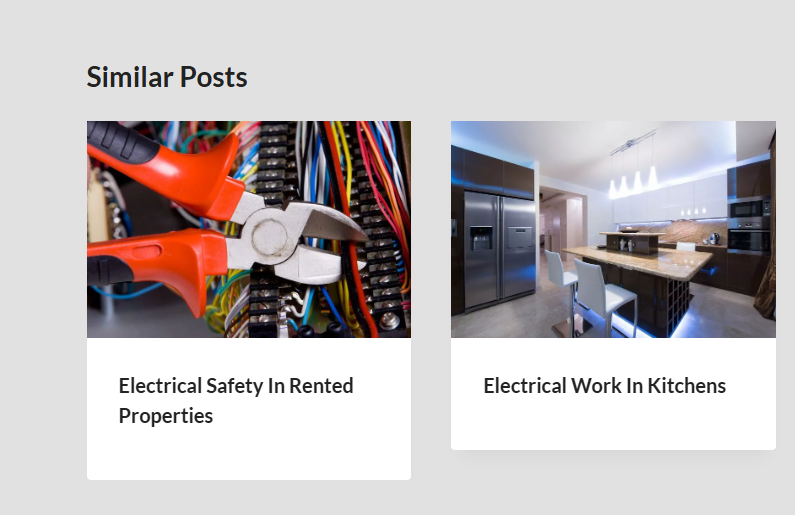
Related posts. On a blog, show people where to go next. Someone reading "Do I Need a House Rewire?" might get "Signs Your Wiring Is Unsafe" and "What's Involved in a Full Rewire?" (made up). It pulls them deeper into the site and shows you know your stuff without a hard sell. When they're ready to book, you're already the electrician in their head.
Call-to-action links. These turn readers into leads by taking them to your contact or booking page. "Think your wiring might be outdated? Book your electrical safety check today." Subtle, relevant and helpful always wins.
Knowing the types is one thing. How do you organise them?
What internal linking structure suits an electrician's website?
The internal linking structure that suits an electrician's website depends on its size: a traditional silo for a full range of services, a flat silo for a small site, hub and spoke for blog clusters, and a location-based silo for several towns. A silo just means grouping related pages and linking them on purpose. In Electrician SEO Pro's view, the traditional silo is the one to start with if you offer a full set of electrical services.
You could link randomly, whenever a topic happens to come up. It does work, to a point, but your most important pages won't get the push they need. A silo boosts your topical authority, helps Google crawl the site and makes it easier for Google to connect your services, blogs and locations. Here are the four to know.
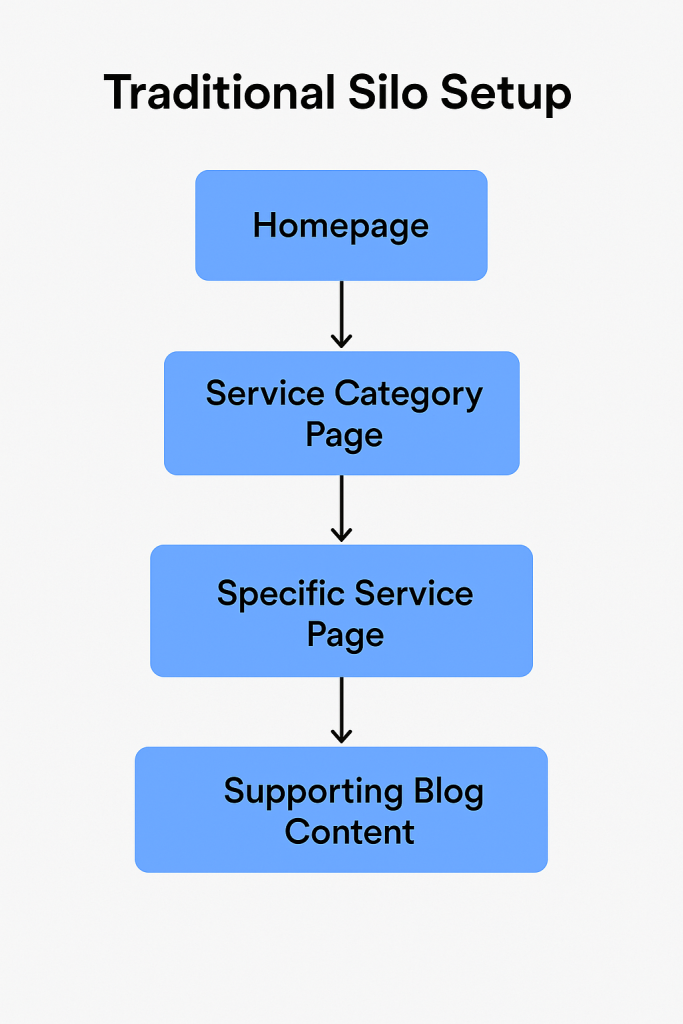
1. Traditional silo (hierarchical). The most traditional form, and the one that's been really effective for electricians I've done SEO for. Homepage, then a service category page, then a specific service page, then supporting blog content. For example (made up): Home, Electrical Services, Rewiring, "Signs You Need a Rewire" (blog). Use it when you've got a full set of services (inspections, EV chargers, rewiring) and want depth within each one. It's easy for Google to crawl, and each category page acts like a mini homepage for its topic.
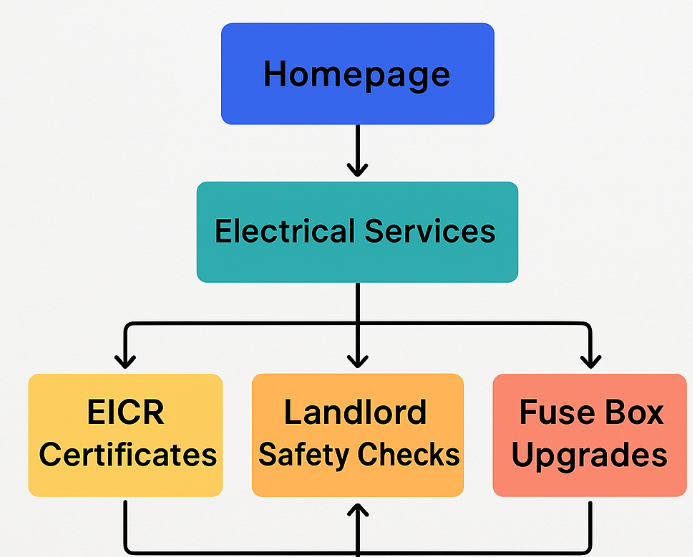
2. Flat silo (cross-linking). Pages in the same category link to each other directly, side to side rather than top down. Your EICR Certificate page links to Landlord Electrical Checks and Fuse Box Upgrades (made up). It suits smaller sites, or anyone building topic clusters without deep nesting, and it keeps everything within one or two clicks. Use it to lift lower-traffic services by tying them to the better performers.
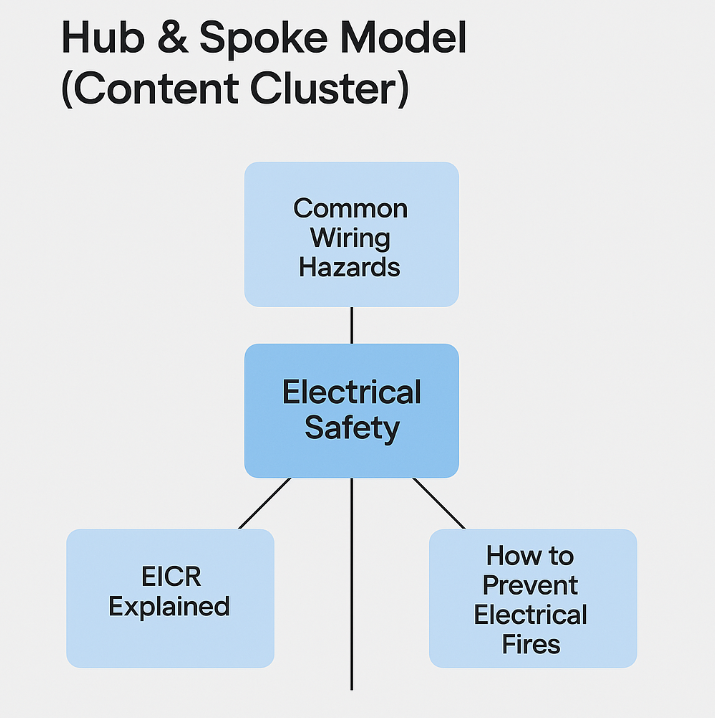
3. Hub and spoke (content cluster). One central pillar page, the hub, links out to supporting pieces, the spokes, and each spoke links back. Example: Electrical Safety as the hub, with Common Wiring Hazards, How to Prevent Electrical Fires and EICR Explained as spokes. Use it for blog clusters on topics like safety, smart homes or consumer units, then link the blog hub to the matching service page. Planning the pillar itself is in my guide to content pillars for electrical websites.
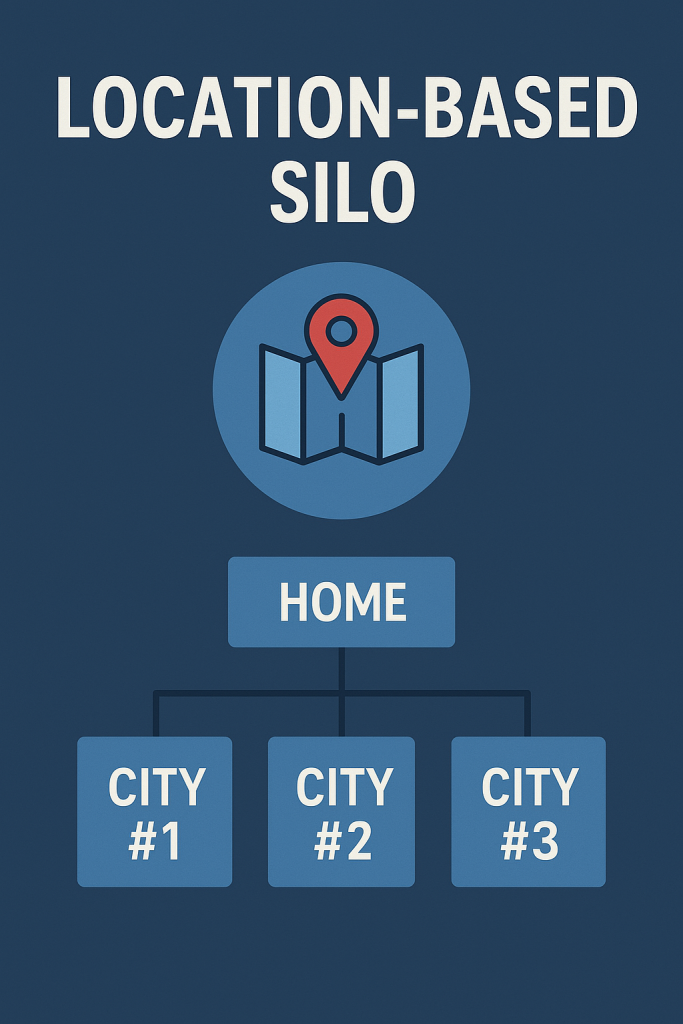
4. Location-based silo. Main service page, then location pages, then local blogs. For example (made up): Home, Electrical Services, Electrician in Leeds, "5 Signs You Need an Electrician in Leeds". Use it when you're targeting several towns and want Google to treat each area as unique but related.
Before building any of them, check what you've already got.
How can an electrician check the internal links on their website?
An electrician can check the internal links on their website by crawling it with a tool such as Screaming Frog or Sitebulb, or by clicking through the site by hand. The aim is to find orphan pages with nothing linking to them, broken internal links and service pages that hardly any other page points to. Electrician SEO Pro's rule is to audit first, so you know what's missing before you build any new links.
My favourite is Sitebulb, but old-school clicking through works too. You're hunting for three things:
- Orphan pages. Live pages that nothing else links to.
- Broken internal links. Links that lead to a 404.
- Barely linked service pages. The ones that should be your stars and are hiding at the back.
Say your "EV Charger Installations in Newcastle" page is live but nothing else on your site points to it (made up). Google and your visitors will struggle to find it. Fixing that is your first move.
Once the audit's done, the trick is to keep it tidy as you go.
How should an electrician add internal links to new pages?
An electrician should add two to three internal links to every new page or blog post as soon as it's published, pointing at their money pages and at related content already live on the site. Electrician SEO Pro's rule is to build those links in the same sitting as the page, so nothing is ever left isolated. It saves a clean-up job later and keeps the internal network strong from day one.
Say you publish a page for "EV Charger Installation in Stockton" (made up). Link to it from your main EV Charger Installation page, your homepage and your Stockton location page. Google finds it quicker, and so do customers. Easy win.
Writing a run of related posts? Link each one back to its pillar page and, ideally, to the others, the hub and spoke way.
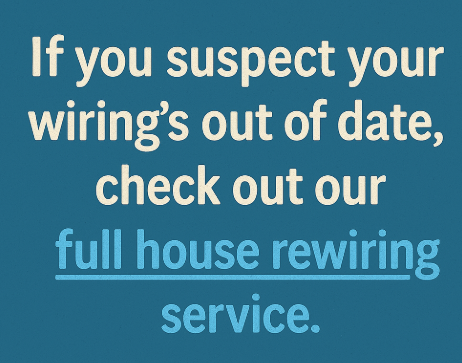
Then write the link text like a human would say it. Not "click here to learn about rewiring". Try "If you suspect your wiring's out of date, check out our full house rewiring service." Descriptive, readable and matched to the page it points at. I go deeper in my guide to anchor text for electricians.
Link early, link often, link with purpose.
Want a hand linking up your electrician website?
You can get a hand linking up your electrician website from Electrician SEO Pro, as part of a full SEO service for your electrical business, or do it yourself with a link audit and a few links on every new page. Internal linking is one part of on-page SEO, alongside titles, headings and content. Whichever route you take, the rule stays the same: link with purpose, point at the pages that earn the jobs, and make it easy for customers to move on.
If you've got the time, everything you need is in my free on-page SEO guide for electricians. If you'd rather spend your evenings pricing jobs than hunting for orphan pages, I can take it off your hands, alongside the rest of your SEO.
See how I can help, or crack on yourself.
Over to you.