

SEO for electrical contractors is the work of getting a contracting firm found on Google by the people who hire electrical contractors, from homeowners needing a rewire to businesses needing a fit-out. It covers the website, the Google Business Profile and a page for each type of work. Electrician SEO Pro's view is that the basics match SEO for any electrician, while contractors need more care over who is searching, how the site is organised and how much proof it shows.
What does SEO involve for an electrical contracting firm?
SEO for an electrical contracting firm involves four jobs: building a page for each type of work, keeping the Google Business Profile complete, earning trust through reviews and credentials, and tracking the enquiries that come in. Each job feeds the others, and together they decide whether the firm appears when a customer searches. Electrician SEO Pro aims for the top three in both the Map Pack and the organic results, because customers see both on the same page.
SEO is about climbing the ranks for the exact terms your customers punch into Google. The closer your pages match what they're after, the better your odds of turning clicks into enquiries.
It's not about chasing the latest social media fad. On Instagram, ads wrestle for attention while people scroll past. Someone typing "emergency electrician near me" or "consumer unit upgrade cost" into Google is already after help, and actively looking for a firm like yours.
I cover the whole process, step by step, in my complete SEO guide for electricians. Everything here is about what's different when you're a contractor.
So how different is it, really?
Is SEO different for commercial and domestic electrical contractors?
SEO for commercial and domestic electrical contractors follows the same basics, but the customers differ, so the pages, keywords and proof differ too. Domestic customers often search for a specific job in their town, such as a consumer unit upgrade, while commercial customers often search for a type of firm, such as a commercial electrician or an electrical contractor, plus their town. Electrician SEO Pro's rule is to give commercial and domestic work separate pages, so each search lands on a page written for that customer.
I say on my homepage that whether you're a registered electrician doing domestic rewires or a commercial electrical contractor chasing bigger fit-outs, the approach is the same: get found by the people ready to book. So here's what stays the same, and what doesn't.
What stays the same:
- Real searches decide your pages.
- One service per page.
- A complete, consistent Google Business Profile.
- Reviews and proof.
What changes for a contractor:
- Who's searching. A homeowner with a problem on one side, a business with a building or a project on the other.
- The keywords. "Commercial electrician" and "electrical contractor" plus a town, not just jobs like rewires and EICRs.
- The proof. I'd show a business that you're accredited and have done work like theirs, and a homeowner that you're safe to let in the house.
- The scale. More services, more people and sometimes more than one location.
Let's start with the commercial side.
How do commercial electrical contractors get found on Google?
Commercial electrical contractors get found on Google by ranking for searches such as "commercial electrician" and "electrical contractor" plus the town they serve, in the Map Pack and in the organic results. That takes a page for each commercial service and area, a complete Google Business Profile and a steady flow of reviews. Electrician SEO Pro aims for the top three in both places, because those spots get the most clicks.
Here's what that looks like for "electrical contractor Bristol". There are three places to win: the ads at the top, the Map Pack, then the organic results.
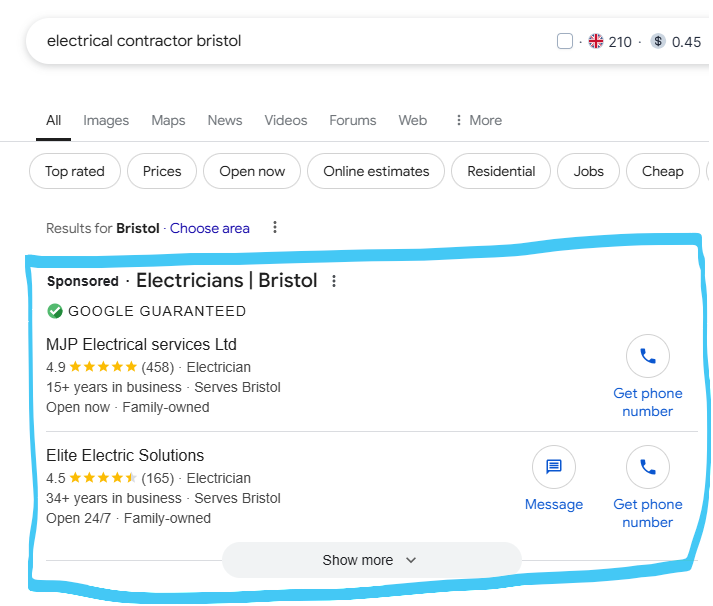
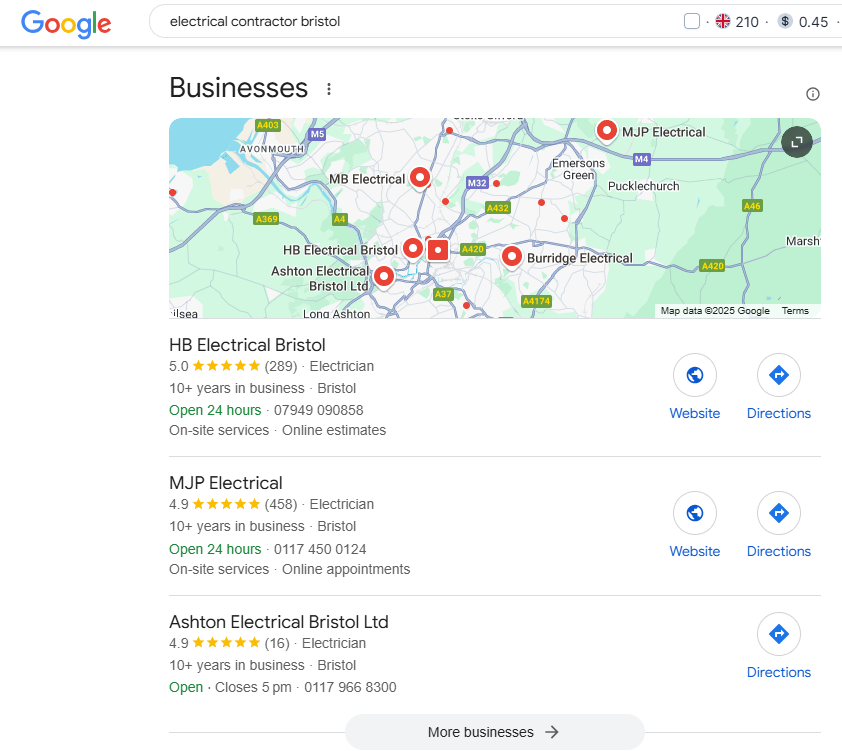
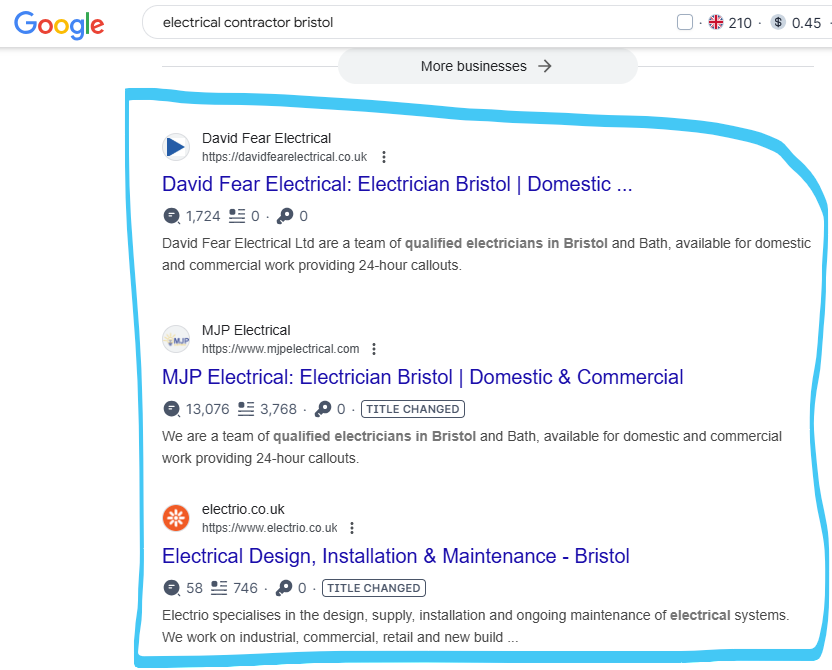
Two of the three organic results in my screenshot say they cover both domestic and commercial work. If you do both, say so, clearly.
Word of mouth and repeat clients are king. But beyond that, you need a system delivering leads around the clock, and for most firms that starts with being found for these searches. Finding the exact terms is a job of its own, covered in my guide to keyword research for electricians.
Getting found is half the job. The site then has to send each customer to the right place.
How should an electrical contractor's website handle commercial and domestic work?
An electrical contractor's website should handle commercial and domestic work by giving each its own section and its own pages, linked from the main menu, with one service per page and the main location in the headings. A homeowner looking for a rewire and a business looking for an electrical contractor should each land on a page written for them. Electrician SEO Pro builds service pages around one service per page, so each page has one job and one keyword.
Here's the menu from an electrician's site in Leeds. "Electrician in Leeds", "Domestic Electrician", "Commercial Electricians" and "EICR Test" all sit in the main menu, so nobody has to hunt.

Your core services should live in the main menu, tied to your main location, like "Emergency Electrician in Leeds". That makes them easy for Google to crawl and dead simple for customers to find. What you don't want is everything buried under one generic page.
Keep commercial and domestic keywords on separate pages, and plan them in a keyword map so no two pages chase the same search. How to build a proper service page is in my service page blueprint for electricians, and how to write the web addresses is in my guide to URL structure for electrician websites.
Pages get you found. Proof gets you hired.
What proof should an electrical contractor's website show?
An electrical contractor's website should show proof a customer can check quickly: accreditations such as NICEIC or NAPIT, real reviews, photos or write-ups of finished jobs, and a phone number near the top of every page. Customers, domestic or commercial, want to know a firm is legitimate before they ring. Electrician SEO Pro's advice is to put credentials and reviews on the homepage, where a visitor sees them without hunting.
Here's a row of scheme badges above a five-star review, which is exactly the sort of thing I like to see on a homepage.

The proof that closes the gap between ranking and response is accreditations, insurance, guarantees, before and after photos and case studies. For a contractor, I'd add short write-ups of finished jobs (with the client's say-so), because a business wants to see you've done work like theirs.
Reviews are fuel. Send your review link to happy clients after every job and make it routine. Don't push too hard, and never pay or bribe for them. My guide to Google reviews for electricians has the detail.
Put your phone number at the top, make it tap-to-call on mobile, and keep booking forms or buttons high on every service page.
Now, what changes when a contractor works from more than one place?
How does local SEO work for electrical contractors with more than one location?
Local SEO for electrical contractors with more than one location works by giving each place the firm genuinely serves its own page on the website, and its own Google Business Profile only where the firm really operates, with the same name, address and phone details everywhere. Each location page needs real local detail, not the same page with the town name swapped. Electrician SEO Pro's rule is to build a page for a place only when there is something genuine to say about it.
If you cover five towns, a proper page per town beats the same page with the name swapped. Genuine local content wins: the postcodes you cover, jobs typical of that town's housing stock, a recent job nearby. That's the difference between a thin page and a useful one.
Skip the towns you don't really work in. A page for somewhere you've never been is a doorway page, not a service.
More locations means more to keep tidy. Your name, address and phone number need to match everywhere, which is why NAP consistency matters even more once there's more than one site. Each page needs its own row in your keyword map, so "commercial electrician Salford" and "commercial electrician Bolton" (made up) don't blur into one. And the local content itself is covered in localised content for electricians. Whether each location can have a Business Profile of its own depends on the address rules, which I cover in why electricians need a physical address on Google Business Profile.
So what does all that cost?
How much does SEO for electrical contractors cost?
SEO for electrical contractors costs £750 a month flat with Electrician SEO Pro, with no long contracts. Other agencies often price by competition, the number of locations and how much work is covered, so get a clear monthly figure from anyone you talk to before you sign. The real test is what a booked job is worth against the monthly fee.
Elsewhere, what tends to push the price up for a contractor is more services (commercial and domestic means more pages), more locations and a more competitive city. With me it's one flat monthly fee, so you know the number before we start.
What it doesn't do is buy a guarantee. Nobody can promise you a number-one spot, so be wary of anyone who does.
The honest way to judge it is to run the sum: what is one booked job worth to you, and how many does the fee need to bring in to cover itself? A booked domestic job and a booked commercial one are rarely worth the same, so run the sum for both.
If you do hire someone, how do you pick?
How can an electrical contractor choose an SEO agency?
An electrical contractor can choose an SEO agency by asking three questions: what the process is, how results are reported and how the agency stays in touch. A good answer covers keyword research, technical fixes, content and links, monthly reporting on both leading and lagging metrics, and regular contact rather than a monthly email. Electrician SEO Pro's view is that a contractor should also ask whether the agency specialises in electricians, rather than treating the trade like any other.
Tons of outfits target trades, but plenty are duds. Hit them with:
- "What's your process?" It's a beast: keyword digs, technical fixes, content and links. Half-measures won't cut it.
- "How do you report?" Vague dashboard talk with no breakdown of the work done is a red flag. A good one shows leading and lagging metrics every month.
- "How do we connect?" Good ones check in regularly, not just a monthly email drop.
Leading metrics are what the agency drives, like pages published or links earned, and they should climb every month. Lagging metrics, like calls, clicks and traffic, show the payoff weeks later. Tracking and reporting for electricians goes through both.
The only number that really matters to you is how much money it's making you. Leads, clicks and impressions come second. And if anyone promises a number-one ranking, walk.
Know the basics and you'll spot a chancer from a mile off.
Want a hand getting your electrical contracting firm found on Google?
You can get a hand getting your electrical contracting firm found on Google from Electrician SEO Pro, as part of a full SEO service for electricians and electrical contractors, or tackle it yourself, one page and one listing at a time. Commercial and domestic work need their own pages, proof and keywords. Whichever route you take, the rule stays the same: each type of work gets a page of its own, built for the customer who searches for it.
If you're doing it yourself, start with my free SEO guide for electricians, which covers every step, and my local SEO guide for electricians if you work from more than one place. If you'd rather spend your time quoting for jobs than reading about SEO, I can take it off your hands, alongside the rest of your SEO.
See how I can help, or crack on yourself.
Over to you.