Yes, electricians need a physical address on Google Business Profile, because Google builds every profile around a real location it can verify, but most electricians shouldn't show it. If customers don't come to you, set up as a service-area business, hide the address and list the towns you cover. Where you're based is a local ranking signal either way. Electrician SEO Pro's rule: your real base, hidden unless customers can genuinely walk in, and never a PO box or virtual office.
What counts as a physical address for an electrician's Google Business Profile?
A physical address for an electrician's Google Business Profile is the actual, real-world place the business runs from, such as your home, a workshop, a unit or an office. It has to be somewhere you genuinely work from, so a PO box, a mail forwarding service or a rented address you never use doesn't count. Plenty of electricians use their home address, and that's fine. Electrician SEO Pro checks one thing first: could you take Google to this address and show them your business?
Why so fussy? The way I see it, Google's job is to keep scams, spam and dodgy businesses off the map, and a real business has a real place in the world. An address you can stand outside is the start of proving you exist.
How the usual set-ups shake out (all made up):
- Working from home, van on the drive. Your home address is your physical address. Use it, then hide it.
- Your accountant's office. If you're a limited company, your registered office might be there. That's where your post goes, not where you work, so it isn't the address for your profile.
- A PO box or a "business address" service. Not a physical address, however professional it looks.
And that "show them your business" bit isn't a figure of speech. It's how verification works.
Does an electrician need an address to verify a Google Business Profile?
Yes, an electrician needs a real address to verify a Google Business Profile, because Google asks for a business address it can find before it verifies a profile, even if that address is going to be hidden. Google chooses which verification methods you're offered, which can include a phone call or text, email, a video, or a postcard to the address. A video check asks you to show where you are, the tools or equipment you use and proof you run the business. Electrician SEO Pro's advice is to verify at your real base, because that's the place you can actually prove.
For an electrician, a video check is easier than it sounds. Think branded van, test kit and tools, a street sign near your base, and something that shows you run the show, like your keys.
A postcard goes to the address you entered. Working from home? It lands on your doormat, and nobody else ever needs to see that address. While you wait, don't edit your business name, address or category, or the code won't work.
I walk through the whole setup, verification included, in my Google Business Profile guide for electricians.
Once you're verified, the big question: should anyone else see that address?
Should electricians hide their address on Google Business Profile?
Yes, electricians should hide their address on Google Business Profile if they don't serve customers there, which covers most electricians who work from home or out of the van. Google tells service-area businesses, the ones that travel to customers, to remove the address from the profile and set the areas they cover instead. Only show it if customers can genuinely visit, with your business name on permanent signage and someone there during your opening hours. Electrician SEO Pro's default for an electrician working from home is hidden, every time.
Google's help page on service areas puts it bluntly: if you don't serve customers at your business address, remove it from your profile. Its examples of service-area businesses? Plumbers and cleaning services. Swap in electricians and that's most of you.
Hiding it isn't a fudge or a workaround. It's what Google asks for. And let's be honest, you probably don't want customers turning up at your house unannounced, asking if you can "just have a quick look" at a socket.
Most electricians end up hidden. Which leads to the obvious worry: does that mean no map results?
Can electricians with a hidden address appear in the local pack?
Yes, electricians with a hidden address can appear in the local pack, the map results at the top of Google, because a service-area business is a normal type of Business Profile, not a second-class one. Hiding the address stops customers seeing it, but Google still holds the address you verified with, and the profile shows your service area instead. Service-area electricians appear in local results every day. Electrician SEO Pro sets most electricians up this way and competes on what moves local rankings: reviews, the right categories and a complete profile.
You'll hear it said that no visible address means no map results. It's not true, and believing it is what pushes electricians towards virtual offices and fake addresses, which really can get you wiped off the map.
What hiding changes is what customers see: the areas you cover instead of a street address. For someone who needs an electrician to come to them, that's the useful bit anyway.
Getting into the local pack still takes work, hidden or not. The right primary category, your services, photos, honest opening hours and a steady flow of reviews all count. I cover reviews in how electricians get more Google reviews.
So hidden doesn't mean invisible. But does where you're based change where you rank?
Is a physical address a ranking signal for electricians?
Yes, an electrician's physical address is a local ranking signal, because Google ranks local results on relevance, distance and prominence, and distance is how far the business is from the person searching. That's why an electrician usually finds it easiest to show up near their base and harder in towns further away. Google doesn't say a visible address ranks higher than a hidden one, and it tells service-area businesses to hide theirs, so hiding it breaks no rule. In Electrician SEO Pro's view, your address sets where you start, and reviews and relevance decide how far you reach.
Google sets out the three factors in its guide to improving local ranking. Distance is how far each business is from the customer searching. The way I see it, your address is your anchor point for local search, hidden or not: the closer it is to the person searching, the better your chances.
Search for an electrician in a big city and you'll see it in action. The businesses are spread right across the map, and which ones you're shown depends on where you're searching from.
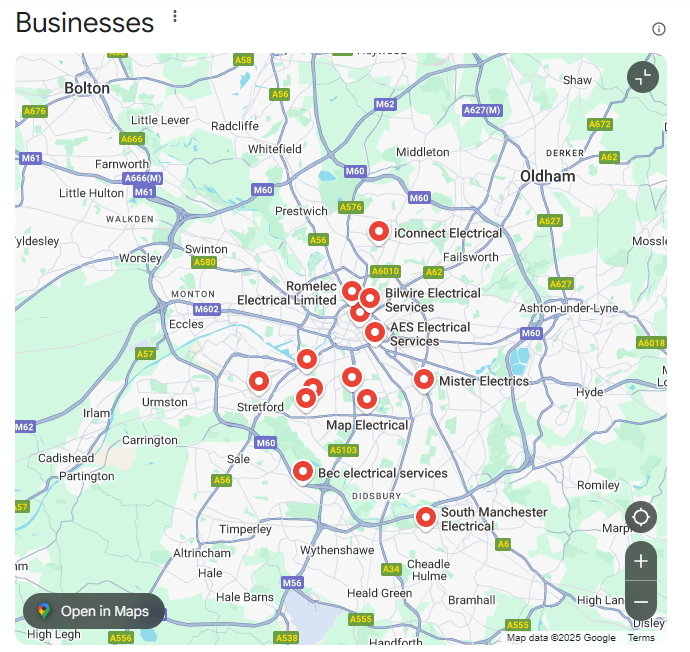
My honest view: if two electricians are otherwise neck and neck, a visible address on real premises can give a small edge for searches right next to it. That's my opinion, not a Google rule, and it's never worth faking. You can't move closer to every customer, so beat the nearer competitor on the right categories, services and reviews instead.
Right, enough theory. Here's how to set it up properly.
How do electricians hide their address and set service areas?
Electricians hide their address and set service areas in the Location section of their Google Business Profile: select Edit profile, then Location, turn off "Show business address to customers" under the business location, and save. Then edit the service area and add up to 20 towns, cities or postcodes, staying within about two hours' drive of where you're based. Electrician SEO Pro adds only the places an electrician genuinely works, starting with the town they're based in.
Step by step:
- Sign in to the Google account that manages your profile, then search for your business name, or "my business".
- Select Edit profile, then Location.
- Next to Business location, select Edit, turn off Show business address to customers, and save.
- Next to Service area, select Edit and add the towns, cities or postcodes you cover. Save again.
- Give it a couple of days. Approved service area edits can take up to 48 hours to show.
You can't draw a radius any more, so name real places: "Stockton-on-Tees" and "Thornaby", not "the North East". And only add towns you'd happily drive to for a socket swap. Two hours is Google's rough outer edge, not a target.
Moved recently? A new address means verifying again, and every directory that lists you needs updating too. My NAP consistency guide covers the order to do it in.
That's the legit route. Now for the shortcut some electricians try instead.
Can electricians use a virtual office or PO box on Google Business Profile?
No, electricians aren't allowed to use a virtual office or PO box on Google Business Profile. Google doesn't accept PO boxes or mailboxes at remote locations, and a rented address the business doesn't actually operate from isn't eligible for a profile. A co-working space only counts if it has your signage, receives customers and is staffed by your business during opening hours. Electrician SEO Pro's advice is to use your real base and hide it, because a profile built on an address you don't work from can be suspended.
It's all in Google's guidelines for representing your business, under the address rules.
I get the temptation. A smart address in town looks more established than a list of service areas. But here's what you're signing up for:
- Suspension risk. It might slip through at first, but your listing is always one complaint away from being suspended, and a suspended profile vanishes from Maps while you argue with support. If it's already happened, here's how to fix a suspended profile.
- Weak trust. Customers can spot a dodgy address a mile off. If your "office" turns out to be a mailbox shop, they'll trust you less, and they're deciding whether to let you into their home.
If you're serious about building an electrical business, one you and your town can be proud of, maybe one you'll pass down one day, use a legit address. Your real one, hidden, is legit.
There is a right way to get a visible address, though.
When is it worth an electrician showing their address on Google?
It's worth an electrician showing their address on Google when customers can genuinely visit it, such as a trade counter, a showroom or an office with permanent signage and someone there during the opening hours on the profile. That makes the business a hybrid, so it can show the address and set service areas as well. A visible address gives customers a place to find you and proof you're local, which builds trust. Electrician SEO Pro's view is that it's only worth it for real premises: showing a home address to look established breaks the rules and invites strangers to your door.
If you've got premises that qualify, show them off. A real address tells customers where you've planted your flag, so if a job ever goes wrong, they know where to find you. Nobody wants a "where are they even based?" mystery.
Thinking about a unit anyway? A small workshop or office in the area you cover can be worth it as you grow, as long as you genuinely work from it, put your name on the door and have someone there when your profile says you're open. A desk you visit once a month doesn't count.
Whatever you choose, make the rest of the web match. Shown on Google means shown, letter for letter, on your website and directories. Hidden on Google means hidden there too, with your service area instead. My local citations guide for electricians covers where to list your business.
Real address, real results.
Want a hand setting up your electrician Google Business Profile?
You can get a hand setting up your electrician Google Business Profile from Electrician SEO Pro, as part of a full local SEO service for your electrical business, or sort your address and service areas yourself from the profile's Location settings. Either way, the rule stays the same: a real base, hidden unless customers can walk in, service areas you genuinely cover, and details that match everywhere.
If you're doing it yourself, my local SEO guide for electricians covers what to tackle once the profile is sorted. If you'd rather be on the tools than fiddling with Google settings, I'll set it up properly, alongside the rest of your local SEO.
See how I can help, or crack on yourself.
Over to you.