An electrician should write a meta description of about 150 characters that starts with the service and the town, says what the page offers and ends with a reason to click. A meta description isn't a ranking signal, but it's the pitch under your link in Google, so a good one wins more clicks from the rankings you already have. Electrician SEO Pro's rule is a unique, honest description for every page.
What is a meta description on an electrician's website?
A meta description on an electrician's website is a short summary of a page, written in the page's head, once per page. Google can show it as the grey text under your blue title in the search results, and social platforms sometimes use it in link previews. It tells a searcher what the page offers before they click. Plugins like Yoast SEO and Rank Math let you write it without touching code.
Here's what it looks like in the code (made up). I know you're not a coder, so don't panic. As long as your SEO person or web developer knows what they're doing, you're good to go.
<head>
  <meta name="description" content="Need a trusted electrician in Liverpool? Vetted, reliable work for homes and businesses. Same-day callouts and free quotes. Call now.">
</head>
Think of it as your elevator pitch. It sits under your title tag, and like a title tag, there's one per page.
The place it matters most is the search results, because that's where a customer decides who to click:
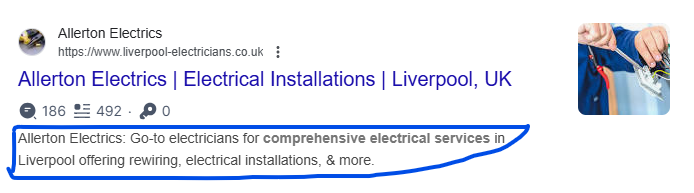
On social media it can show up in link previews. Yoast SEO and Rank Math let you set a different one for each platform, if you want to tailor it.
It's tiny and hardly anyone sees it being written, so does it do anything for rankings?
Is a meta description a ranking signal for electricians?
No, a meta description is not a ranking signal for electricians, but it still matters, because it's the pitch that decides whether a searcher clicks your listing or the next one. A better description earns more clicks from the rankings you already have, which means more calls from the same visibility. In Electrician SEO Pro's view, a meta description is a click tool, so write it for the customer, not for Google.
Straight talk: it won't move you up the results. What it does is make the most of the spot you've already earned.
Here's the maths (all made up). Say a page gets 1,000 searches a month. At 10 clicks in every 100, that's 100 visitors. A better description that lifts it to 15 in every 100 is 150 visitors, from the same ranking, for a few words. Now imagine doing it on every page.
Put your main keyword in anyway. Google tends to bold the words that match what the searcher typed, so their own words jump out. Your description is also your first touchpoint with a customer on the results page, alongside your title. If it doesn't grab them, they scroll on.
So how much room have you got?
How long should an electrician's meta description be?
An electrician's meta description should be about 150 to 155 characters long, because Google cuts the text to fit the width of the screen and ends it with three dots. Google sets no character limit, so it's a width limit: wide letters take up more room than narrow ones, and phones show less than desktops. Electrician SEO Pro's rule is to put the answer, the service and the town at the start, so the important part still shows if the end gets cut.
The usual rule of thumb on desktop is about 920 pixels, which works out at roughly 155 to 160 characters. Treat it as a guide, not a law.
Here's a made-up example that fits comfortably, at 133 characters:
Need a trusted electrician in Liverpool? Vetted, reliable work for homes and businesses. Same-day callouts and free quotes. Call now.
Yoast SEO shows a length bar as you type, and SERP preview tools (Mangools has one) show you exactly where the cut falls. Don't aim to fill every character, aim to say something useful before it runs out.
Length sorted. What should the words actually say?
What should an electrician's meta description say?
An electrician's meta description should say what the page offers, for whom and where, in plain words that match the search, then end with a reason to click. A service page needs the service, the town and a trust point; a blog post needs the answer it gives and a soft invitation to read on. Electrician SEO Pro writes each description to suit the page type and what the searcher wants.
Content comes first. A lovely description on a poor page just gets people to bounce faster, so sort the page, then write the pitch.
The recipe changes with the page:
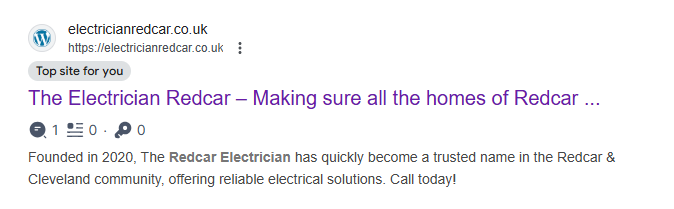
- Homepage: broad but compelling. Main keyword, main service, location and a call to action. For most electricians it's one of the most important pages on the site, because plenty of people convert from it.
- Local service pages: your money pages, where the hot prospects land. Main keyword, location, service, a trust signal such as vetted or expert, and a call to action.
- Blog posts: cold traffic. These people want a straight answer, not a hard sell, so lead with the long-tail keyword and finish with a soft invitation like "read on". Skip the brand details.
Here's what a homepage, a local page and a blog post look like in the wild:
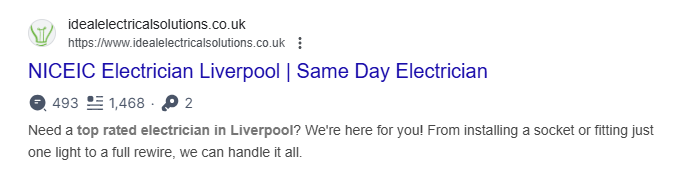
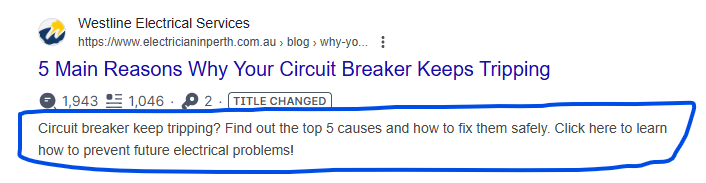
Whichever page you're on, match what the searcher is after. Someone asking a question wants an answer, and someone typing "emergency electrician" wants a phone number. My guide to search intent explains how to read the difference.
Should every one of them end with a call to action, though?
Should an electrician put a call to action in a meta description?
Yes, an electrician should put a call to action in a meta description on service pages, because telling a searcher what to do next, such as call now or get a free quote, gives them a reason to click. Blog posts need a softer invitation, such as read on, because readers want an answer, not a sales pitch. Electrician SEO Pro recommends a call to action on every description, matched to the page type.
A strong call to action makes the listing feel inviting, and gives a searcher a reason to pick you over the next electrician. Two made-up examples:
- "Book a free electrical inspection. Call now."
- "Get fast, reliable electrical work. Contact us today."
Only promise what you actually do. If you don't offer free inspections, don't say you do.
What about keywords?
Should electricians put keywords in their meta descriptions?
Yes, electricians should put their main keyword in a meta description, near the start and once, because Google tends to bold the words that match a search and customers spot their own words quickly. It doesn't need repeating or a list of variations. Electrician SEO Pro's rule is one main keyword per page, written into a sentence a customer would actually say.
It isn't 2008. Stuffing doesn't work, and searchers can smell it a mile off. Here's the difference (both made up):
- Stuffed: "Electrician in Manchester | Best Electricians Manchester | Manchester Electrical Services"
- Better: "Need a reliable electrician in Manchester? Expert service and fast callouts. Call now."
Google can work out what your page is about from the content, so it doesn't need to be told five times. And the keyword-packed version looks like it was written for a robot, so real people won't click it.
If you want to rank for variations, put them in the page content, not the description. Where else keywords belong is covered in my guide to keyword placement.
So what happens if Google ignores all of it?
Does Google rewrite an electrician's meta description?
Yes, Google sometimes rewrites an electrician's meta description, using text from the page instead when it thinks that describes the page better for the search. Google builds most snippets from the page content and only sometimes uses the meta description you wrote. Electrician SEO Pro still writes one for every page, because it's the version you control and the one Google may choose.
Google's own guidance on snippets and meta descriptions says the same, and adds that the snippet can differ from search to search for the same page.
I've seen it happen countless times, on my own sites and on client sites, even when the description was solid. Google keeps testing, so check back now and then and you'll see descriptions change.
Can you stop it? Not completely. But if your description matches the page and the search, Google has less reason to swap it. A description that just says "Electrician Liverpool" isn't much use to anyone, so expect Google to write something better.
And if you write nothing at all? Google writes one from the page, and it can read oddly, sometimes starting mid-sentence. They're getting better at it, but it takes about 30 seconds to write your own, so just write your own.
Last bit: the mistakes I see most often.
What meta description mistakes should electricians avoid?
The meta description mistakes electricians should avoid are copying one description across several pages, stuffing in keywords, shouting in capitals or piling on emojis, promising things the business doesn't offer, and leaving the field blank. Each one makes a listing look careless or spammy, or hands the job to Google. Electrician SEO Pro's fix is a unique, honest, plain-English description for every page.
- Copy and paste. One description can't describe two pages. Every page needs its own, so write each one for the page it sits on.
- Emojis and symbols. You can use them, but don't. Google sometimes shows symbols, pipes and emojis, and one tasteful one might not hurt. A description with a row of flames and sirens and three exclamation marks looks desperate, and it hands Google a reason to swap it.
- Shouting. ALL CAPS in a description is a customer scrolling past.
- Empty promises. "Free quotes", "fully insured" and "24/7" are only fine if they're true.
- Leaving it blank. Then Google writes it for you.
If you're experimenting with special characters, check how they look in a SERP preview tool before you publish.
Stay human. Stay clickable.
Want a hand with your electrician meta descriptions?
You can get a hand with your electrician meta descriptions from Electrician SEO Pro, as part of a full SEO service for your electrical business, or write them yourself, one page at a time, starting with your homepage and your best service pages. Meta descriptions are only one part of on-page SEO; titles, content, headings and internal links matter just as much. Whichever route you take, the rule stays the same: one honest, unique description per page.
If you've got the time, everything you need is in my free on-page SEO guide for electricians. If you'd rather spend your evenings quoting jobs than counting characters, I can take it off your hands, alongside the rest of your SEO.
See how I can help, or crack on yourself.
Over to you.