
SEO for Electricians: The Complete Guide to More Leads
Everything I’d do to get an electrician ranking and booked, laid out in this SEO for electricians step by step guide, so you can run it yourself without paying me a penny. Or skip the learning curve and hand the lot over.
★★★★★ 5.0 · Google reviewsWhy SEO is a must for electricians
SEO for electricians is how you get found by the 185,000+ people who search Google for an electrician every month in the UK, and turn those searches into booked jobs. Demand for electrical work is steady, so you need an SEO game plan that targets the right local keywords in your service area.
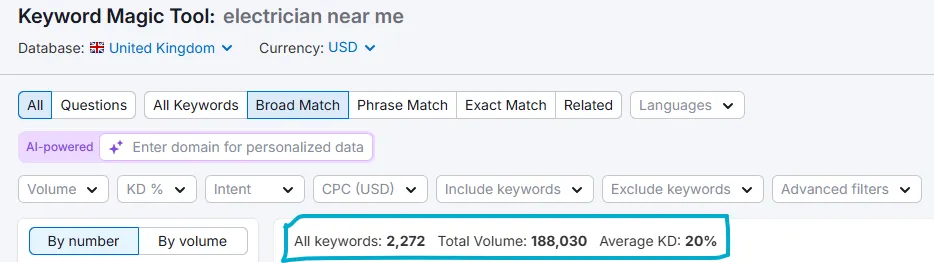
Here’s the thing most electricians miss: you rarely need more website traffic in the abstract. You need more high-intent enquiries for the services that pay, emergency call-outs, EICRs, rewires, fault finding and consumer unit work. SEO, done properly, improves your visibility across the SERP so you show up exactly when search intent is strongest and the customer is ready to call.
As a service-area business, your two most valuable lead sources are organic rankings and Google Maps. Both drive calls, quote requests and a better conversion rate far more than vanity traffic ever will. Word of mouth and repeat clients are king, no argument, but they’re not a system. SEO is the system that delivers leads around the clock, and it compounds: steady work across content, technical SEO, local backlinks and conversion usually pays off over several months, which is why consistency beats sporadic fiddling. It all starts with keyword research.
Running a commercial contracting firm rather than a domestic business? See my guide to SEO for electrical contractors.
How Google decides who ranks
For local results, Google weighs three things: relevance (how well you match the search), proximity (how close you are to the searcher), and prominence (how well known and trusted you are). You can’t do much about proximity, but relevance and prominence are won, not given.
Prominence is where reviews, citations, link building, local backlinks and brand mentions separate the serious operators from the average firm. Relevance is reinforced by clear service-area information, accurate Google Business Profile categories, schema markup and consistent contact details, the kind of trust signals a lot of electricians overlook entirely. Nail both and you’ll appear in the Local Pack (the Google Maps listings) and the organic results for the searches that matter.
Keyword research and search intent
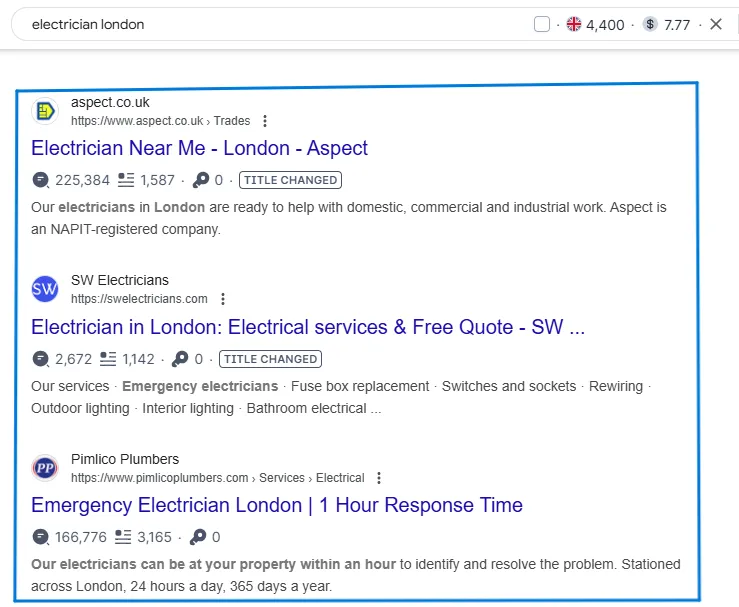
Keyword research is just finding the exact terms your customers type, then making sure you own them across Google Maps (the local pack via your Google Business Profile) and the standard organic results. These are also the keywords you’d plug into Google Ads later, so the work is never wasted.
Done right, the “triple-threat” puts you front and centre: #1 in Google Ads, #1 in the local pack, and #1 in organic. Forget “page one” as a target, that’s old news. Aim for the top 3 across every asset to soak up the clicks and max out your click-through rate, leaving competitors with nothing.
How to actually build the list
Don’t wing it. Open Google Keyword Planner, click “Discover New Keywords”, type something broad like “electrician” plus your town (e.g. “electrician Manchester”) and hit Get Results.
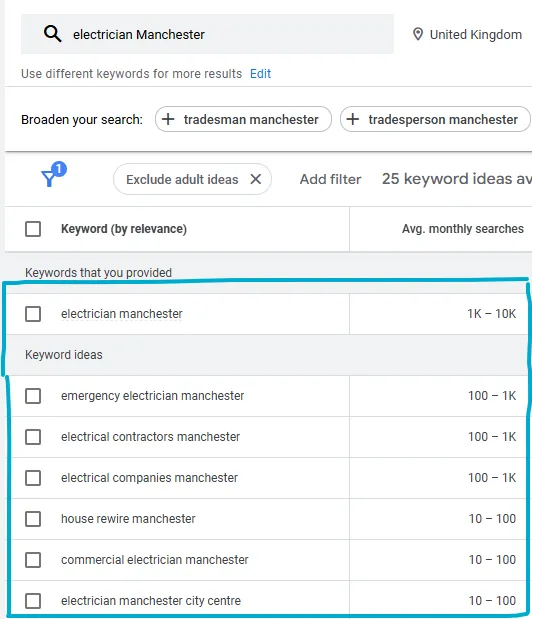
Don’t stress about optimisation yet, just build a solid list of commercial keywords, where the search intent is to hire. Someone searching “emergency electrician in Manchester” isn’t browsing for fun; they need you now. Those high-intent terms deliver the best bang for your buck.
Match the page to the intent
The highest-value searches pair a service with local intent, often with a location modifier or “near me” searches attached. Broad searches for “electrician” tend to be research; a service-plus-place search is someone ready to book. The best electrician keywords are rarely the broadest, terms like fault finding, 24/7 electrician, EICR certificate, consumer unit replacement and fuse box upgrade usually convert better because they reflect urgent or regulated demand.
Use modifiers that pre-qualify the lead, words like emergency, same-day, certified, NICEIC and landlord narrow the intent before the customer even clicks. And remember commercial electrician searches behave differently from domestic electrician ones: commercial buyers want evidence of scale, compliance and reliability, so they respond to dedicated service pages, not generic copy. Larger industrial electrician work is different again.
A simple keyword template you can reuse
- Service keyword: emergency electrician, consumer unit replacement, EICR certificate, EV charger installation.
- Local modifier: town, borough, postcode district, or a “near me” variant.
- Page formula: service + audience or problem + local relevance.
Top keywords for electricians to target
When your site’s new, start with lower-competition phrases. As you gain traction, go after the tougher ones.
- electrician + town
- electrician near me
- emergency electrician + town
- domestic electrician + town
- commercial electrician + town
- rewire house + town
- EICR + town
- consumer unit replacement + town
- fuse box upgrade + town
- fault finding + town
- EV charger installation + town
- 24/7 electrician + town
Validate demand with a keyword tool for volume and difficulty, then confirm with Google Search Console once the site’s live. Search Console shows what real users already associate with your pages, which is often more useful than any third-party estimate. See the full keyword research walkthrough →
Website foundations: architecture, UX and trust
Strong site architecture helps both customers and Google reach your money pages fast. For electricians that means clean navigation for your core services, service areas, about, contact, reviews and trust pages, not everything buried under one generic “domestic electrician” page.
People mix up website structure and URL structure, so quickly: website structure is how pages link together through your navigation (your key services should sit in the sitewide nav, paired with your primary location). URL structure is how you build the address itself, keep it clean off the root domain (yoursite.co.uk/emergency-electrician-bristol) for a single-area firm, or use folders if you’re targeting many areas. Either way, get your main keyword in the URL.
Conversion friction kills leads faster than weak rankings. Click-to-call buttons, short quote forms, visible coverage details, HTTPS, a mobile-first design and crawlable navigation all matter, because most electrical enquiries happen on a phone mid-problem, not during leisurely research. And proof closes the gap between ranking and response: accreditations, insurance, guarantees, before-and-after photos and case studies reduce perceived risk and lift your conversion rate.
Service pages vs location pages
Service pages explain the work; location pages prove local relevance. Most electricians need both, but each page must have a distinct purpose or it turns into a thin doorway page that adds nothing.
Build service pages one clear outcome at a time, “house rewiring in Glasgow” gets a page built to convert, while “average cost of rewiring a house in Glasgow” gets a blog post packed with useful detail. Too many electricians chase vague national terms like “what is rewiring” and wonder why the phone’s quiet; those don’t rank for you and don’t reach your local crowd anyway. Stay in your lane.
A good location page carries genuine proof: nearby jobs, response patterns, testimonials and service specifics. Google rewards that specificity because it signals real operational presence, not templated expansion. For an electrician in Leeds, useful angles might be “What’s the average cost of house rewiring in Leeds?” or “Future tech: smart home installations in Leeds”, get as local and data-driven as you can.
On-page SEO: make each page the best answer
Good on-page SEO lines your page structure up with the customer’s question and the service intent. A precise title tag, a strong H1 and clean headings help Google connect the page to the job being searched, without ever resorting to keyword stuffing. The copy itself should cover symptoms, process, compliance, timescales, guarantees and likely outcomes, because useful detail builds trust and dwell time.
Here’s the step-by-step I use, with the Yoast SEO plugin on WordPress:
- Set your focus keyword in the Yoast box (e.g. “house rewiring Birmingham”).
- Build a strong outline first, intro, cost factors, process, local considerations and FAQs.
- Craft a killer title with the keyword near the front, under 60 characters.
- Write a meta description with a hook and the keyword, capped at ~155 characters. It’s your advert in the results.
- Use the keyword in your H1 once, naturally.
- Drop it in the first line, kept natural, never jammed in.
- Sprinkle a variation in a subheading (an H2).
- Work it into the body 2 to 4 times across 800 to 1,200 words. Don’t overstuff.
- Optimise the URL so the keyword’s there, no clutter.
- Check Yoast’s feedback and fix anything orange or red, including image alt text.
- Add internal links with smart anchor text (never “click here”).
- Publish and test, Google your keyword in quotes after a few days and adjust.
Internal linking is a revenue tool, not just a technical tidy-up: link your EICR page to remedials, consumer unit upgrades and landlord electrical safety pages so readers move toward the next service they’re likely to need. Where it’s relevant, reference your qualifications and compliance (Part P, BS 7671), electrical work is trust-sensitive, and compliance language supports both credibility and relevance.
FAQ blocks win long-tail queries. A concise, specific FAQ section helps a page rank for natural-language searches and feed AI Overviews. Answer what customers genuinely ask before booking: cost, disruption, certificates, booking times and safety.
Do this properly and you’ll leave plenty of electrician sites, your competitors, looking amateur. Full on-page SEO guide →
Technical SEO
Technical SEO is the groundwork that lets Google crawl, read and trust your site. You don’t need to be a developer, but if the foundations are broken, none of the content work lands.
- Speed and Core Web Vitals. Test your page speed in Google PageSpeed Insights, under 80 on mobile is a problem. On a mobile-first web, speed is a genuine ranking factor, and a slow site loses the “my power’s off” caller.
- HTTPS and a clean setup. A padlock, no broken links and crawlable navigation so every page can be reached.
- Schema markup. Structured data that spells your business out to Google. Add LocalBusiness schema for your details and service area and Service schema on each service page, so Google reads your business details without guessing.
Get the technical SEO right once and everything else you do works harder for it. Full technical SEO guide →
Conversion: turn visitors into customers
Ranking is pointless if visitors don’t call, so once your content plan’s nailed, focus on the experience. You want a responsive design that works on phones, tablets and desktops, set up to make enquiring as easy as possible.
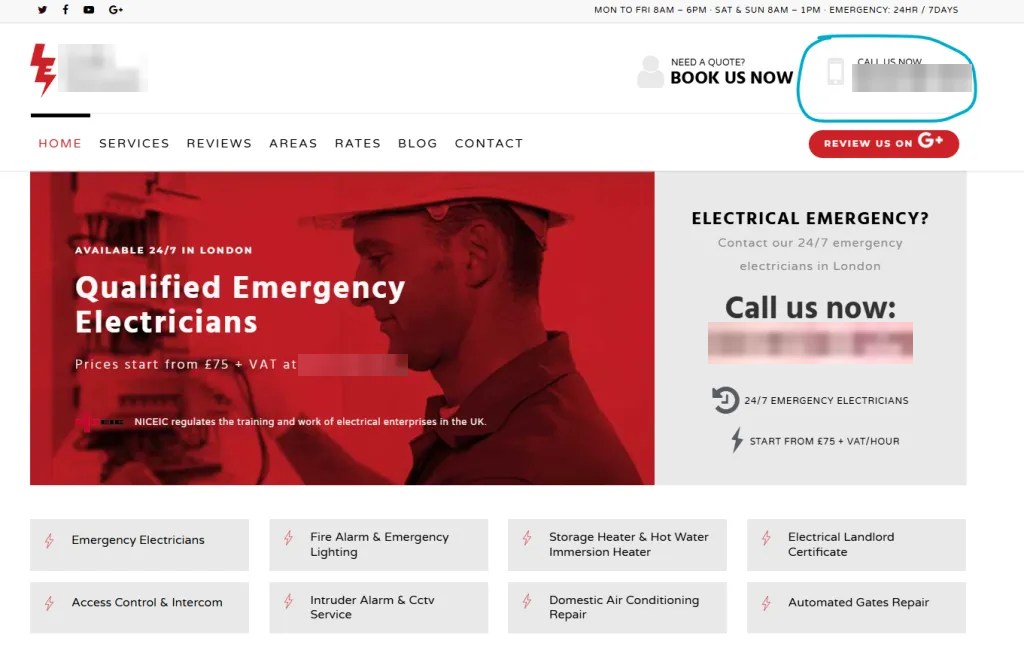
- Phone number up top, in the header and tap-to-call on mobile for max enquiries.
- Short quote forms high on every service page. Nobody fills in a 12-field form to book an electrician.
- Trust front and centre, experience, a proven record, proper quals like NICEIC, and cracking reviews. This is Google’s E-E-A-T (Experience, Expertise, Authoritativeness, Trustworthiness) made visible, and it reassures the human too.
- Add a “what happens next” line after every form. Telling customers when they’ll hear back lifts completion, and showing your pricing approach (even just ranges or a call-out fee) improves lead quality by filtering poor-fit enquiries.
Local SEO: Google Business Profile, reviews and citations
For most electricians, local SEO is the fastest route to more calls, because your Google Business Profile often shows above the traditional organic listings. A fully optimised profile can shift lead flow before your website even ranks strongly.
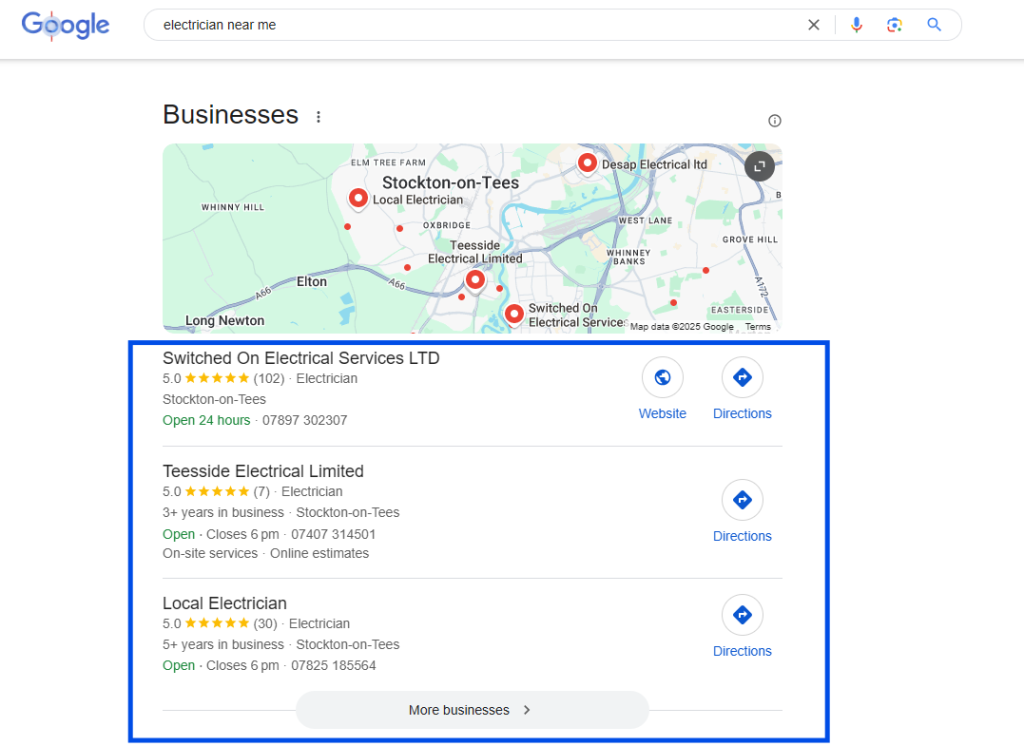
- Have a real base in your target area. Google ranks local results partly on distance from the searcher, so you show up most easily near where you’re based. Use your real address, and hide it if customers don’t visit you (here’s why).
- Optimise your Google Business Profile. Choose the primary category that matches your highest-value service, then align your Google Business Profile categories and listed services to your money pages. Use Google Posts and your services list to pre-qualify leads on availability, pricing and job type.
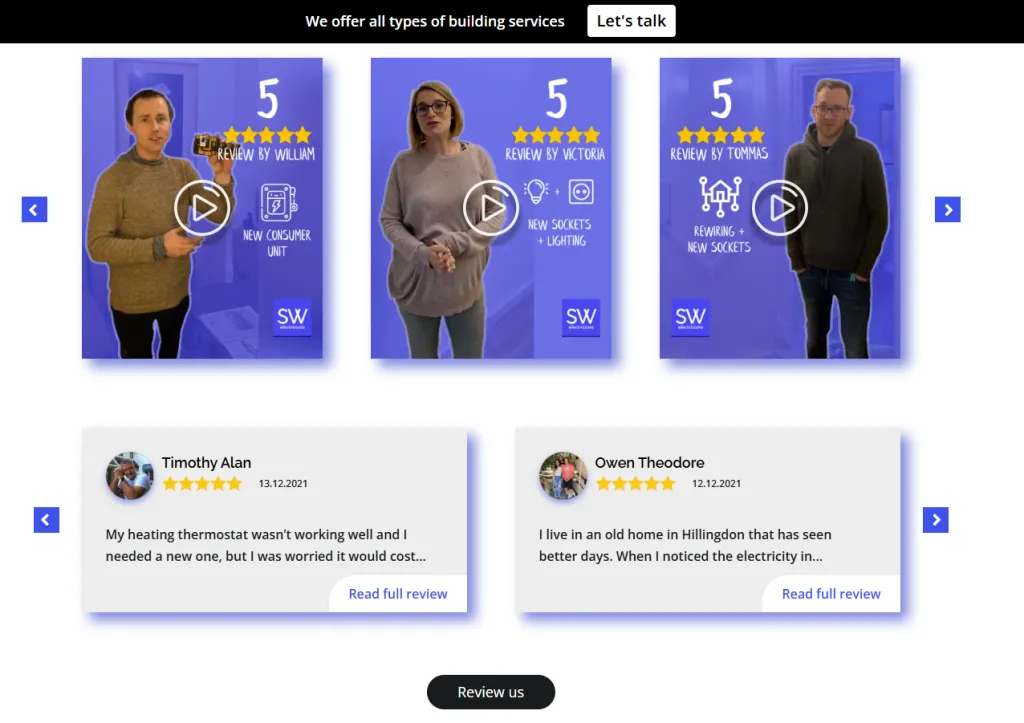
- Get reviews rolling. Volume, recency and rating all count. Make a habit of sending the review link to happy customers, and keep your review responses consistent, replying to every one tells Google you’re active.
- Sort your citations and NAP consistency. Keep your Name, Address and Phone identical across the directories that matter, prioritising trusted directory listings and trade bodies over bulk submissions. Clean up any duplicate listings, because they confuse customers and dilute prominence.
Content that attracts ready-to-book leads
Money pages come first, but support content moves customers from uncertainty to action. Topics like landlord electrical safety, EICR timescales, RCD tripping and EV charger requirements pull in people who are close to booking but still want reassurance.

Case studies are especially powerful for electricians, because they combine proof, local relevance and service detail in one asset. A simple structure, problem, diagnosis, solution, time taken, outcome, mirrors how customers judge competence, so it ranks and converts. Refresh content regularly too: updated photos, standards references and internal links signal the business is current, which matters in regulated trades.
Backlinks and authority: earn trust without spam
Backlinks, links from other sites to yours, are word of mouth in digital form. When a decent, relevant site links to you, Google counts it as a vote and bumps you up. But relevance beats quantity every single time: one link from a local plumber or supplier you actually work with is worth more than twenty from dodgy directories, and irrelevant or spammy links can actually drag you down.
Authority grows through real relationships. Links from suppliers, builders, letting agents, manufacturers and approved-installer pages carry more weight than random guest posts because they reflect genuine trust, exactly the kind of local backlinks that lift your local pack odds. Link building can be creative: sponsor the local football team (a local link, community goodwill and your name on the kit), or chat up a local journalist for an interview.
Digital PR works well for electrical firms when the angle is genuinely useful, seasonal safety checks or EV adoption guidance, for instance. Keep your anchor text mostly branded and natural; aggressive exact-match anchors look manipulative, whereas relevance and referral value build domain authority safely over time. Aim for a handful of strong, relevant links over months, not a flood of rubbish. Full off-page SEO guide →
Tracking, KPIs and ROI
If you’re not measuring it, you’re guessing. Lead tracking is what turns SEO from a marketing expense into an operational channel. Rankings matter, but calls, quote requests, booked jobs, qualified leads and cost per lead are the numbers that prove the work is commercially sound.
Hook up the basics: Google Search Console shows the searches you appear for, your impressions, clicks and average position; Google Analytics 4 shows what visitors do once they land; and call tracking (with dynamic number insertion, plus Google Tag Manager to deploy it cleanly) ties a ranking straight to a phone call. Track Local Pack performance separately from organic visibility, because they behave differently. Add rank tracking and you’ve got a practical attribution stack.
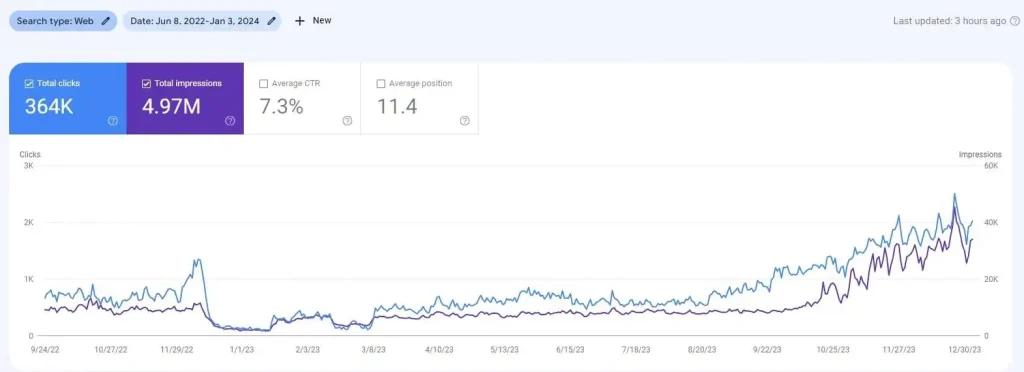
Watch two kinds of number. Leading metrics (pages published, citations and links earned) are the work you control and should climb steadily. Lagging metrics (impressions, clicks and calls) are the payoff, and they lag the work by weeks or months, so don’t panic in week two. The 80/20 rule applies hard here: focus first on your top five services and top five areas, then the pages closest to page one and the Google Business Profile actions most likely to lift calls. But honestly, the one KPI that matters is how many genuine enquiries you got this month, that’s your real ROI. Full tracking & reporting guide →
Common mistakes electricians make with SEO
The biggest one is relying on a single generic “electrician” page to rank for everything. Google rewards specificity, so dedicated pages for EICRs, rewires, emergency work, EV chargers and consumer units almost always beat a broad service list.
The other recurring killers: neglected Google Business Profile updates, thin location pages, inconsistent contact details, duplicate listings, and no tracking at all, which makes it impossible to know which changes actually produced quote requests. Fix those and you’re already ahead of most local competitors.
Quick wins you can do this week
- Rewrite your title tags and H1s so each page reflects one clear service intent.
- Add internal links, concise FAQs and fresh job photos to both the site and your Google Business Profile.
- Ask recent customers for reviews and reply to every one naturally, mentioning the type of work reinforces relevance.
- Check your NAP consistency across the big directories and clear out any duplicate listings.
Want more? I’ve rounded up 11 SEO tips for electrical companies you can start on straight away.
DIY or hire an agency? (and what it costs)
You’ve got two roads: run everything above yourself, or hand it to a professional. If you go the agency route, plenty of outfits chase trades, but not all are worth your money. Grill them:
- “What’s your process?” A real answer covers keyword research, competitor breakdowns, technical fixes, on-page, content and link building. If they wave their hands, walk.
- “How do you report?” You want the full picture every month, leading and lagging metrics in plain English, not a “proprietary” dashboard hiding the lack of results.
- “How do we stay in touch?” Regular contact, not a monthly PDF and silence.
On cost: get a clear monthly price up front. Electrician SEO Pro charges £750 a month flat, with no long contracts. Knowing how SEO works is exactly how you spot a good agency from a chancer. But just like you wouldn’t tell a customer to rewire their own consumer unit off a YouTube video, doing your own SEO while running a business full time is a gamble with your calendar. If you’d rather be on the tools, that’s exactly what I do, done-for-you electrician SEO backed by the 90-day lead guarantee.*
SEO for electricians: FAQs
How much does SEO cost in the UK?
Costs vary between agencies, so get a clear monthly price before you sign anything. Most electricians use a monthly retainer covering on-page work, local SEO, content, reporting and link activity. Electrician SEO Pro charges £750 a month flat, with no long contracts.
Is there high demand for electricians in the UK?
Yes. Demand is sustained by maintenance, rewires, EICRs, landlord compliance, renovations and EV charger installation, which keeps steady search demand across both domestic and commercial work.
What is the 80/20 rule for SEO?
A small number of actions drive most results. For electricians that’s usually your top services, top coverage areas, Google Business Profile optimisation and a disciplined review strategy.
Is SEO dead or evolving in 2026?
Evolving, not dead. Google still rewards useful, trustworthy pages, but stronger local signals, real proof and measurable business outcomes now matter more than simple keyword placement.
Let’s fill your diary.
Send me a WhatsApp. If it’s not a fit, I’ll tell you straight. If it is, your leads grow in 90 days, or the next 90 are on me.*